9/11/09

Get lost; Artist map downtown New York


GET LOST is a collective portrait of downtown New York. Twenty-one international artists were invited to create a personal view of the city and draw a map of downtown New York, uncovering a territory that is both real and imaginary. The maps were collected in a fanzine publication that was distributed for free at galleries, not-for-profit institutions and other sites that animate the life of downtown New York.

GET LOST brings together fictional landscapes, utopian visions, private memories, and obsessive instructions to explore Manhattan, its past, present, and future.

An exercise in emotional geography, GET LOST sketches the coordinates for an endless drift across the streets and myths of downtown New York.

GET LOST is the city as seen through the eyes of: 16beaver group; Francis Alÿs; Cory Arcangel; Jennifer Bornstein; Beth Campbell; Marcel Dzama; Isa Genzken; Inaba and Associates; Dorothy Iannone; Chris Johanson; Christopher Knowles; Terence Koh; Julie Mehretu; Jonas Mekas; Aleksandra Mir; Thurston Moore; Dave Muller; William Pope.L; Lordy Rodriguez; Rirkrit Tiravanija; Lawrence Weiner.

GET LOST is a New Museum production, edited by Massimiliano Gioni, Director of Special Exhibitions. To view copies, visit the New Museum Resource Center. To purchase, visit the New Museum Store.

Beginning Wednesday, June 6, 2007, free copies of GET LOST were made available to the public at the following markers of the downtown scene and cultural organizations around the city: Opening Ceremony (35 Howard Street), Babeland (43 Mercer Street), Bowery Poetry Club (308 Bowery), The Bowery Hotel (340 Bowery), Congee Village (100 Allen Street), Lost City Arts (18 Cooper Square), Freemans Restaurant (Freeman Alley at Rivington Street), Two Boots (155 East 3rd Street), Patricia Field (302 Bowery), Screaming Mimi's (382 Lafayette Street), Joe's Pub (425 Lafayette Street), Artist's Space (38 Greene Street, 3rd Floor), The Kitchen (512 West 19th Street), Sculpture Center (44-19 Purves Street, Long Island City), The Rotunda Gallery (33 Clinton Street, Brooklyn), Bronx Museum (1040 Grand Concourse at 165th Street, Bronx), and the Bedford Cheese Shop (229 Bedford Avenue, Brooklyn). GET LOST was also distributed at the galleries of participating artists.

Para verlo completo, en Get Lost.

3/11/09

this is like; associative thinking

______

ThisIsLike.Com – The associative knowledge network from Dee Mee Tree on Vimeo.


About This Is Like

This Is Like helps you connect ideas, people, and places through associative thinking.

On a deeper level it's a collaborative system of associations: people can add items, link them together, and share their associative knowledge with the others. This way, clusters of similar items are created, which are rated by the number of connections they have.


Our site has been called the "Last.Fm of travel" and "Wikipedia of associations", you could also call it the "pop" recommendation system. While our software is based on complex patent-pending algorithms and utilizes several advanced APIs (Calais is one of them), we do not follow the semantic web hype and instead focus on free associative thinking to invite people to share their knowledge and simply play.

Please, navigate these sections to learn more about ThisIsLike.Com:

• Concept – what's the main idea behind ThisIsLike.Com and how it's different.

• History – how it was created and what was the inspiration.

• Objectives – what our objectives and goals are (and it's not about taking over Google)

• Our Team – a complete profile on all the people behind ThisIsLike.Com

• Technology – no, we don't have huge TV screens and a fancy office like Wolphram Alpha.

• Business – how to promote your knowledge on this site.

2/11/09

The Map as Art: Contemporary Artists Explore Cartography


Maps can be simple tools, comfortable in their familiar form. Or they can lead to different destinations: places turned upside down or inside out, territories riddled with marks understood only by their maker, realms connected more to the interior mind than to the exterior world. These are the places of artists' maps, that happy combination of information and illusion that flourishes in basement studios and downtown galleries alike. It is little surprise that, in an era of globalized politics, culture, and ecology, contemporary artists are drawn to maps to express their visions. Using paint, salt, souvenir tea towels, or their own bodies, map artists explore a world free of geographical constraints. Katharine Harmon knows this territory. As the author of our best-selling book You Are Here, she has inspired legions of new devotees of imaginative maps. In The Map as Art, Harmon collects 360 colorful, map-related artistic visions by well-known artists—such as Ed Ruscha, Julian Schnabel, Olafur Eliasson, Maira Kalman, William Kentridge, and Vik Muniz—and many more less-familiar artists for whom maps are the inspiration for creating art. Essays by Gayle Clemans bring an in-depth look into the artists' maps of Joyce Kozloff, Landon Mackenzie, Ingrid Calame, Guillermo Kuitca, and Maya Lin. Together, the beautiful reproductions and telling commentary make this an essential volume for anyone open to exploring new paths.

Esta parte de la info desde aquí.

"The Map as Art," a new book edited by Katharine Harmon from Princeton Architectural Press, richly surveys today's artistic landscape and its relation to the map. Perhaps it's no surprise that the map has inspired artists throughout history. Today though, in spite of an interdepent globalized economy and hyperconnectivity brought about by the internet, cartographic identity runs strong.

For anyone who's ever gotten lost in the pages of a AAA road map or daydreamed of faraway places while spinning a globe, "The Map as Art" offers ample opportunity for fascination. Divided into a series of thematic chapters—Conflict and Sorrow, Global Reckoning, Personal Terrain, Inner Visions, etc.—the book charts the myriad ways artists use the map as a tool for investigating notions of identity, political allegiance, economy, the environment and more. Several essays by Gayle Clemans expound upon these themes through a deeper critique of work by artists Joyce Kozloff, Ingrid Calame, Guillermo Kuitca and Maya Lin.

Y esta otra, desde aquí.

27/10/09

Dream of art spaces collected


En el evento genial que estuvimos invitados a participar BarraDiagonal unos días atrás, MODIFI, pudimos conocer entre otros muchos proyectos interesantes, la iniciativa Dreams of Art Spaces Collected. Desde la página de Dorothee Albrecht (una de las componentes del proyecto), una pequeña reseña:

Dreams of Art Spaces Collected investigates visions and experiences in exhibiting and mediating contemporary art starting with Europe, China and Australia, collecting various perspectives from artists, non profit project spaces and artist run initiatives. The research is based on extensive video interviews with practitioners, artists, art curators and theorists. It’s an open collection of video interviews, but also of images, publications and links.

(...)

Un poco más desde la página del propio proyecto:

DREAMS OF ART SPACES COLLECTED emerged as an artistic research project by the artists Dorothee Albrecht, Alf Löhr, Andreas Schmid and Moira Zoitl for the Internationale Gesellschaft der Bildenden Künste (IGBK), Berlin in 2007.

Their decision to focus on a collection of video-interviews naturally led towards an extension of already existing networks and experiences, starting from Australia, as Alf Löhr was based in Melbourne at that time, starting from China, as Andreas Schmid has been concerned with Chinese contemporary art since he studied in Hangzhou during the mid-80s, and starting from Europe, but more from the margins of Europe, along the interests of Moira Zoitl and Dorothee Albrecht. This parallel beginning seems very important in highlighting the networking character of the collection starting from different nodal points around the globe. It is conceived as a setout open to affiliation with other networks; an opportunity for the emergence of new networks between artists in different parts of the world.


Investigating visions and experiences in exhibiting and mediating contemporary art, the artists collected various perspectives of artists, curators and theorists with the emphasis on non-profit project spaces and artist run initiatives.


To initiate a conversation we used the following questions:

If you imagine the art space of your dreams. What’s it like? What is it supposed to do? How would you evaluate existing setups? What are the focus and the strategy of your space? What kind of audiences is your space trying to attract?

Seguir leyendo.

Para ver las entrevistas, aquí.

12/10/09

Las fotografías de archivo asaltan Flickr!

___________

Autochromes de la Galería de George Eastman House


Curious photo, autor desconocido, ca. 1880, Albúmina, GHE

Lo vengo observando desde hace un tiempo, pero ha sido el ínclito Pablo, desde su laboratorio en workroomfilms, el que me ha hecho reparar definitivamente en las proporciones de la cuestión. Hace años que las grandes colecciones fotográficas ofrecen en Internet una gran parte de sus fondos digitalizados, desde la sección Prints and Photographs de la Library of Congress, pasando por la veterana George Eastman House, hasta la Photography Initiative de la Smithsonian Institution. De esta forma se venían ofreciendo amplísimas colecciones de fotografías localizables mediante potentes sistemas de búsqueda avanzada. Son las herramientas a las que muchos hemos acudido para sentir el vértigo de aquello que se ha venido a llamar Internet Invisible o Web Profundo, y que no afecta únicamente a la información textual, sino que también contiene todas esas imágenes fijas y en movimiento que cada día inundan la web en mayor medida.

Pero hete aquí que algunas de estas instituciones que parecían dotadas de pies de plomo han decidido airear sus fotografías acudiendo a las herramientas específicas que para ello existen. El Archivo Nacional de Alemania acaba de donar 100.000 fotografías históricas a la Wikipedia; la revista Life se ha asociado con Google para hacer visibles sus fondos fotográficos; la George Eastman House y la Smithsonian Institution, por su parte, se han subido al carro de Flickr, y aunque lo que actualmente exponen a través de este servicio puede considerarse -en relación a la totalidad de sus fondos- apenas una pequeña vitrina o uno de esos escasos postaleros giratorios, hay que reconocer que han realizado una exquisita selección. Valga como ejemplo el delicioso álbum de autocromos de la GEH.

(...)

Aquí para leer el artículo completo e hincarle el diente a todos los links que propone, en la inagotable e ineludible maquinaria de la nube.

11/10/09

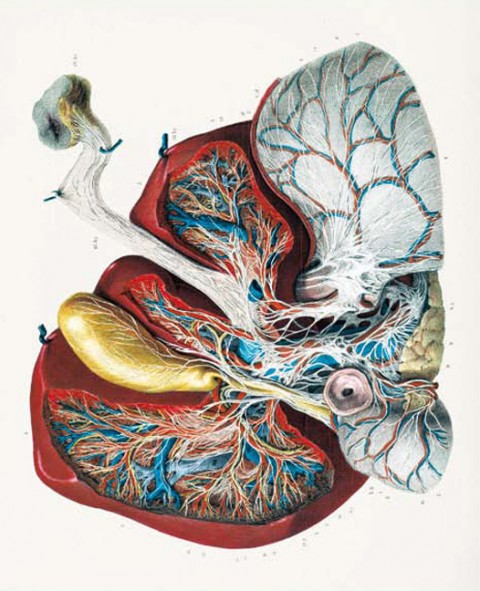
J.M. Bourgery's Atlas of Human Anatomy and Surgery


Mapping the human body

One of the most remarkable works in the whole history of anatomy: J.M. Bourgery's Atlas of Human Anatomy and Surgery


A monumental work of the 19th century

Anatomical knowledge was for a long time limited to data gathered from the dissection of animals by Galen (c. 130 - c. 200), a Greek physician who practised in Pergamon and Rome, and whose influence was considerable right up until the 16th century. In the Middle Ages, the only work on anatomy truly worthy of the name was that of Mondino dei Luzzi (c. 1275-1326), written in 1319 and titled Anathomia; taking up the data of Galen, he made some interesting observations on the basis of human dissections he had undertaken in 1315. These works were disseminated in the form of manuscript copies and were very sparsely illustrated. With the invention of printing by Johann Genfleisch, alias Gutenberg (pre-1397-1468) in about 1450, the dissemination of knowledge was to increase by leaps and bounds. The so-called incunabula, in other words works printed before 1500, include the first edition of the Anathomia of dei Luzzi, printed in 1478. The anatomical drawings of Leonardo da Vinci (1452-1519), 228 handdrawn plates of incredible scientific quality, occupy a very marginal place, because they were never edited and were ignored by the scholars of the day. Published for the first time in 1898, they had no impact on the development of the subject. In 1543 the work by André Vésale (1514-1564), De humani corporis fabrica, was published in Basle; it is indisputably the most outstanding book in the whole history of anatomy both in respect of its concept and of its aesthetic qualities. The publication of this work represented a veritable scientific revolution, providing a new vision of Man by replacing Galen's speculative studies and his extrapolations from animal anatomy by systematic dissections of the human body. Vésale's work comprises 25 superb plates separate from the text, and numerous figures within the text, all of them woodcuts, probably the work of Jan Stephan von Calcar, who belonged to Titian's circle. This book, of which a second improved edition appeared in 1555, and which went through several more, had a considerable impact and was copied by numerous authors.


La primera imagen que nos lanzó en la busqueda de este maravilloso Atlas of Human Anatomy and Surgery (re-editado por Taschen) la encontramos ilustrando la portada del fabuloso libro El rival de Prometeo, Vidas de autómatas ilustres con una edición deliciosa muy cuidada a cargo de la no menos fabulosa Marta Peirano.

Japanese anatomical charts


En morbid anatomy tienen una muy buena colección de imágenes en torno a la cartografía del cuerpo, cómo este ejemplo de una entrada sobre imágenes de anatomía japonesa. Más aquí, aquí y aquí.