Mostrando entradas con la etiqueta ciencia. Mostrar todas las entradas

15/1/12

THE RESCUE OF THE EFFECTS - Notes for a Theory of the Reader


// Opening: January 19, 20:00.
// Aditional opening hours: January 20 – 22, 15:00 – 19:00.
// General Public, Schönhauser Allee 167c, 10435 Berlin

In a landscape where reality has long ceased to be seen without the presence of auxiliary instruments, which constructs at the same time its registration and setting it up as an archive, the experience does not conform directly in contact with the world but as a mediated doppelgänger. In this type of situation we should not forget that each of the disseminating and accumulating structures that support the architecture of the information is itself a technology with a built-in ideological organisational criteria, of inclusion and exclusion.

This project is built from reflections on creative reading with an active attitude regarding materials from libraries, archives, collections or found-materials establishing with a critical fascination some series of narrative itineraries that discover hidden relationships from the intra-history, the creation of fictions and the infraordinary to practice a critical reading of their architecture, an anarcheology of the structures of knowledge and the everyday-life as well as an analysis of structures of consciousness formation.  

This research tries to present projects that blur the boundaries between the practice of curators, historians, researchers, cultural producers and artists. Thus, located in this area of indistinct borders, it essays a significant rearrangement of the cultural materials that restate the questions to be undertaken, as well as the focus of interest. In fact, all the participating artists are engaged to or from several disciplines: in addition to the context of art itself, speak of their work also located in editing, research, music creation, educational programmes, curating, organising events and reflecting on exhibition spaces.  

These are works that start at the same time questioning both the analysis of content as the actual means of implementation and presentation: devices, methodologies, materials selection, editing, exhibition strategies or building space.

With: Daniel G. Andújar, Sol Calero, Constant Dullaart, Embankment, Herzbeat hotel, Bettina Hutschek, Jeleton, Christopher Kline, Phanos Kyriacou, Regina de Miguel, Alexandra Navratil, Paloma Polo, Teresa Solar, Poderes Unidos and JODI.

A project by Lorenzo Sandoval
With the support of: Ministerio de Cultura de España, General Public, GlougauAIR, Altes Finanzamt, Raum für Projektion.
Collaborator: Spanische Botschaft

9/6/10

Microcósmica inauguran Puede que nadie vuelva a tener el mismo conocimiento el 18 de Junio en Halfhouse


Mañana se inaugura el proyecto conjunto de María Castelló Solbes y Regina de Miguel en Halfhouse.

Con el prometedor título de Puede que nadie vuelva a tener el mismo conocimiento, realizan una instalación que toma como punto de partida la(s) historia(s) del gabinete de curiosidades que se encuentra en el espacio, la colección permanente de los propietarios de Halfhouse compuesta de piezas de arte, recuerdos, souvenirs, regalos, etc. A partir de ahí desarrollan un dispositivo visual que cruza las referencias, entre otros, a los modos de presentación de los museos científicos, a los ejercicios de catalogación, a representaciones cartográficas de caracter victoriano para prácticar un flashback y situarse junto a un Julio Verne que a través de la ciencia ficción imagina el futuro y a un Aby Warburg que organiza itinerarios a través de la ley de buena vecindad: el toparse junto al libro que uno fue a buscar al desconocido vecino de estantería que nos descubrirá una información vital y nunca antes intuida.

Además de recomendarles que no dejen de acudir a la inauguración si tienen la oportunidad tampoco dejen de consultar el tumblr de Microcósmica dónde han ido recopilando gran parte de la información en la que han basado el proceso de investigación. En ella nos encontramos una gran cantidad de referencias muy gratas a esta casa. Aquí abajo un par de perlas de las muchas que han encontrado:


Bertuch’s Bilderbuch für Kinder


Ah! Y además participan en las jornadas Atlas, ciencia de lo estético y lo estético de la ciencia que han organizado los amigos de Rampa entre en el 16 y 17 de junio:


ATLAS es una puesta en relación entre dos disciplinas, la estética y la ciencia, que se relacionan de diferentes formas en el momento actual. El objetivo de estas jornadas es establecer un diálogo entre artistas e historiadores de la ciencia cuyas líneas de producción e investigación sacan partido de los múltiples cruces que existen entre la producción de conocimiento y de sentido y procesos como la narración, la representación y la ficción.

Si me pudiese teletransportar hasta allí, ni lo dudaba.

25/5/10

Topic Map: How Sciencetific Paradigms relate


A MAP OF SCIENCE created by Sandian Kevin Boyack with collaborators Richard Klavans and Brad Paley, resembles a filamentous microorganism you might see under a microscope.

The map represents 800,000 scientific papers (shown as white dots) and shows relationships between them and different scientific disciplines. The "filaments" are common words unique to each "scientific paradigm" — the 776 red circular nodes or clusters of papers. Each node contains papers that are commonly cited together. Larger nodes have more papers. Nodes are connected with lines of various lengths and thicknesses, denoting the strength of the citation linkages between the nodes. Layout of the nodes was done using Sandia's VxOrd clustering algorithm. Chemistry papers are found in the right-hand peninsula while astrophysics is located at the top. Medicine covers the large region at the lower left.

A four-foot-by-four-foot version of the map is on display at the New York Hall of Science until Feb. 25 as part of the "Places & Spaces: Mapping Science" exhibition. This image also appeared in the Gallery section of the 2006 year-end issue of Nature (vol. 444, p. 985).

Boyack, a founding member of the advisory board of Places & Spaces, produced the map in collaboration with Klavans, SciTech Strategies of Berwyn, Pa., and Paley, graphic artist and director of Information Esthetics, New York, N.Y., using 2003 data from Thomson ISI. It was enabled by work performed under a Laboratory Directed Research and Development project whose purpose was to generate large-scale maps of science for planning and evaluation purposes.

For more information on interpreting the map see Paley’s website http://didi.com/brad/mapOfScience. For details on the exhibition see http://www.scimaps.org.

11/10/09

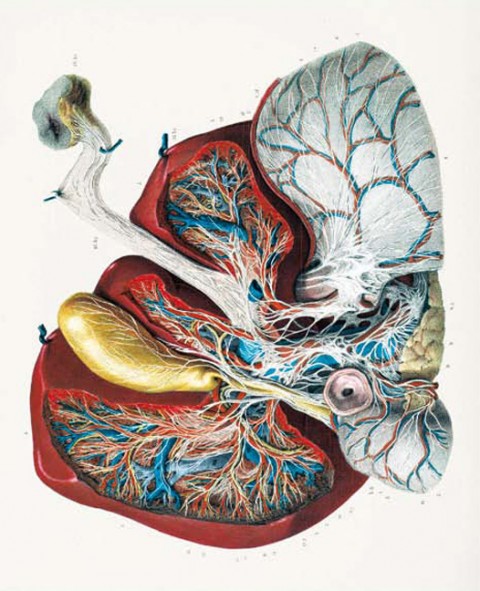
J.M. Bourgery's Atlas of Human Anatomy and Surgery


Mapping the human body

One of the most remarkable works in the whole history of anatomy: J.M. Bourgery's Atlas of Human Anatomy and Surgery


A monumental work of the 19th century

Anatomical knowledge was for a long time limited to data gathered from the dissection of animals by Galen (c. 130 - c. 200), a Greek physician who practised in Pergamon and Rome, and whose influence was considerable right up until the 16th century. In the Middle Ages, the only work on anatomy truly worthy of the name was that of Mondino dei Luzzi (c. 1275-1326), written in 1319 and titled Anathomia; taking up the data of Galen, he made some interesting observations on the basis of human dissections he had undertaken in 1315. These works were disseminated in the form of manuscript copies and were very sparsely illustrated. With the invention of printing by Johann Genfleisch, alias Gutenberg (pre-1397-1468) in about 1450, the dissemination of knowledge was to increase by leaps and bounds. The so-called incunabula, in other words works printed before 1500, include the first edition of the Anathomia of dei Luzzi, printed in 1478. The anatomical drawings of Leonardo da Vinci (1452-1519), 228 handdrawn plates of incredible scientific quality, occupy a very marginal place, because they were never edited and were ignored by the scholars of the day. Published for the first time in 1898, they had no impact on the development of the subject. In 1543 the work by André Vésale (1514-1564), De humani corporis fabrica, was published in Basle; it is indisputably the most outstanding book in the whole history of anatomy both in respect of its concept and of its aesthetic qualities. The publication of this work represented a veritable scientific revolution, providing a new vision of Man by replacing Galen's speculative studies and his extrapolations from animal anatomy by systematic dissections of the human body. Vésale's work comprises 25 superb plates separate from the text, and numerous figures within the text, all of them woodcuts, probably the work of Jan Stephan von Calcar, who belonged to Titian's circle. This book, of which a second improved edition appeared in 1555, and which went through several more, had a considerable impact and was copied by numerous authors.


La primera imagen que nos lanzó en la busqueda de este maravilloso Atlas of Human Anatomy and Surgery (re-editado por Taschen) la encontramos ilustrando la portada del fabuloso libro El rival de Prometeo, Vidas de autómatas ilustres con una edición deliciosa muy cuidada a cargo de la no menos fabulosa Marta Peirano.

Japanese anatomical charts


En morbid anatomy tienen una muy buena colección de imágenes en torno a la cartografía del cuerpo, cómo este ejemplo de una entrada sobre imágenes de anatomía japonesa. Más aquí, aquí y aquí.