Mostrando entradas con la etiqueta mapa conceptual. Mostrar todas las entradas
Mostrando entradas con la etiqueta mapa conceptual. Mostrar todas las entradas
19/11/12


5/11/12
Lines of flight: urban resistance, dreamscapes and social play; Lorena Muñoz-Alonso, 2012
Some theoretical notes concerning the exhibition Desire Lines
Exactly one hundred years ago, in one of his most memorable poems,
Antonio Machado exhorted us to become more conscious of our choices, to
assume what is perhaps the most transcendental responsibility of our
existence as individuals: forging our own path in life rather than being
swept along by social pressure, fear or the paralysing shadow of
apathy. In that poem, the path is a metaphor for life, a powerful image
no less apt for being somewhat hackneyed. It is the perfect allegory for
an existential journey, with all of its inherent forks, choices and
decisions.
‘Desire lines’ is the name given to the alternative trails that emerge in a landscape— chosen itineraries eroded by wayfarers’ footprints, initially in an improvised manner that follows a transgressive urge, until they are consolidated and widened as a result of the kind of subversion that surpasses the individual to become collective. No path is ever made by one individual: it requires a group. It takes the repeated footsteps of many people to create these indelible marks.

This metaphor, which evokes both real and imaginary paths, is the
starting point for the exhibition, which features the work of eleven
international artists who explore subversive ways of navigating, using
and living the city. The eleven works selected for Desire Lines
take the urban fabric to be a complex, contradictory realm, brimming
with possibilities. A broad stage with the capacity to both repress our
deepest, destabilising desires and act as a catalyst for atavistic
spirits of resistance that can trigger collective action. In this
scenario the figure of the artist is key, as the embodiment of the
metropolitan denizen. The artist is the city dweller par excellence,
often roaming like a nomad from one metropolis to another, leading a
type of existence that normally verges on the precarious—one of the many
results of the gentrification process that the urban theorist and
economist Richard Florida has been studying since the beginning of the
21st century2—and therefore being a privileged witness to the joys and miseries of life in the big city.
If the artist exemplifies the citizen, he is thus the hero of the urban odyssey that billions of us face every day. The influential essay The Practice of Everyday Life3 (1984) by the theorist and scholar Michel de Certeau is dedicated to the “ordinary man. To a common hero, an ubiquitous character, walking in countless thousands on the streets. […] This anonymous hero is very ancient. He is the murmuring voice of societies. […] We witness the advent of the number. It comes along with democracy, the large city, administrations, cybernetics. It is a flexible and continuous mass, woven tight like a fabric with no rips nor darned patches, a multitude of quantified heroes who lose names and faces as they become the ciphered river of the streets, a mobile language of computations and rationalities that belong to no one.” It is hard to think of a more eloquent and poignant way to express the loss of identity and agency that the individual endures within an oppressive urban context. The artists and works featured in this show attempt to incite resistance to this situation, to remind us that we can choose our own path; that sometimes empowerment is found in the most inconsequential and impromptu decisions and actions.
De Certeau described these activities, imbued with a tremendous subversive potential, as ‘tactics’, as opposed to ‘strategies’ –the institutional processes that establish the rules and conventions that govern societies. Tactics are the creative opportunities that operate between the gaps and slips of conventional thought and the patterns of everyday life. Of the contemporary philosophers who have promoted this type of liberating, playful, non-conformist behaviour, one of the most instrumental was undoubtedly Guy Debord, leader and founding member of the Situationist International (IS). This revolutionary group, created in 1957, reached its peak of influence with the publication of Society of the Spectacle (1967)4 and the subsequent May ’68 protests in Paris, a movement that borrowed both its ideas and most enduring slogans (such as the famous “Ne travaillez jamais!”). The group’s philosophy was based on the construction of ‘situations’ or environments in which one or more individuals were stimulated to critically analyse their everyday lives so they could identify and pursue their true desires. These ideas, developed by the artist Constant Nieuwenhuys alongside Debord, eventually crystallised into a fully fledged plan of action. Constant dedicated years to this project, entitled New Babylon, where he applied the concepts of what he called ‘unitary urbanism’. Because the Situationist critique of 20th-century urbanism questioned above all the degree of citizen participation, this “new Babylon” proposed a new form of urban planning based mostly on the concepts of mobility and play. Rather than a conventional urban development plan, this model fostered critical activities designed to promote participation in the city through a ‘mobile space of play’ and the construction of ‘situations’.

The idea of play, of understanding the city as a space in which to
act out our most pressing desires, is central to this philosophy and is
put into practice through the exercise of ‘drifting’ (dérive):
One of the basic Situationist practices is the ‘dérive’, a technique of rapid passage through varied ambiances. ‘Dérives’ involve playful, constructive behaviour and awareness of psychogeographical effects, and are thus quite different from the classic notions of journey or stroll. In a ‘dérive’ one or more persons during a certain period drop their relations, their work and leisure activities, and all their other usual motives for movement and action, and let themselves be drawn by the attractions of the terrain and the encounters they find there. 5
The notion of drifting as productive or constructive play is particularly relevant in the context of this exhibition: play in the sense in which Dutch historian and cultural theorist Johan Huizinga explored it in his controversial essay Homo Ludens6, written in 1938, a time of utter political and social turmoil when the idea of play seemed, at best, a far-fetched irony and, at worst, an inappropriate and rather sick joke. According to Huizinga, the notion of play is inherent to the human condition and even predates it, as evidenced by the fact that it is found in the vast majority of animal species. Huizinga argued that the intrinsic value of play, besides being essential to the generation of culture, is that it permeates archetypal activities of human society such as language, myths and rituals. Rejecting the notion of play as something that is “not serious”, Huizinga explained that play creates a transitory order (or a set of rules), a community of players and a feeling of tension or instability, thus generating collective situations and social exchanges that constitute the first step towards the creation of ‘cultures’.

For example, Looking Up (2001) by Francis Alÿs, a work present
in this exhibition, is a video documentation of an action in which the
artist walks into the middle of Mexico City’s busy Plaza del Zócalo and,
standing impassively on the same spot, starts looking up at the sky. A
group of passers-by, surprised and curious, gradually gather behind the
artist, trying to see for themselves the elusive sight he is so keenly
observing. Looking Up is, in many ways, a practical joke turned
into an artwork, but it is a joke that unveils some distinctive human
traits: for instance, the fact that groups tend to follow a leader like a
herd of animals, often without the slightest guarantee of a worthwhile
outcome. More positively, Looking Up examines curiosity and play as agents that mobilise groups, reassuring us of our capacity to respond to events collectively.
The need to overcome that passive ‘herd’ mentality was also staunchly advocated by Gilles Deleuze and Félix Guattari in their seminal philosophical treatise Anti-Oedipus7 (1972), which denounced and challenged the human urge to repress oneself by means of ‘territories’ such as work, family, political parties or education: in short, any social construct born out of the exercise of power relations. To combat this drive and achieve what they called ‘deterritorialisation’, thereby triggering a chain reaction leading to change, it is necessary to forge ‘lines of flight’: brand-new paths in which one can break away from the material of the past.
That such ‘lines of flight’ seem to recall the concept of desire lines is no mere coincidence. For Deleuze and Guattari, desire (never in its strictly sexual sense) is the real force that can mobilise our freer and inevitably more transgressive impulses. This is why the aforementioned ‘territories’, from the workplace to the city, are such excellent machines for repressing our desires, making us docile and obedient as a result of the eternal battle between the social machines and us, the desiring-machines. As Deleuze and Guattari argue so eloquently throughout Anti-Oedipus, desire is socially repressed because any sign of uncontrolled behaviour has the capacity to destabilise the prescribed symbolic order. The lines that stem from desire can sabotage hegemony.
Desire lines—the real and imaginary ones—are an unmistakable symptom of the transgressive capacity of an individual desire that becomes a collective impulse. They symbolise the small acts of urban resistance that emerge from a strong impulse to deviate from the paths created and imposed by others. Regardless of the form these disruptions might take within the symbolic order—games, poetic acts, jokes, minor sabotages or a revolutionary and violent explosion—such transgressions can and should be extrapolated onto the field of human existential behaviour. They should be valued for what they are worth and used as tools for reviving the sensation, buried beneath layers of bureaucracy and social norms, that every life, every fate, is unique and worth fighting for, from the smallest routine struggle to the most pyrrhic battle. When disobedience leaves such a tangible mark, one must acknowledge it and take notice, rather than turning a blind eye, as evidenced by the protests that have shaken the world over these last two years, 2011 and 2012, from the 15 May Movement to the worldwide demonstrations of Occupy.
The works featured in Desire Lines represent different spirits of insurgence as well as tactics for appropriating and celebrating the city’s latent creative potential. We are honoured that artists as inspiring as Lawrence Abu Hamdan, Mark Aerial Waller, Francis Alÿs, Francisca Benítez, Mircea Cantor, Filipa César, Cyprien Gaillard, Regina de Miguel, Laura Oldfield Ford, Alejandra Salinas and Aeron Bergman, and John Smith have accepted our invitation to participate in this project and allowed us to exhibit their stimulating works, lending consistency to a set of enthusiastic ideas. It’s the turn of the audience now. We hope this journey is as enriching for them as it has been for the two curators.
-
This essay is part of the catalogue of the exhibition Desire Lines, curated by Lorena Muñoz-Alonso & Bárbara Rodríguez Muñoz.
The exhibition will open on the 21st of November 2012 at the Espai Cultural Caja Madrid in Barcelona and will run until the 13t of January 2012.
Catalogue design by David G. Uzquiza.
-
Bibliography
1. This poem belongs to the anthology Campos de Castilla which Antonio Machado first published in 1912. Campos de Castilla, Madrid,Cátedra, 1992. Translation by the author of the essay.
2. Richard Florida, The Rise of the Creative Class: And How It’s Transforming Work, Leisure, Community and Everyday Life, New York, Basic Books, 2002.
3. Michel de Certeau, L’invention du quotidien, tome 1: Arts de faire, Paris, Gallimard, 1990. (Published in English as The Practice of Everyday Life.)
4. Guy Debord, La sociéte du spectacle, Paris, Buchet-Chastel, 1967. (Published in English as The Society of the Spectacle.)
5. Théorie de la dérive was originally published in Internationale Situationniste no. 2 (Paris, December 1958). A slightly different version had appeared in 1956 in the Belgian Surrealist magazine Les Lèvres Nues no. 9. (Published in English as “Theory of the Dérive”.)
6. Johan Huizinga, Homo Ludens, Boston, Beacon Press, 1955.
7. Gilles Deleuze and Félix Guattari, Capitalisme et schizophrénie. L’anti-Œdipe, Paris, Les Éditions de Minuit, 1972. (Published in English as Anti-Oedipus: Capitalism and Schizophrenia.)
Wayfarer, your footprints
are the way, and nothing else;
wayfarer, there is no path,
you make the path by walking.1
are the way, and nothing else;
wayfarer, there is no path,
you make the path by walking.1
Antonio Machado, Campos de Castilla, 1912
‘Desire lines’ is the name given to the alternative trails that emerge in a landscape— chosen itineraries eroded by wayfarers’ footprints, initially in an improvised manner that follows a transgressive urge, until they are consolidated and widened as a result of the kind of subversion that surpasses the individual to become collective. No path is ever made by one individual: it requires a group. It takes the repeated footsteps of many people to create these indelible marks.
Image of a desire line
If the artist exemplifies the citizen, he is thus the hero of the urban odyssey that billions of us face every day. The influential essay The Practice of Everyday Life3 (1984) by the theorist and scholar Michel de Certeau is dedicated to the “ordinary man. To a common hero, an ubiquitous character, walking in countless thousands on the streets. […] This anonymous hero is very ancient. He is the murmuring voice of societies. […] We witness the advent of the number. It comes along with democracy, the large city, administrations, cybernetics. It is a flexible and continuous mass, woven tight like a fabric with no rips nor darned patches, a multitude of quantified heroes who lose names and faces as they become the ciphered river of the streets, a mobile language of computations and rationalities that belong to no one.” It is hard to think of a more eloquent and poignant way to express the loss of identity and agency that the individual endures within an oppressive urban context. The artists and works featured in this show attempt to incite resistance to this situation, to remind us that we can choose our own path; that sometimes empowerment is found in the most inconsequential and impromptu decisions and actions.
De Certeau described these activities, imbued with a tremendous subversive potential, as ‘tactics’, as opposed to ‘strategies’ –the institutional processes that establish the rules and conventions that govern societies. Tactics are the creative opportunities that operate between the gaps and slips of conventional thought and the patterns of everyday life. Of the contemporary philosophers who have promoted this type of liberating, playful, non-conformist behaviour, one of the most instrumental was undoubtedly Guy Debord, leader and founding member of the Situationist International (IS). This revolutionary group, created in 1957, reached its peak of influence with the publication of Society of the Spectacle (1967)4 and the subsequent May ’68 protests in Paris, a movement that borrowed both its ideas and most enduring slogans (such as the famous “Ne travaillez jamais!”). The group’s philosophy was based on the construction of ‘situations’ or environments in which one or more individuals were stimulated to critically analyse their everyday lives so they could identify and pursue their true desires. These ideas, developed by the artist Constant Nieuwenhuys alongside Debord, eventually crystallised into a fully fledged plan of action. Constant dedicated years to this project, entitled New Babylon, where he applied the concepts of what he called ‘unitary urbanism’. Because the Situationist critique of 20th-century urbanism questioned above all the degree of citizen participation, this “new Babylon” proposed a new form of urban planning based mostly on the concepts of mobility and play. Rather than a conventional urban development plan, this model fostered critical activities designed to promote participation in the city through a ‘mobile space of play’ and the construction of ‘situations’.
Guy Debord, Guide Psychogeographique de Paris: Discours Sur Les Passions D’Amour, 1957
One of the basic Situationist practices is the ‘dérive’, a technique of rapid passage through varied ambiances. ‘Dérives’ involve playful, constructive behaviour and awareness of psychogeographical effects, and are thus quite different from the classic notions of journey or stroll. In a ‘dérive’ one or more persons during a certain period drop their relations, their work and leisure activities, and all their other usual motives for movement and action, and let themselves be drawn by the attractions of the terrain and the encounters they find there. 5
Guy Debord, “Theory of the Dérive”
The notion of drifting as productive or constructive play is particularly relevant in the context of this exhibition: play in the sense in which Dutch historian and cultural theorist Johan Huizinga explored it in his controversial essay Homo Ludens6, written in 1938, a time of utter political and social turmoil when the idea of play seemed, at best, a far-fetched irony and, at worst, an inappropriate and rather sick joke. According to Huizinga, the notion of play is inherent to the human condition and even predates it, as evidenced by the fact that it is found in the vast majority of animal species. Huizinga argued that the intrinsic value of play, besides being essential to the generation of culture, is that it permeates archetypal activities of human society such as language, myths and rituals. Rejecting the notion of play as something that is “not serious”, Huizinga explained that play creates a transitory order (or a set of rules), a community of players and a feeling of tension or instability, thus generating collective situations and social exchanges that constitute the first step towards the creation of ‘cultures’.
Anna Halprin, City Dance, 1976-1977. Performance on the streets of San Francisco
The need to overcome that passive ‘herd’ mentality was also staunchly advocated by Gilles Deleuze and Félix Guattari in their seminal philosophical treatise Anti-Oedipus7 (1972), which denounced and challenged the human urge to repress oneself by means of ‘territories’ such as work, family, political parties or education: in short, any social construct born out of the exercise of power relations. To combat this drive and achieve what they called ‘deterritorialisation’, thereby triggering a chain reaction leading to change, it is necessary to forge ‘lines of flight’: brand-new paths in which one can break away from the material of the past.
That such ‘lines of flight’ seem to recall the concept of desire lines is no mere coincidence. For Deleuze and Guattari, desire (never in its strictly sexual sense) is the real force that can mobilise our freer and inevitably more transgressive impulses. This is why the aforementioned ‘territories’, from the workplace to the city, are such excellent machines for repressing our desires, making us docile and obedient as a result of the eternal battle between the social machines and us, the desiring-machines. As Deleuze and Guattari argue so eloquently throughout Anti-Oedipus, desire is socially repressed because any sign of uncontrolled behaviour has the capacity to destabilise the prescribed symbolic order. The lines that stem from desire can sabotage hegemony.
Desire lines—the real and imaginary ones—are an unmistakable symptom of the transgressive capacity of an individual desire that becomes a collective impulse. They symbolise the small acts of urban resistance that emerge from a strong impulse to deviate from the paths created and imposed by others. Regardless of the form these disruptions might take within the symbolic order—games, poetic acts, jokes, minor sabotages or a revolutionary and violent explosion—such transgressions can and should be extrapolated onto the field of human existential behaviour. They should be valued for what they are worth and used as tools for reviving the sensation, buried beneath layers of bureaucracy and social norms, that every life, every fate, is unique and worth fighting for, from the smallest routine struggle to the most pyrrhic battle. When disobedience leaves such a tangible mark, one must acknowledge it and take notice, rather than turning a blind eye, as evidenced by the protests that have shaken the world over these last two years, 2011 and 2012, from the 15 May Movement to the worldwide demonstrations of Occupy.
The works featured in Desire Lines represent different spirits of insurgence as well as tactics for appropriating and celebrating the city’s latent creative potential. We are honoured that artists as inspiring as Lawrence Abu Hamdan, Mark Aerial Waller, Francis Alÿs, Francisca Benítez, Mircea Cantor, Filipa César, Cyprien Gaillard, Regina de Miguel, Laura Oldfield Ford, Alejandra Salinas and Aeron Bergman, and John Smith have accepted our invitation to participate in this project and allowed us to exhibit their stimulating works, lending consistency to a set of enthusiastic ideas. It’s the turn of the audience now. We hope this journey is as enriching for them as it has been for the two curators.
-
This essay is part of the catalogue of the exhibition Desire Lines, curated by Lorena Muñoz-Alonso & Bárbara Rodríguez Muñoz.
The exhibition will open on the 21st of November 2012 at the Espai Cultural Caja Madrid in Barcelona and will run until the 13t of January 2012.
Catalogue design by David G. Uzquiza.
-
Bibliography
1. This poem belongs to the anthology Campos de Castilla which Antonio Machado first published in 1912. Campos de Castilla, Madrid,Cátedra, 1992. Translation by the author of the essay.
2. Richard Florida, The Rise of the Creative Class: And How It’s Transforming Work, Leisure, Community and Everyday Life, New York, Basic Books, 2002.
3. Michel de Certeau, L’invention du quotidien, tome 1: Arts de faire, Paris, Gallimard, 1990. (Published in English as The Practice of Everyday Life.)
4. Guy Debord, La sociéte du spectacle, Paris, Buchet-Chastel, 1967. (Published in English as The Society of the Spectacle.)
5. Théorie de la dérive was originally published in Internationale Situationniste no. 2 (Paris, December 1958). A slightly different version had appeared in 1956 in the Belgian Surrealist magazine Les Lèvres Nues no. 9. (Published in English as “Theory of the Dérive”.)
6. Johan Huizinga, Homo Ludens, Boston, Beacon Press, 1955.
7. Gilles Deleuze and Félix Guattari, Capitalisme et schizophrénie. L’anti-Œdipe, Paris, Les Éditions de Minuit, 1972. (Published in English as Anti-Oedipus: Capitalism and Schizophrenia.)
30/7/12
Jokes by Ad Reinhardt

Ad Reinhardt, ‘How to Look at Art in America’ (1961)


Ad Reinhardt, ‘How to Look at an Artist’ (1961)
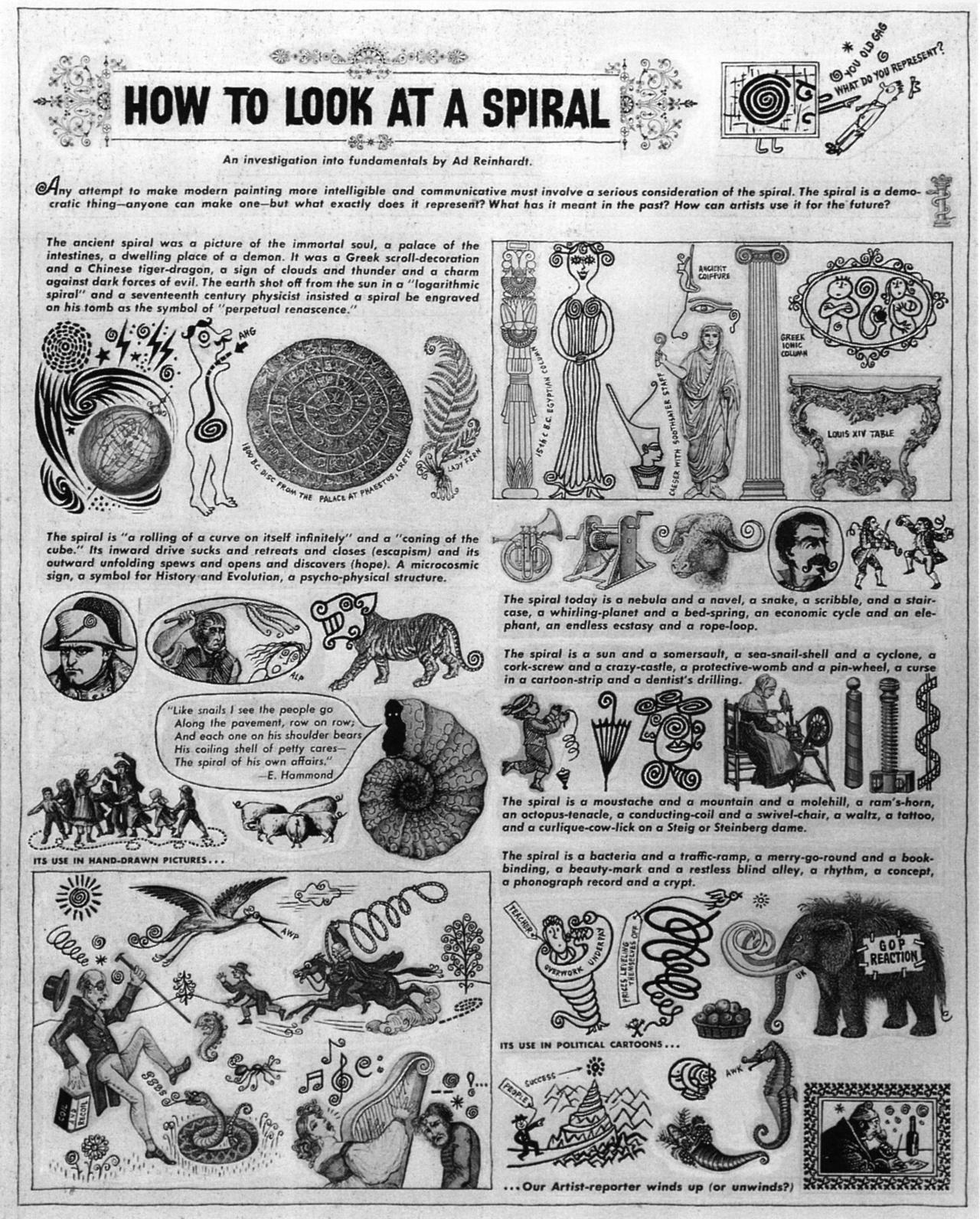
Ad Reinhardt, How to Look at a Spiral, 1946
5/7/12
Ahn Min Jeong

Self-Portrait, digital print, 2007
(88×210.3cm)
Stunning autobiographic data analytics based illustrations created by south korean Ahn Min Jeong who says; “My work appears to be emotionless and analytic, but when you take a close look at it, the majority of my work employs motifs from personal memories, people around me and things that I have.”

Six-Membered Family Portrait: Mother Distributed Aloes of Her Own Cultivation among Her Family, digital print, 2007
(400×78.4cm)
"In the piece, six members of my family gathered together massaging with
aloes that my mother had grown herself. Through this artwork, I tried
to capture stories of family and the relationships between family
members. The halo around the mother’s head represents her warm energy
and aura. Yellow rays coming out from the mother’s forehead represent
the “light of love” that she has toward her family. Also, I used the
hormone, Oxytocin which is related to motherhood, for my older sister’s
love and care for her baby sister."
From Triangulation blog.
30/5/12
Graphcommons. El network como medio.

“Network of Artists Who Exhibited Together: ARTER Second Exhibition”, Burak Arikan, 2010. El mapa muestra a los artistas que participaron en la exposición ARTER “Second Exhibition” y los artistas y comisarios que participaron con ellos en anteriores exposiciones colectivas. El mapa contiene más de 5000 nombres provenientes de más de 700 exposiciones entre 1981 y 2010.
Graphcommons es ideal para el trabajo colaborativo. Cada usuario puede invitar a otras personas a participar en su visualización así como decidir si abre el resultado a la comunidad o lo mantiene en privado. También pueden extraerse imágenes de las visualizaciones, comunicar con los demás usuarios y seguir la evolución de los mapas sobre los que trabajan los otros miembros de la comunidad. En el estado actual de desarrollo, sólo es aplicable a redes de relaciones sencillas pues unicamente permite visualizar un tipo de relación cada vez.
Pero Graphcommons no es sólo una herramienta. También es un espacio de aprendizaje para profundizar en el análisis de networks, el pensamiento relacional o el diseño de información. ¿Cuál es la diferencia entre una relación de transmisión, que es aquella a través de la cual circulan flujos, y una de afiliación, que es la que determina la pertenencia de un elemento a un grupo o categoría? ¿Cuál es la diferencia entre la centralidad y la organización por clusters o grupos de afinidad? ¿Qué significado tiene la equivalencia entre nodos, los grados de densidad o el diámetro del network? Algunas de las respuestas se pueden encontrar aquí y en los talleres formativos que imparte el propio Arikan por todo el mundo.
http://graphcommons.com
De María Ptqk, reportera en la 7 Bienal de Berlín en Thetrendnet, aquí al completo.
Mapa conceptual de la acampadasol
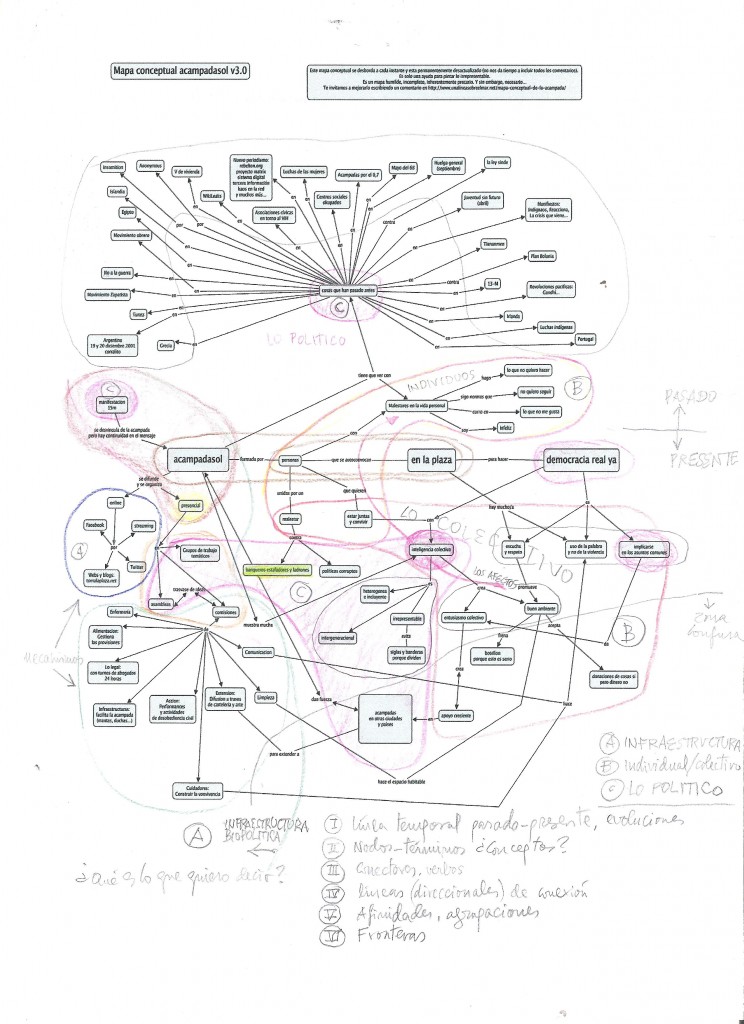
Novedad: versiones en inglés
Los mapas han sido realizados con con CMapTools versión lite. Animamos a reutilizarlos, copiarlos, traducirlos, recombinarlos…
Versión 3.0 es la actual:
acampadasol_v03-acampadasol.cxl (código de la versión 3.0 en formato CXL, la actual)
acampada_v03.jpg (imagen jpeg de la versión 3.0, la actual)
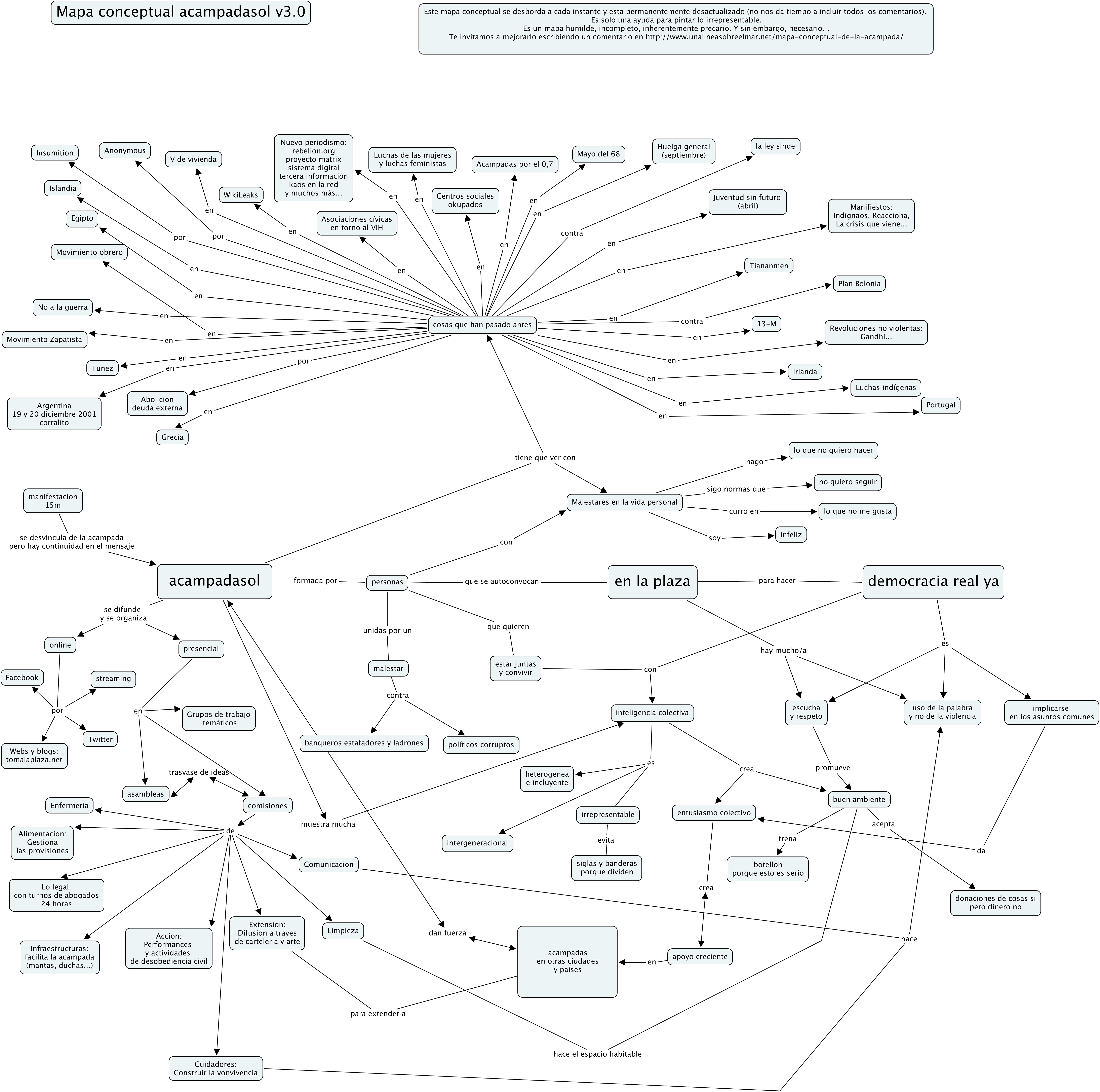
acampadasol_v02-acampadasol.cxl (código de la versión 2.0 en formato CXL)
acampada_v02.jpg (imagen jpeg de la versión 2.0)
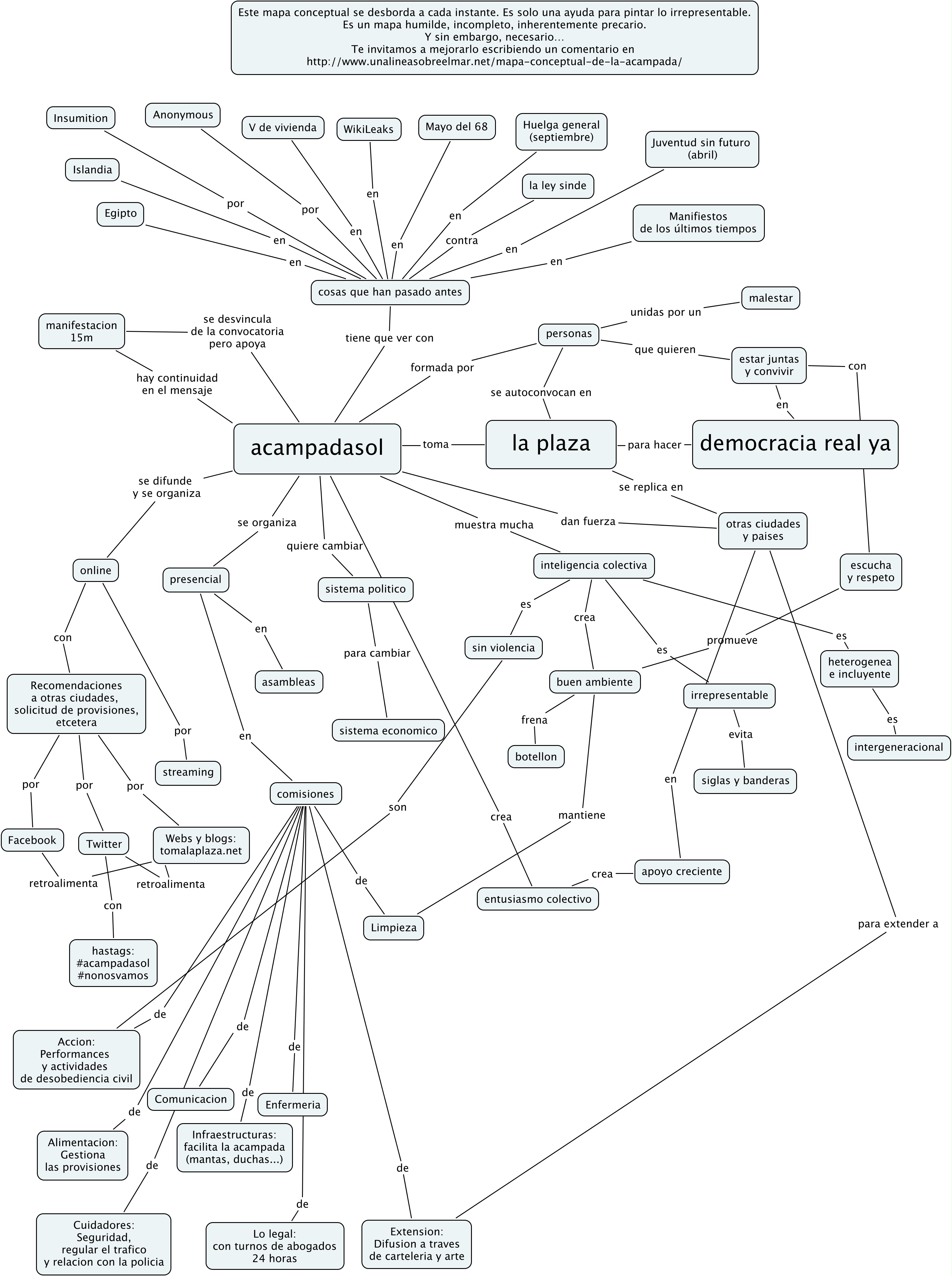
acampadasol_v01-acampadasol.cxl (código de la versión 1.0 en formato CXL)
acampada_v01.jpg (imagen jpeg de la versión 1.0)
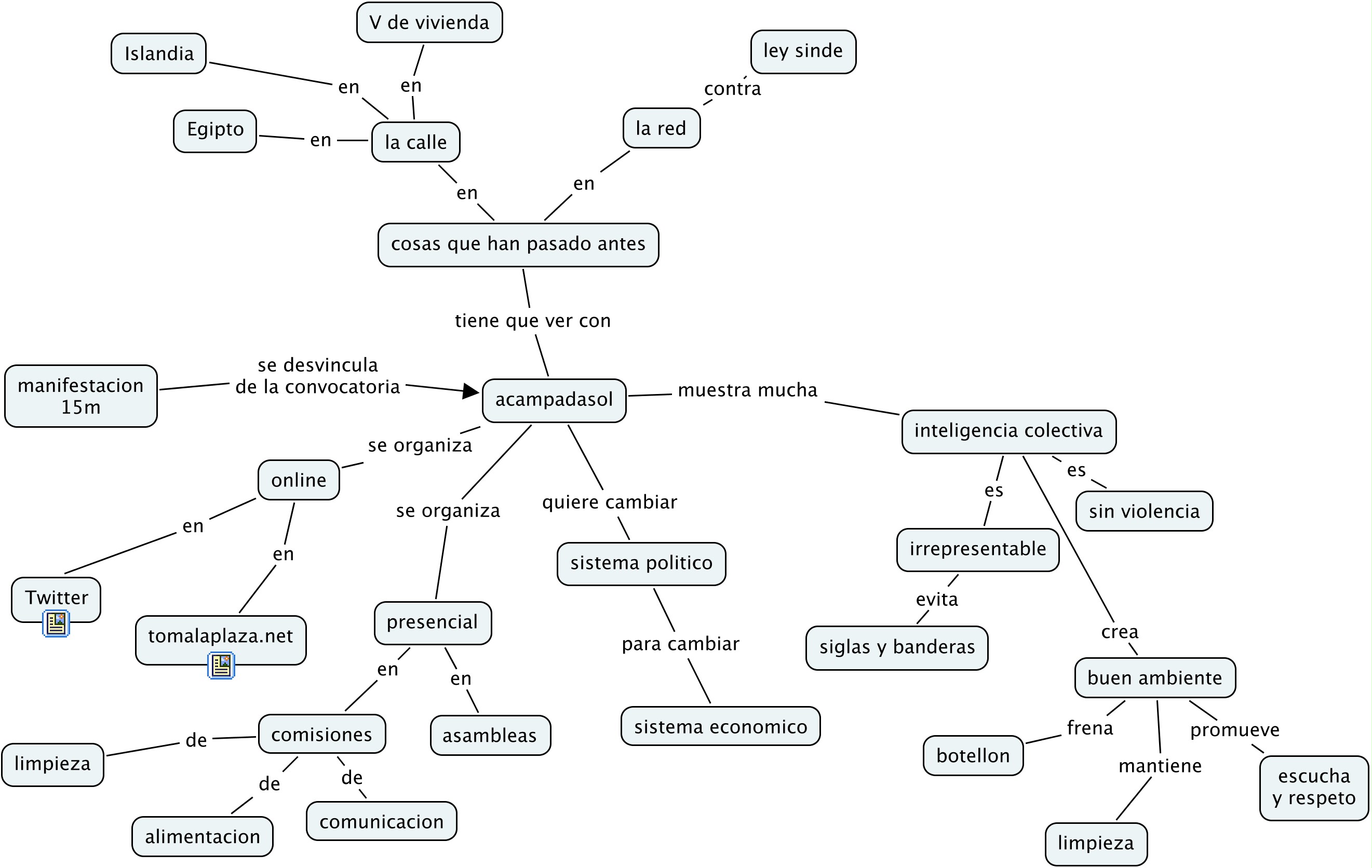
Fotos del mapa conceptual en Sol
Desde Una línea sobre el mar.
25/5/10
Topic Map: How Sciencetific Paradigms relate

A MAP OF SCIENCE created by Sandian Kevin Boyack with collaborators Richard Klavans and Brad Paley, resembles a filamentous microorganism you might see under a microscope.
The map represents 800,000 scientific papers (shown as white dots) and shows relationships between them and different scientific disciplines. The "filaments" are common words unique to each "scientific paradigm" — the 776 red circular nodes or clusters of papers. Each node contains papers that are commonly cited together. Larger nodes have more papers. Nodes are connected with lines of various lengths and thicknesses, denoting the strength of the citation linkages between the nodes. Layout of the nodes was done using Sandia's VxOrd clustering algorithm. Chemistry papers are found in the right-hand peninsula while astrophysics is located at the top. Medicine covers the large region at the lower left.
A four-foot-by-four-foot version of the map is on display at the New York Hall of Science until Feb. 25 as part of the "Places & Spaces: Mapping Science" exhibition. This image also appeared in the Gallery section of the 2006 year-end issue of Nature (vol. 444, p. 985).
Boyack, a founding member of the advisory board of Places & Spaces, produced the map in collaboration with Klavans, SciTech Strategies of Berwyn, Pa., and Paley, graphic artist and director of Information Esthetics, New York, N.Y., using 2003 data from Thomson ISI. It was enabled by work performed under a Laboratory Directed Research and Development project whose purpose was to generate large-scale maps of science for planning and evaluation purposes.
For more information on interpreting the map see Paley’s website http://didi.com/brad/mapOfScience. For details on the exhibition see http://www.scimaps.org.
19/5/10
Gender art net

GenderArtNet is an experimental mapping project exploring the interrelation of gender, ethnicity, race, class and sexualities in contemporary Europe.
GenderArtNet’s primary aim is to thematically link the various existing online resources of feminist and queer artists, projects and networks rather than provide yet another user platform for artist profiles. By connecting existing, often remote, online resources, we would like to improve the accessibility and readability of these resources while keeping the memory of feminist artistic and cultural production in the broader Europe alive.
By organising this information in a map, we work to provide contexts, connections, and relations between artists, artworks and networks and between geopolitics and artistic practice. Our starting point is a relational understanding of feminism as a critical, multilayered practice that considers the interrelatedness of various forms of social, political and cultural hierarchies and exclusions along the lines of gender, sexuality, ethnicity, bodily ability, race, class and geopolitical location.
8/2/10
Lia Perjovschi; Mental maps

Mind Map Subject (detail), 1999-2006
100 x 137 cm
100 x 137 cm
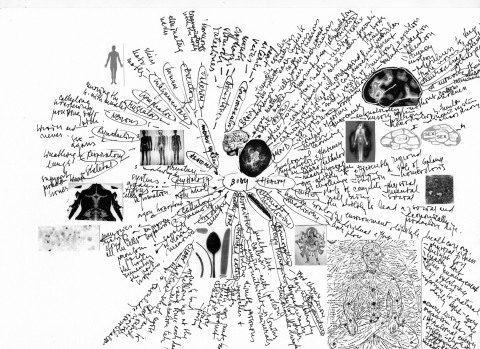
Lia Perjovschi, Body Mind Map , 2006
digital print enlargement of variable size after original A4 ink drawing/collage Detail of Knowledge Museum, 1999
digital print enlargement of variable size after original A4 ink drawing/collage Detail of Knowledge Museum, 1999
The freedom of critical thinking is crucial to Lia’s practice, which involves recovering, collecting and disseminating information. She is – in sum – a personal alternative to the institutionalisation of knowledge and carries her own portable, emancipated system of knowledge with her. Her history of the world from pre-history to today appears in note form as a reading of ideas in hand-drawn diagrams that touch on history, art theory, politics and language – what she calls a Mind Map (Diagram).
Info desde aquí. Es realmente complicado encontrar información de esta artista sin que mencionen a su pareja, Dan Perjovschi.

For over ten years now, the artist has been interested in the visual representation of the accumulation of information/knowledge. The belief in ideals, in the realization of dreams, as well as in the function of art in increasing knowledge, is one of the most important characteristics of Perjovschi’s artistic practice. With the Plan for a Museum of Knowledge, she proposes an imaginary museum, which is based on the metaphors of the Body, the Earth and the Universe. The museum is complemented with the subunits of Culture, Art and Science. The installation, which comprises drawings, objects, charts, photos and colour prints, is an objectification of the mass of information the artist has acquired through reading, travelling and creative work.
Algo más sobre ella que llega desde aquí.
La primera pista, desde esta expo con muy buena pinta que inaugura en breve en Montehermoso .
The Collective
The launch of the magazine was an event at Mediamatic called Children of Roena, an evening we will never forget!
Desde el flickr de Poly-Xelor.
Proyecto Redada; Yproducciones.

Sobre Redada
El Proyecto Redada es una iniciativa de YProductions para CAMON Alicante que se desarrolla en tres fases. Primero empezamos entrevistando a los principales agentes culturales de la zona de Alicante, San Juan de Alicante, San Vicente del Raspeig y Elche para entender mejor cómo se estructura la producción cultural de la zona. Los resúmenes de estas entrevistas y nuestras impresiones serán posteriormente subidas a este sitio web.
Segundo, a través de la información proporcionada por las diferentes personas y colectivos con los que nos entrevistamos realizaremos el mapa Conexión_Camon en el que se podrán ver las relaciones y lugares que ocupan las diferentes iniciativas culturales del contexto alicantino. Por último terminaremos haciendo un taller en el que participarán tanto los agentes y colectivos con los que nos hemos entrevistado como personas interesadas en la cultura durante el que interpretaremos los mapas y la información que hemos podido recoger durante todo el proceso.
De esta forma generamos una investigación colectiva en torno a la producción cultural de la zona, viendo las relaciones que se establecen entre las entidades públicas y privadas, el tipo de tramas que sustentan la cultura y las dinámicas de trabajo que emergen en esta realidad.
Desde YP hemos trabajado la noción de innovación emergente como forma de describir ciertos procesos de innovación que se producen en la cultura. Para que ésta se produzca es necesario permitir que se generen procesos de autoorganización, se han de fomentar modelos de trabajo y colaboración bottom-up, las políticas culturales y administraciones han de ser sensibles a los procesos y dinámicas culturales que acontecen de forma espontánea en la ciudad. Si pensamos que el espacio cultural puede ser un espacio de producción de conocimiento es necesario comprender las dinámicas de producción y distribución que sustentan la cultura, buscando las maneras en las que estos conocimientos puedan insertarse en el tejido social y cultural de las ciudades. Para comprender como funcionan todos estos procesos nos hemos lanzado a las calles…
¡Vamos pues con la redada!
Para consultar el proyecto completo, el archivo de trabajadores culturales y etc, échale un ojo en la página de Redada de Yproducciones.
11/1/10
Manipulating reality, how image redefine the world


The exhibition focuses on the meaning of the term "reality" in contemporary artistic research, as it explores different ways of visually representing the world in the ambiguity that lies between the real and the verisimilar, the concrete and the apparent, the present and the past.
In today's mass-media society, only what becomes image is considered real. In a process of reversal, the representation of the world comes to replace the world itself, a world in which the user operates digitally.
Several different scientific disciplines have already defined a paradigmatic change when they contend that the "real world" does not exist as an independent category, merely as a projection or a construction by the individual; and this, even though in daily life we still tend to raise concepts of reality and truth to the lofty rank of objective facts, on which we then base our actions and our beliefs.
Photography and video art have always been based on the conflict between recording reality and, at the same time, becoming themselves a falsification of that reality. Today, with the spreading popularity of easy-to-use digital technology and the massive dissemination of images through the mass media and the Internet, that ambiguity has if anything increased, pushing the conflict between appearance and reality to its outer edges and demanding that the spectator play an active role in defining what he or she is seeing as real.
Rather than set itself the impossible goal of finding the answer to the question of the nature of a reality reproducible in image form, the exhibition Manipulating Reality presents a selection of 23 artistic approaches that work through photography and video to develop possible models of reality. Its aim is not to understand whether photographs can convey reality but how this can occur. The works exhibited represent different artistic strategies addressing the construction, reflection or distortion of reality in images. In addition to investigating the value of documentary photography today, many of the artists presented reflect in part the conditions of the tool of photography and adopt known artistic techniques such as collage, presentation in model form, abstraction and the assemblage of different elements. Visitors find themselves faced with different constructions of reality, thus being prompted to reconsider their criteria for what is real and subject them to critical reappraisal in the light of the works exhibited.
Manipulating Reality is a CCCS project that availed itself of the scientific advice of Luminita Sabau (director of the DZ Bank collection of contemporary photography in Germany), Brett Rogers (director of the Photographers' Gallery, London), Martino Marangoni (director of the Fondazione Marangoni, Florence) and Franziska Nori (project director of the CCCS).
Artistas:
Olivo Barbieri, Sonja Braas, Adam Broomberg & Oliver Chanarin, Gregory Crewdson, Thomas Demand, Elena Dorfman, Christiane Feser, Andreas Gefeller, Andreas Gursky, Beate Gütschow, Osang Gwon, Tatjana Hallbaum, Ilkka Halso, Robin Hewlett & Ben Kinsley,
Rosemary Laing, Aernout Mik, Saskia Olde Wolbers, Sarah Pickering, Moira Ricci,
Cindy Sherman, Cody Trepte, Paolo Ventura, Melanie Wiora
Street with a view, 2008;Robin Hewlett and Ben Kinsley
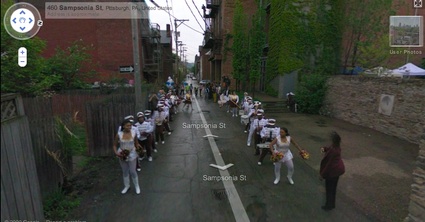
Esta imagen desde we-make-money-not-art.
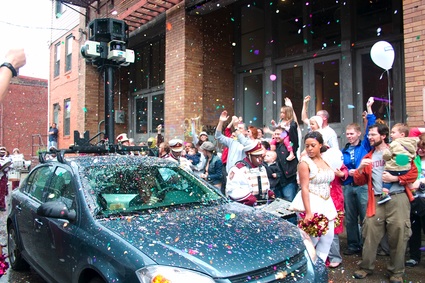
Algunas escenas del proyecto:

Narrow Escape
Torn bed sheets form a ladder and suggest a narrow escape, but who is escaping? And from what?
See it in Street View!

Ham
Artist Michelle Fried donned her ham suit as proof to Doug’s claim—Meats here!
See it in Street View!

Sword Fight
Members Askarus and Twolf of the medieval battle society Angaron (Pittsburgh’s local chapter of Dagorhir Battle Games) engaged in swordsmanship and hand-to-hand combat in a grassy “battle field” at the corner of Sampsonia Way and Federal Street.
See it in Street View!
Street With A View introduces fiction, both subtle and spectacular, into the doppelganger world of Google Street View.
On May 3rd 2008, artists Robin Hewlett and Ben Kinsley invited the Google Inc. Street View team and residents of Pittsburgh’s Northside to collaborate on a series of tableaux along Sampsonia Way. Neighbors, and other participants from around the city, staged scenes ranging from a parade and a marathon, to a garage band practice, a seventeenth century sword fight, a heroic rescue and much more...
Street View technicians captured 360-degree photographs of the street with the scenes in action and integrated the images into the Street View mapping platform. This first-ever artistic intervention in Google Street View made its debut on the web in November of 2008.
An incredible cast of real-life characters contributed their time, energy and talents to creating pseudo-street life on Sampsonia Way. Please check out the scene breakdown, the participant page and the video documentation to learn more about the artists, groups and participants that made Street With A View possible.Más información sobre el proyecto en Street of a view.
Future everything

FutureEverything commissions new artworks and presents exhibitions on society, technology, environment and the city, with a focus on artworks that are participatory, sited in public space, and in an urban context.
Each year the festival also features a special focus on an annual theme. In 2010 the annual theme is The City Experiment - Doing It Together.
Sub-themes include
The City Experiment The ways people can experiment in remaking the city.
iPhone and the Derive Art in the age of the iPhone and Android.
Adaptive Cities Cities are not static but fluid and alive.
Data Visualisation Interpreting complexity.
Rapid Prototyping Launching the UK's first FabLab.
Sub-themes include:
The City Experiment The ways people can experiment in remaking the city.
iPhone and the Derive Art in the age of the iPhone and Android.
Adaptive Cities Cities are not static but fluid and alive.
Data Visualisation Interpreting complexity.
Rapid Prototyping Launching the UK's first FabLab.
Read a statement on the festival themes here.
FutureEverything now invites submissions of artworks, social interventions or digital culture innovations for inclusion in the FutureEverything 2010 Art Programme.
Más futuro por aquí.9/11/09
Get lost; Artist map downtown New York

GET LOST is a collective portrait of downtown New York. Twenty-one international artists were invited to create a personal view of the city and draw a map of downtown New York, uncovering a territory that is both real and imaginary. The maps were collected in a fanzine publication that was distributed for free at galleries, not-for-profit institutions and other sites that animate the life of downtown New York.
GET LOST brings together fictional landscapes, utopian visions, private memories, and obsessive instructions to explore Manhattan, its past, present, and future.
An exercise in emotional geography, GET LOST sketches the coordinates for an endless drift across the streets and myths of downtown New York.
GET LOST is the city as seen through the eyes of: 16beaver group; Francis Alÿs; Cory Arcangel; Jennifer Bornstein; Beth Campbell; Marcel Dzama; Isa Genzken; Inaba and Associates; Dorothy Iannone; Chris Johanson; Christopher Knowles; Terence Koh; Julie Mehretu; Jonas Mekas; Aleksandra Mir; Thurston Moore; Dave Muller; William Pope.L; Lordy Rodriguez; Rirkrit Tiravanija; Lawrence Weiner.
GET LOST is a New Museum production, edited by Massimiliano Gioni, Director of Special Exhibitions. To view copies, visit the New Museum Resource Center. To purchase, visit the New Museum Store.
Beginning Wednesday, June 6, 2007, free copies of GET LOST were made available to the public at the following markers of the downtown scene and cultural organizations around the city: Opening Ceremony (35 Howard Street), Babeland (43 Mercer Street), Bowery Poetry Club (308 Bowery), The Bowery Hotel (340 Bowery), Congee Village (100 Allen Street), Lost City Arts (18 Cooper Square), Freemans Restaurant (Freeman Alley at Rivington Street), Two Boots (155 East 3rd Street), Patricia Field (302 Bowery), Screaming Mimi's (382 Lafayette Street), Joe's Pub (425 Lafayette Street), Artist's Space (38 Greene Street, 3rd Floor), The Kitchen (512 West 19th Street), Sculpture Center (44-19 Purves Street, Long Island City), The Rotunda Gallery (33 Clinton Street, Brooklyn), Bronx Museum (1040 Grand Concourse at 165th Street, Bronx), and the Bedford Cheese Shop (229 Bedford Avenue, Brooklyn). GET LOST was also distributed at the galleries of participating artists.Para verlo completo, en Get Lost.
3/11/09
this is like; associative thinking
______
ThisIsLike.Com – The associative knowledge network from Dee Mee Tree on Vimeo.
About This Is Like
This Is Like helps you connect ideas, people, and places through associative thinking.
On a deeper level it's a collaborative system of associations: people can add items, link them together, and share their associative knowledge with the others. This way, clusters of similar items are created, which are rated by the number of connections they have.
Our site has been called the "Last.Fm of travel" and "Wikipedia of associations", you could also call it the "pop" recommendation system. While our software is based on complex patent-pending algorithms and utilizes several advanced APIs (Calais is one of them), we do not follow the semantic web hype and instead focus on free associative thinking to invite people to share their knowledge and simply play.
Please, navigate these sections to learn more about ThisIsLike.Com:
• Concept – what's the main idea behind ThisIsLike.Com and how it's different.
• History – how it was created and what was the inspiration.
• Objectives – what our objectives and goals are (and it's not about taking over Google)
• Our Team – a complete profile on all the people behind ThisIsLike.Com
• Technology – no, we don't have huge TV screens and a fancy office like Wolphram Alpha.
• Business – how to promote your knowledge on this site.
Suscribirse a:
Entradas (Atom)