1/12/13

La respusta tecnológica de Brasil a Estados Unidos; Sergio Figueroa, 28/11/2013

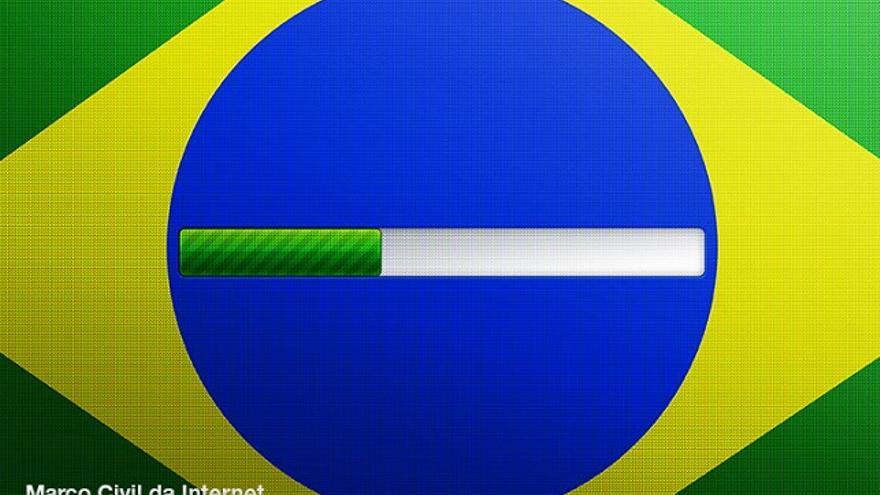
Marco Civil da Internet - Bandera Brasil tech

El Parlamento brasileño está a punto de crear un marco regulatorio de internet con el que pretende, entre otras cosas, protegerse del espionaje internacional. Allí el debate no es nuevo, comenzó hace más de cuatro años y solo ahora los políticos se vuelcan en lograr su aprobación con más medidas concretas y más polémicas que cuando fue desarrollado.
Al menos eso espera la presidenta, Dilma Rousseff. A pesar de que ha sido ahora cuando ha saltado a la agenda política internacional, la propuesta llamada Marco Civil da Internet lleva más de dos años a la espera de una votación que nunca llega. El impacto del escándalo internacional ha conducido al Gobierno a reformular el texto con cambios de última hora relacionados con medidas tecnológicas y no sólo de regulación política.

Neutralidad de la red, cable e email propio y servidores en territorio nacional

“La libertad de expresión, la privacidad de los individuos y el respeto por los derechos humanos; gobernanza abierta, multilateral y democrática; universalidad que asegure el desarrollo social y humano y la construcción de una sociedad inclusiva y no discriminatoria; diversidad cultural, sin la imposición de creencias, costumbres y valores; y neutralidad de la red, guiada solo por criterios técnicos y éticos, fijando como inadmisible restringirlo por aspectos políticos, comerciales o religiosos”.
Es parte del discurso de Rousseff en la Asamblea General de las Naciones Unidas del pasado 24 de septiembre y resume los principios de la legislación que se trata de aprobar. Si finalmente sigue esos patrones, el marco va a establecer internet como un derecho fundamental y a asegurar la neutralidad de la red, o lo que es lo mismo, impedir que las compañías discriminen entre usuarios por el tipo de contenido al que acceden.
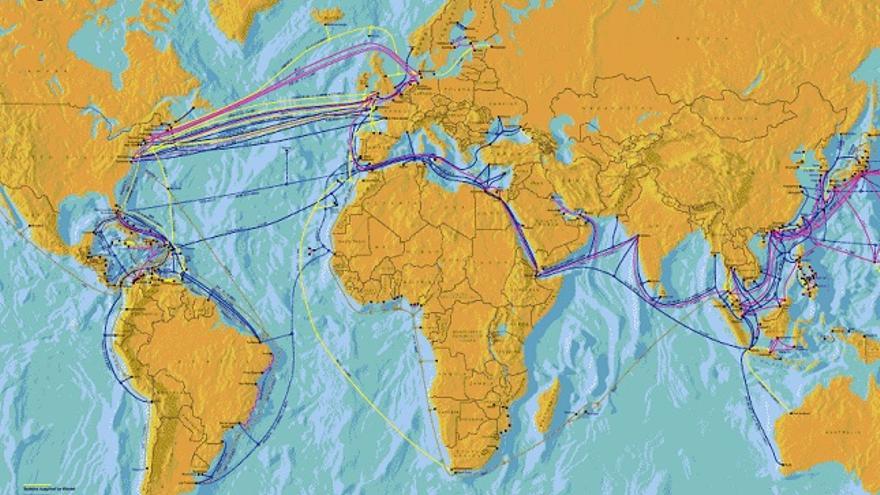
Desde el punto de vista técnico, el Partido dos Trabalhadores (PT) maneja la propuesta de construir cable submarino entre Brasil y Europa y entre los países suramericanos, ya que la mayor parte de sus conexiones actualmente pasan por Estados Unidos.
Para solucionar el espionaje al correo electrónico, el Gobierno ha encargado el desarrollo de un servicio de email brasileño con su propio sistema de cifrado. Su idea es sustituir a los grandes proveedores, Gmail, Outook y Yahoo!, que, como empresas estadounidenses, deben abrir sus candados cada vez que un juez se lo solicita. En el Marco Cívico da Internet, queda reconocida la inviolabilidad de las comunicaciones y se reserva al Poder Judicial la capacidad de cerrar páginas webs por contenido.
Mapa mundial del cable submarino de fibra óptica
Mapa mundial del cable submarino de fibra óptica.
Por último, la medida que más tarde ha llegado a la propuesta y que más ruido está generando: exigir a las compañías que almacenen la información de los usuarios brasileños en centros de datos ubicados en el propio país.
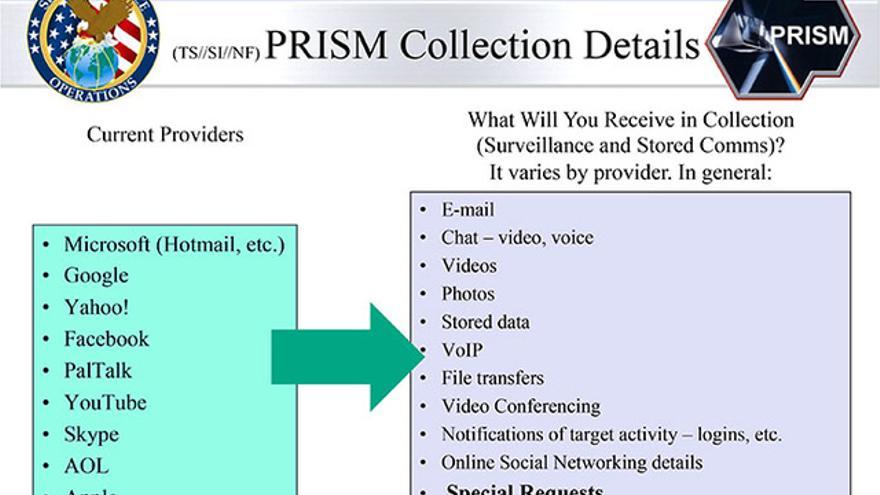
El objetivo es someter a empresas como Google o Facebook a la legislación brasileña y evitar que la decisión sobre el acceso de las agencias como la NSA a los datos quede en manos de la Justicia estadounidense, o impedir que puedan entrar por la supuesta puerta trasera de acceso a datos que las multinacionales siguen negando, pese a las evidencias publicadas por The Guardian y The Washington Post.
Ha recibido dos grandes críticas, una cívica y otra empresarial. Son muchos los colectivos que han aplaudido la declaración de Rousseff, pero al mismo tiempo hay recelos sobre la medida porque “puede funcionar como una barrera a la libertad de circulación de la información online, y no tiene por qué mantener necesariamente la información de los brasileños lejos de las manos del alcance la NSA”, en palabras de Emma Llansó, directora del proyecto de libertad de expresión del Center for Democracy and Technology.
Llansó pone en duda también la concepción de gobernanza multilateral con Naciones Unidas como “pilar central” que explicó la presidenta brasileña, ya que el internet libre que persiguen este tipo de organismos no se consigue pasando de la dependencia de un Gobierno al de varios ejecutivos o instituciones internacionales, sino con la descentralización.
Por otro lado, se critica el coste y el alcance de esta decisión. No sólo por cómo se podría aplicar a pequeñas compañías sin capacidad para establecerse en Brasil, sino también por la reacción de los gigantes ante el coste de construir centros de datos en un país tropical.
Google ha dicho que sería complicado desarrollar esta infraestructura, según recoge Bloomberg, y su responsable en el país latinoamericano pinta un panorama de retroceso en los servicios para los brasileños, sin acceso a las últimas novedades. No dice, sin embargo, el beneficio que obtiene en un país que es el tercero en número de terminales Android y el quinto en visitas a YouTube, según datos de comScore citados en el mismo artículo. Otras voces claman que este marco podría fomentar la creación de empresas tecnológicas locales que ocupasen los huecos dejados.
NSA - Programa PRISM
Programa PRISM de espionaje fuera de Estados Unidos.

Marco Civil da Internet, una vieja propuesta

En realidad, el Ejecutivo de Rousseff no ha tenido que buscar mucho para encontrar una propuesta que encajar sobre independencia tecnológica en esta revuelta contra Estados Unidos. Desde 2009, el Ministerio de Justicia tiene sobre su mesa una propuesta llamada Marco Civil da Internet, rebautizada como la Constitución de Internet para Brasil.
Este marco regulador fue ideado para garantizar un uso generalizado de internet en el país con respeto a los principios de la neutralidad de la red, libertad de expresión y privacidad del usuario. También apuesta por el gobierno abierto, una forma de entender la red que se ha aplicado a su propia creación. El Marco Civil, impulsado por la Fundación Getulio Vargas, contó con más de 2.000 enmiendas propuestas por la ciudadanía en foros de debate y a través de la red.
Desde agosto de 2011, la propuesta está esperando a ser votada por el Parlamento, con sucesivos retrasos explicados por la búsqueda de consenso. Algunos de sus primeros impulsores han denunciado que las enmiendas han desnaturalizado el texto original, como así lo hacía ya en 2012 uno de los expertos implicados en el proyecto, Carlos Alfonso, director del Instituto NUPEF. Las quejas se centran en la cesión de derechos a las compañías telefónicas, que exigen poder controlar el tipo de tráfico.
Tras la filtración de Snowden, Rousseff pidió al Parlamento votar de urgencia el texto, pero la falta de acuerdo sigue retrasando su presentación. La última vez, el 12 de noviembre, cuando el PT decidió volver a recular porque “hay divergencias en la base, en las bancadas y también en la oposición”, explicaba el diputado del PT Arlindo Chinaglia para Journal do Brasil. Las negociaciones continúan a la espera de una nueva fecha.
De Brasil a las Naciones Unidas, porque el objetivo de la presidenta es ofrecer esta medida como ejemplo al resto del mundo. De hecho, ya está organizando con la colaboración de la ICANN una conferencia internacional sobre gobernanza de internet para los días 23 y 24 de abril en São Paulo. Para entonces, el Marco Civil da Internet ya debería haber pasado por el Parlamento brasileño y se conocerá el alcance total de las medidas antiespionaje.

Leer más:  La respuesta tecnológica de Brasil al espionaje de Estados Unidos  http://www.eldiario.es/turing/vigilancia_y_privacidad/respuesta-tecnologica-Brasil-espionaje-Unidos_0_200530636.html#BGW87eiZGKej3tgO

The True Size of Africa: A Small Contribution in the Fight Against Rampant Immappancy by Kai Krause, October 08, 2013 -

Image 2 for article titled "The True Size of Africa: A Small Contribution in the Fight Against Rampant Immappancy by Kai Krause"
 
Kai Krause's map, "The True Size of Africa." Africa looks about the same size as Greenland in a Mercator projection, even though it is actually 14 times bigger; Krause’s map illustrates the fact that Africa is three times larger than the USA and larger than the USA, China, India, Japan, and all of Europe – combined!
 
 
Image 3 for article titled "The True Size of Africa: A Small Contribution in the Fight Against Rampant Immappancy by Kai Krause"
 
Comparison between the Mercator projections (left) and Gall-Peters (right). Image: Wikipedia Commons / NASA.
 
 
Image 4 for article titled "The True Size of Africa: A Small Contribution in the Fight Against Rampant Immappancy by Kai Krause"
 
 A reworking of Mr. Krause's map using Gall's Stereographic Cylindrical Projection (1855) with two standard parallels at 45°N and 45°S. Distortions are still evident at the poles, but, for most countries, shape is maintained, and their areas are shown correctly. As you can see, the results are distinct from Mr. Krause's map. But however you look at it, his point is a good one: Africa is much bigger than it looks on most maps (The Economist, op. cit.)
 
 
Image 5 for article titled "The True Size of Africa: A Small Contribution in the Fight Against Rampant Immappancy by Kai Krause"
 
An Albers projection shows areas accurately, but distorts shapes (Wikipedia: Map projection)

 ...................................................


“In addition to the well-known social issues of illiteracy and innumeracy, there also should be such a concept as “immappancy,“ meaning insufficient geographical knowledge. A survey with random American schoolkids let them guess the population and land area of their country. Not entirely unexpected, but still rather unsettling, the majority chose “1-2 billion” and “largest in the world“, respectively. Even with Asian and European college students, geographical estimates were often off by factors of 2-3. This is partly due to the highly distorted nature of the predominantly used mapping projections (such as Mercator). A particularly extreme example is the worldwide misjudgment of the true size of Africa. This single image tries to embody the massive scale, which is larger than the USA, China, India, Japan, and all of Europe – combined!” (Kai Krause: The True Size of Africa).
Billionaire computer graphics guru Kai Krause is famous for founding MetaCreations Corp., his Kai's Power Tools series of products, and for his contributions to graphical user interface design. In December 2010, he also caused a stir by producing a map of Africa which was designed to illustrate the limitations of popular map projections of the world. “The mathematics of projection do not permit any particular map projection to be "best" for everything. Something will always get distorted. Therefore, a diversity of projections exists to service the many uses of maps and their vast range of scales.”
“Thematic maps normally require an equal area projection so that phenomena per unit area are shown in correct proportion. However, representing area ratios correctly necessarily distorts shapes more than many maps that are not equal-area. Hence, reference maps of the world often appear on compromise projections instead. Due to the severe distortions inherent in any map of the world, within reason, the choice of projection becomes largely one of æsthetics.”
“The Mercator projection, developed for navigational purposes, has often been used in world maps where other projections would have been more appropriate. This problem has long been recognized, even outside professional circles. For example, a 1943 New York Times editorial states: ‘The time has come to discard [the Mercator] for something that represents the continents and directions less deceptively... Although its usage... has diminished... it is still highly popular as a wall map apparently in part because, as a rectangular map, it fills a rectangular wall space with more map, and clearly because its familiarity breeds more popularity.’” (source).
“In 1973, Arno Peters (1916-2002) proposed a projection, also based on the work of Scottish clergyman James Gall (1808-1895), who had the right features for navigation and put the continents in real proportions, with the least possible distortion. Peters believed that the Mercator projection represented the countries the Equator line in a smaller size because they were less significant. The Gall-Peters projection is now the most accepted, but the enhancement and distortion of the northern hemisphere, especially Europe and North America, present on Mercator’s map, still remains in the popular imagination. Thinking about it, the German graphic designer Kai Krause created an image to represent the true size of the African continent” (source).
“G.D.”, in a blog for The Economist on November 10, 2010, points out that “In Mr. Krause's map, he seems to have used the shapes of the countries from a Mercator projection, but has scaled up the outline of Africa, without changing its shape, to show the appropriate area. An alternative and arguably more rigorous approach would be to repeat the exercise using an "equal area" projection that shows the countries' areas correctly while minimizing shape distortion. These two properties are the hardest to balance when showing the whole world on one map. I decided to rework Mr. Krause's map using Gall's Stereographic Cylindrical Projection (1855) with two standard parallels at 45°N and 45°S. Distortions are still evident at the poles, but, for most countries, shape is maintained, and their areas are shown correctly. As you can see (right), the results are distinct from Mr. Krause's map. But however you look at it, his point is a good one: Africa is much bigger than it looks on most maps” (source; also see Matt T. Rosenberg’s article in About.com, Geography, “Peters Projection vs. Mercator Projection”). From here.
Editor’s note: Many thanks to Pat Duncan, an old friend from Wales who now lives in Tenerife, for suggesting this material. 
From here.

26/11/13

The Whole Earth; article by Martina Angelotti at Domus, 2013.

The exhibition at the Haus der Kulturen der Welt in Berlin demonstrates the intellectual commitment between the 1960s and 1970s, mostly in California, starting from the Whole Earth Catalog, Stewart Brand's manual, that Jobs considered the forerunner of Google.

Art / Martina Angelotti


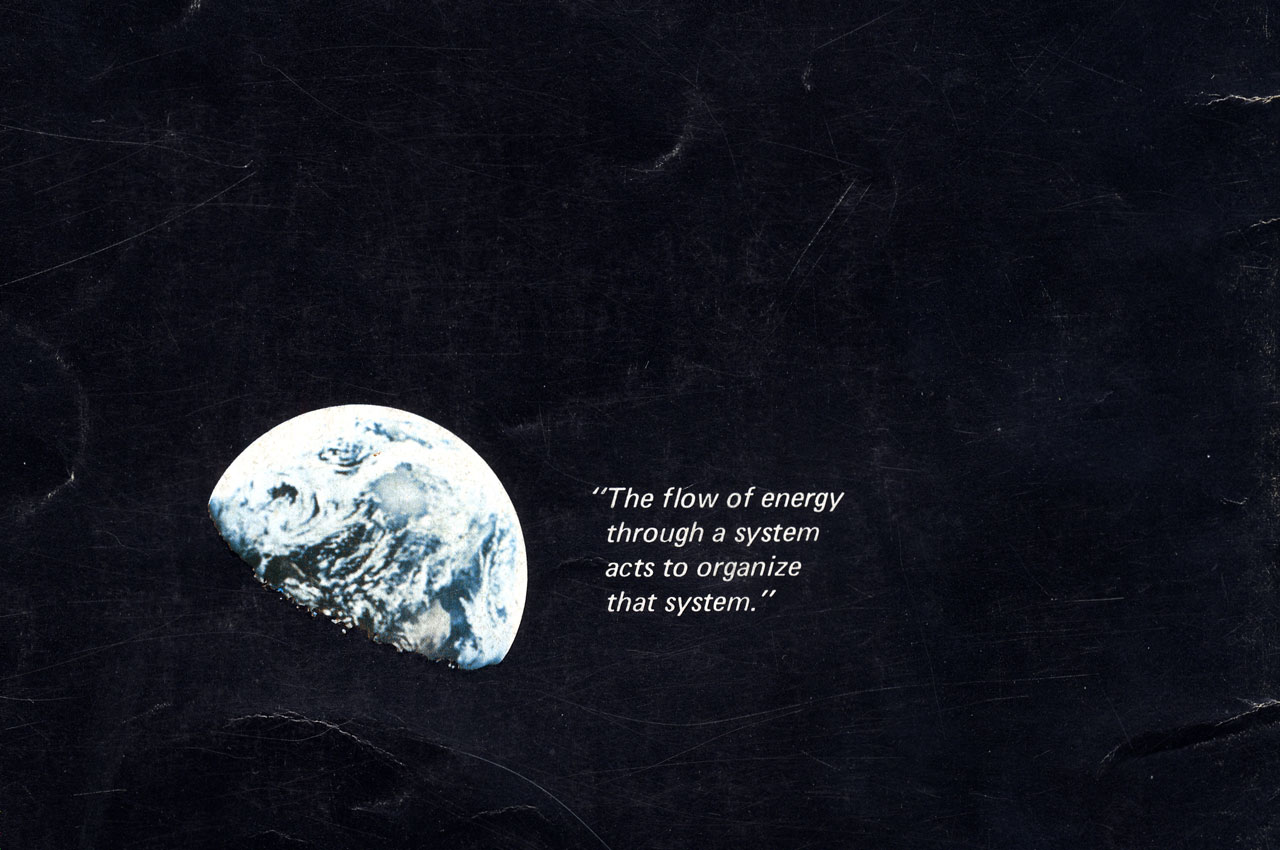
The Blue Planet is the image of the Earth seen from space and has been one of the most popular icons of recent times, having replaced the Mushroom Cloud – the symbol of the post-war period and the Cold War.
Stewart Brand picked it in 1968 for the cover of the first issue of his Whole Earth Catalog, hoping it would make human beings see the Earth as a single place where racism and intolerance would shy into insignificance when viewed from a distance and as part of such a large universe.
Stewart Brand (Ed.): Whole Earth Catalog. Access to Tools, Spring 1969 (Backcover)
The Whole Earth Catalog was a manual encouraging people to create their own environment and lifestyle and to see the Earth as a precious asset to be respected and nurtured through knowledge.
“We are gods”, said Brand in 1968 when speaking about his Catalog “At a time when a New Left was calling for grass-roots political (i.e., referred) power, Whole Earth eschewed politics and pushed grassroots direct power – tools and skills. At a time when New Age hippies were deploring the intellectual world of arid abstraction, Whole Earth pushed science, intellectual endeavor, and new technology as well as old.”
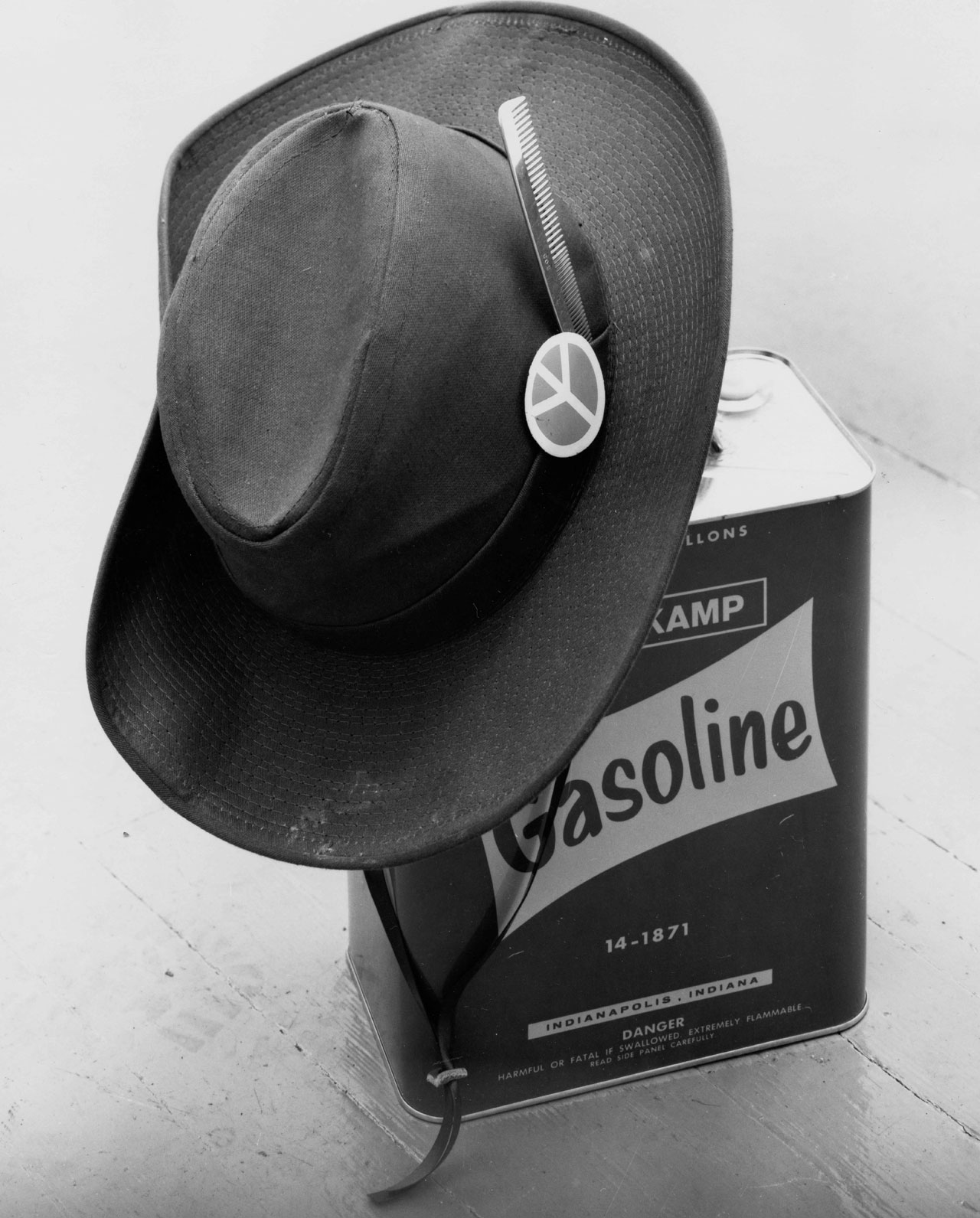
Eleanor Antin, Merrit from California Lives, 1969; replicated 1998. Gasoline can, bush hat with “peace” decal, metal comb, and text panel. Dimensions variable. Courtesy Ronald Feldman Fine Arts, New York
“The Whole Earth” exhibition at the Haus der Kulturen der Welt speaking on behalf of this approach, a demonstration of an intellectual commitment that has turned its focus to the decade between the 1960s and 1970s, mostly in California – a fertile and propitious terrain for the development of the American counterculture, a historical forerunner of that which shortly followed called the “Californian Ideology”. The legacy of the hippy culture and its fusion with cybernetics, the hard-won battles and ensuing projects linked to ecology and the environmental heritage, the fusion of black and white music and that of the dissidents, psychedelics and digital culture. California über Alles sang the Dead Kennedys in the 1980s. The curator Anselm Franke, along with Diedrich Diedrichsen, conveys this political, cultural and social vibrancy with the same intensity of its origins and growth, adopting visual, exhibition and scientific expedients that sustain Stewart Brand’s fundamental idea.
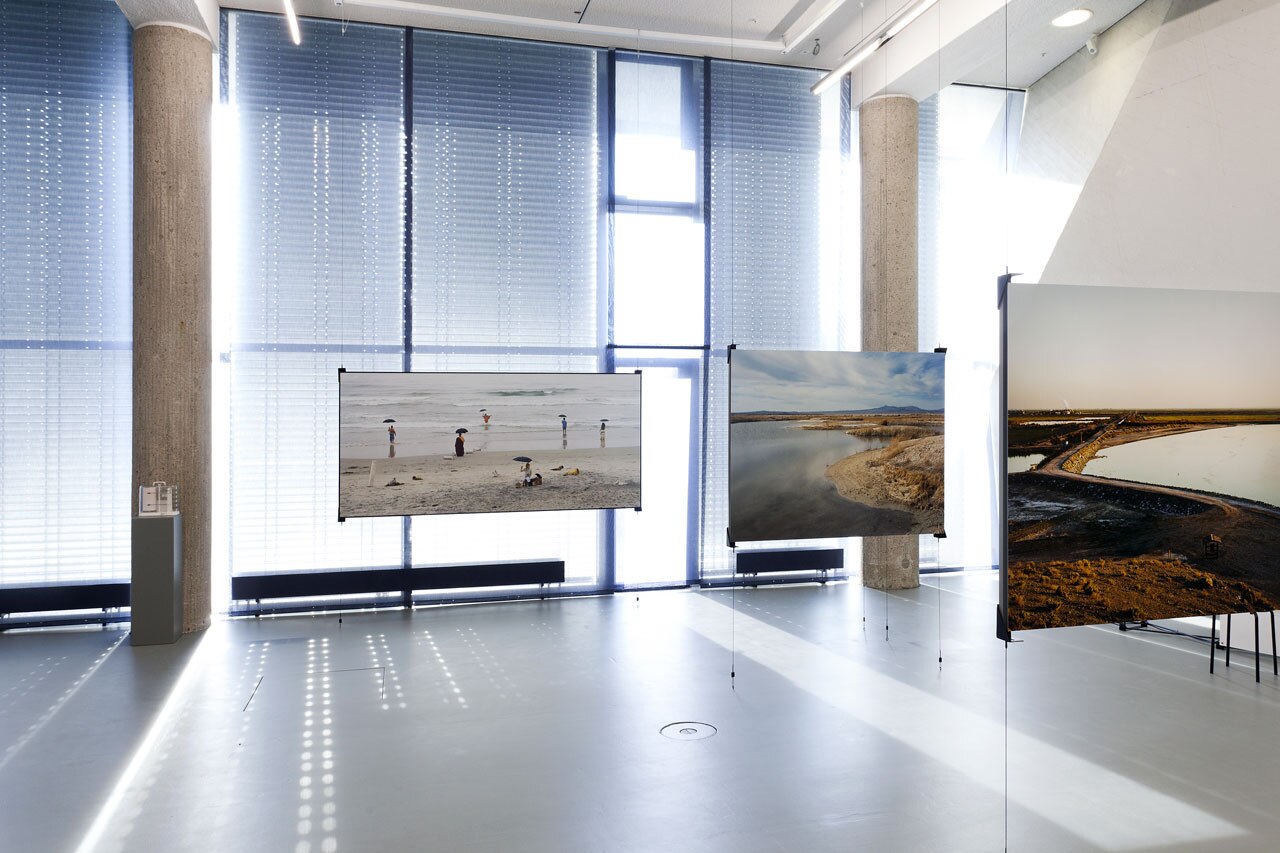
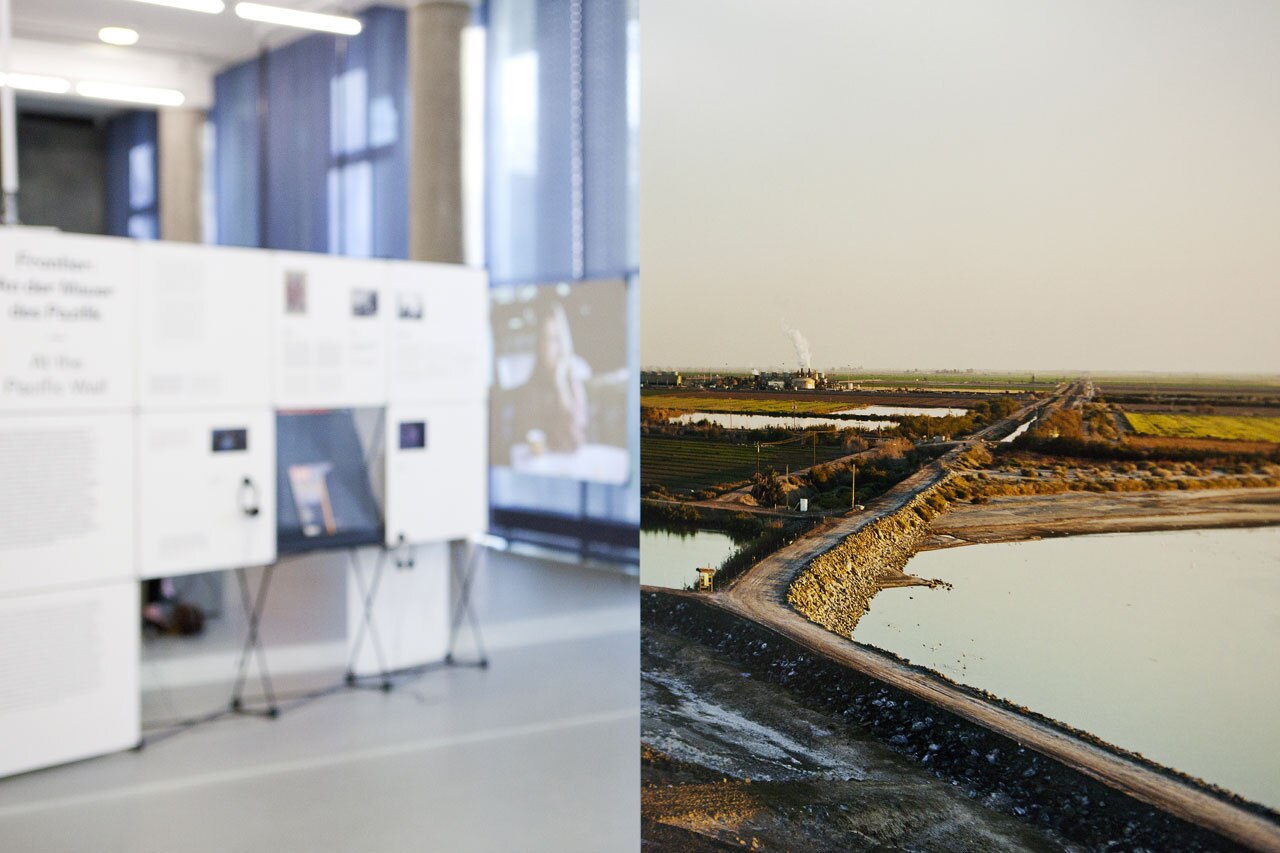
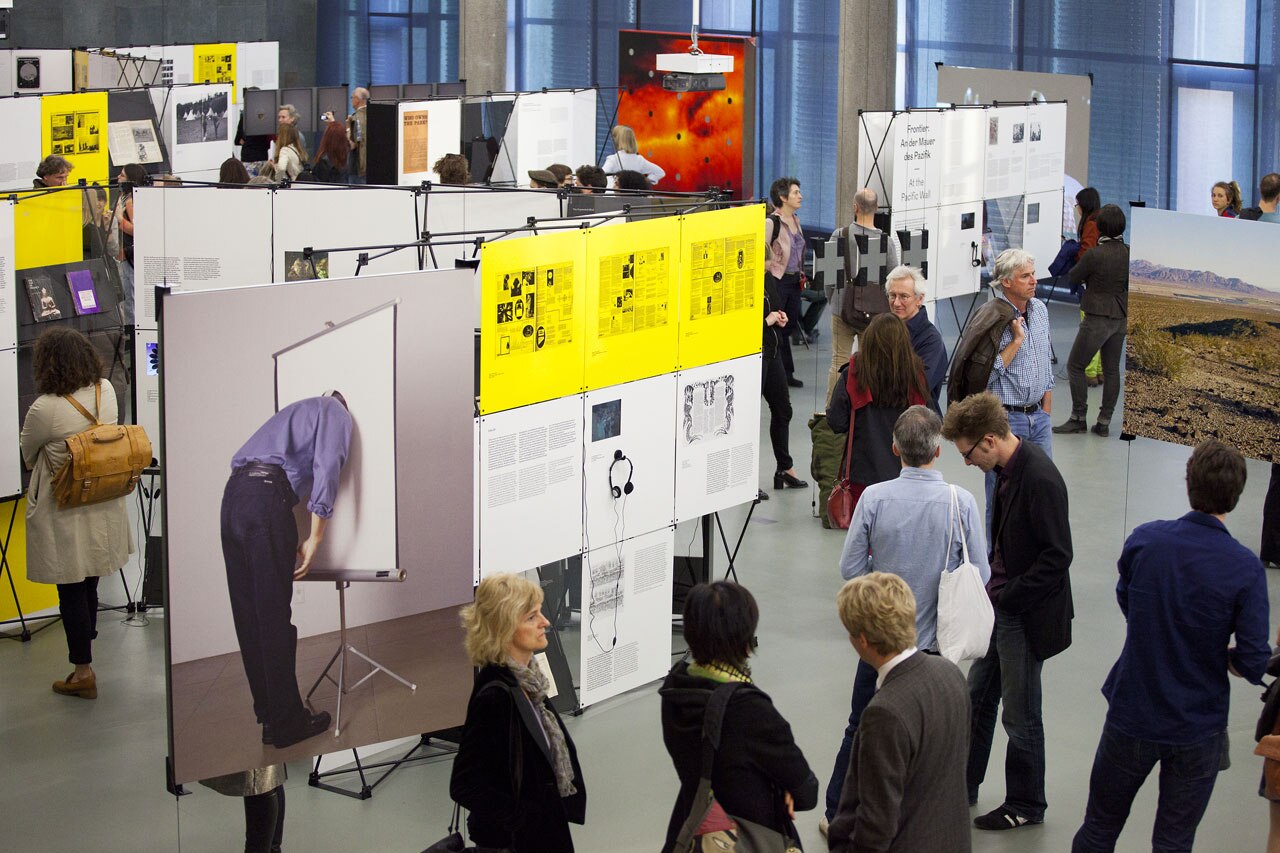
View of the exhibition "The Whole Earth California and the Disappearance of the Outside"
Written texts, archive images and video and audio recordings can be enjoyed on mini-displays installed on printed panels. These form micro theme-rooms inside the space that symbolises Western Modernism. The mobile stools that visitors can move at their will and convenience to enjoy the individual records convey a fluid and functional mobility. A section on psychedelic research and the experimental cinema, with Stan Vanderbeek’s Manifesto, Land Art and ecology works and experiments by Nancy Holt and Robert Smithson, the Beat Generation and its influence on music and performances including, to mention but one, a Lawrence Jordan film. Visitors can listen to music – from Bob Marley’s “Exodus” in the Babylon section to “We Can Be Together” sung by Jefferson Airplane in 1969 even though they were “outlaws in the eyes of America”.
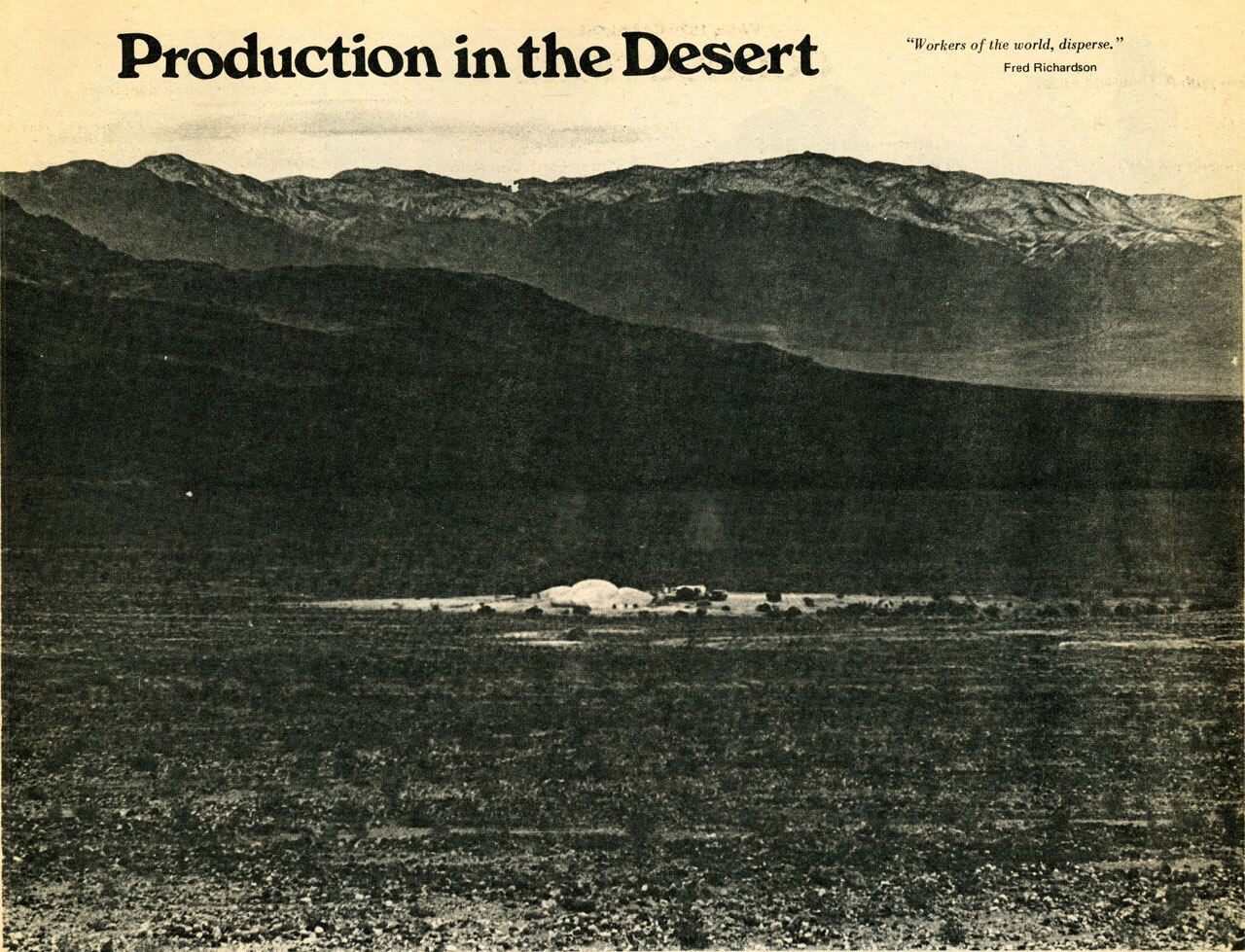
Production in the Desert. In Supplement to the Whole Earth Catalog, January 1971. Stewart Brand (Ed.): Whole Earth Catalog. Access to Tools, Spring 1969 (Backcover)
Renowned Otolith 1 work in the Otolith group’s trilogy which, as described by Brian Rogers, “evokes a non-metaphorical weightlessness of alien intimacy” to pictures by Jack Goldstein capturing “the spectacular instant” of natural and scientific phenomena.
This exhibition is a true statement and a fascinating experiment in how an institution known as a “house of culture” can pursue its informative, scientific and communication aims.
View of the exhibition "The Whole Earth California and the Disappearance of the Outside"
Not strictly speaking a museum that conducts experiments and exhibits products of artistic research but a public institution with broader aims and objectives that relates to the mass public, raising its awareness and involving it in a concept of culture.
The decision to be represented by someone like Anselm Franke, a curator with the finest of intellects and unquestioned ability, is also interesting. Even on his debut here, Franke impressed people with the great insight with which he conceived and staged the theme of animism, an exemplary result on his Ph.D subject. I appreciate and admire the professionalism and depth with which certain themes widely represented and at risk of generalisation in the public domain have, instead, been dealt with and become a part of what, in its own small way, is a keystone not only of the scientific/curatorial approach but also of the even more important one of the work/spectator dialectic.
Philipp Lachenmann, SHU-Still, 2003/2008 Lightjet print behind acrylic, framed, edition: 6 + 1 AP 125,5 x 167,5 cm, framed. © Galerie Andreas Binder und / and Philipp Lachenmann
It is symptomatic of a crucial moment in history that something similar should also have happened at Berlin’s Kunstwerk, which a year ago hosted Arthur Zmijewski’s controversial Biennale. In the same city but in a totally different institution and one with totally different aims, the curator Ellen Blumenstein, who recently took over as director, developed a wholly unusual exhibition by institutional standards. She then asked Nedko Solakov to translate the visual layout of her extensive curatorial project in the revamped spaces of the Kunstwerk with his texts and drawings – a sort of expanded statement in which each visitor has a chance to enter into direct dialogue with its programme and strategies, expressed in the form of teasers and even with an Avatar of Ellen herself.

Eleanor Antin, Going Home, 2004, from Roman Allegories, chromogenic print, 124 x 260 cm. Courtesy Ronald Feldman Fine Arts, New York / Anonymouscollection
At a time in history when contemporary art (as too politics) needs to rediscover its rapport and dialogue with the public, two institutions have sought to pursue this aim in different manners and forms, here in Berlin.
In his Commencement address to Stanford University in 2005, Steve Jobs spoke the words “Stay Hungry, Stay Foolish”. Jobs was quoting Stewart Brand (who also invented the term personal computer). His Catalog was repeatedly mentioned and Jobs considered it the forerunner of Google. Seeing this exhibition is an ideal exercise in putting this statement into practice. Don’t forget where you are coming from or where you are. The universe is immense. Martina Angelotti (@martinanji)


Article from here.

New Ruins. Google Earth Tour ; Manuel Fernandez, 2013.


New Ruins. Google Earth Tour is a visual geolocated 3D installation project made in Google Earth in wich the most known ancient ruin models have been remapped and reinstallated in their original places.

Exhibited at:

Transfer 3D Speed show. Internet Navig@tor. Curated by: Małgosia Woźnica and Dominik Podsiadły. Wrocław, Poland 2012
The Eternal Internet Brotherhood. Curated by Angelo Plessas. Las Pozas Surrealist Park, Xilitla, San Luis Potosi, MX 2013.
What we call sculpture. Cerma. Internet. 2013


New Ruins. Google Earth Tour


New Ruins. Tepozteco. Postcards from Google Earth. PNG Screenshot. 2013. For The Eternal Internet Brotherhood. Mexico


New Ruins. Partenon. Postcards from Google Earth. PNG Screenshot. 2012.


New Ruins. Angkor Wat. Postcards from Google Earth. PNG Screenshot. 2012.


New Ruins. Coliseum. Postcards from Google Earth. PNG Screenshot. 2012.


New Ruins. Machu Picchu. Postcards from Google Earth. PNG Screenshot. 2012.


New Ruins. Pascua Island. Postcards from Google Earth. PNG Screenshot. 2012.


New Ruins. Petra. Postcards from Google Earth. PNG Screenshot. 2012.


New Ruins. Egyptian pyramids. Postcards from Google Earth. PNG Screenshot. 2012.


New Ruins. Stonehenge. Postcards from Google Earth. PNG Screenshot. 2012.


New Ruins. Taj Mahal. Postcards from Google Earth. PNG Screenshot. 2012.


New Ruins. Tikal. Postcards from Google Earth. PNG Screenshot. 2012.

More info from Manuel Fernández here.

28/10/13

Mario García Torres: "Hay que reivindicar la sinceridad en el arte" Por: Miguel Ángel García Vega | 12 de octubre de 2013


MGT_byJoseVazquez_Hor_300[1]
Mario García Torres (Monclova, México, 1975) es uno de los más brillantes artistas de su generación.
Su trabajo es una mirada que nos columpia sobre el tiempo. Hacia el pasado, revisando pequeños acontecimientos olvidados o perdidos de la historia del arte del siglo XX, y hacia el futuro, poniéndolos en contexto dentro de nuestra propia época y de su inquietante porvenir.
En 2010 —muchos se acordarán— mostró una soberbia pieza en el Museo Reina Sofía: ¿Alguna vez has visto la nieve caer? Un viaje, en forma de proyección de diapositivas, en busca del One Hotel de Kabul (Afganistán), un lugar mítico que el artista italiano Alighiere e Boetti (1940-1994) regentó durante la década de los setenta del siglo pasado. En tiempo actual, acaba de presentar en el Museo Vostell-Malpartida (Cáceres), dentro del proyecto Campo Adentro, cuatro instalaciones que reflexionan sobre el arte en el mundo rural. 
Mario García Torres Nieve
Todo ello dibuja una excelente disculpa para conversar con este artista que ha cambiado Los Ángeles por él Distrito Federal (DF) mexicano, que expone, entre otras, en la galería Proyectos Monclova, dirigida por su hermano José, y que ha mostrado su trabajo en la Documenta 13 de Kassel y en la 52 edición de la Bienal de Venecia. Buenos augurios.
Pregunta. Su propuesta exige tiempo y esfuerzo al espectador. ¿No es ir a contracorriente ahora que todo tiene que ser rápido y fácil?
Respuesta.
Cierto. Pero resulta importante buscar la manera de generar que el ritmo y el tiempo sean otros en el museo. Tiene que ver con una necesidad de sinceridad. Puede sonar pretencioso, pero es interesante reivindicar la sinceridad en el mundo del arte. ¿Hasta qué punto puede uno hablar de la historia del arte siendo partícipe de ella? Esa honestidad hacia la conciencia de dónde está uno situado en la historia es de alguna manera lo que trato de pedir al espectador al crear obras. Para mí concebir una pieza tiene que ver con encontrar gente que piense igual que yo o que tenga los mismos intereses. 
Mario García Torrea Reina I
P. ¿Su trabajo genera discursos nuevos o todo son relecturas?
R.
La pregunta está relacionado con si el arte tiene que ver con ideas nuevas o por qué esperamos esas ideas nuevas. Quiero pensar que existe una cierta novedad en lo que hago, en la manera de acercarme a las cosas. Pero hay una gran equivocación en relación a creer que el arte es algo nuevo. Porque una cosa es generar una estrategia interesante y novedosa y otra pensar que el pasado no es algo nuevo. El pasado es una estrategia para hablar de la cotidianeidad.
P. ¿Alguna vez has visto la nieve caer? era, en cierta forma, un ejercicio de nostalgia. ¿Por qué este sentimiento se halla tan presente en su obra?
R. Es cierto que es una presencia. Pero ¿Alguna vez ..? se refiere al fotoperiodismo. Habla de relaciones sociales, de historia y de geografía histórica. En esa pieza hay una cierta atmósfera de recogimiento, pero tiene que ver más con pensar la historia como un gesto íntimo y personal.
P. Vivimos una época en la que cada vez se producen más ocurrencias y menos obras de arte. ¿Cómo distinguir unas de otras?
R.
Es una pregunta difícil. Pero seguramente volvería a hablar de sinceridad. A la hora de mirar una obra de arte hay que ver hasta qué punto es un gesto sincero y hasta qué punto esa sinceridad es pertinente. Cuando las cosas se hacen con demasiada ironía o con desapego al sistema y a la conciencia del sistema en el que esos objetos están funcionando, por más complejo que sea el gesto, resulta ser una ocurrencia. Hay obras de arte que son gestos muy sencillos y parecen una ocurrencia, pero en el momento en el que uno entiende que existe esa honestidad alrededor pueden tener una potencia increíble.
Mario García Torres Reina Sofía
P. ¿Cree que su trabajo tiene un impacto social?
R. No en lo inmediato. Las obras de arte no cambian los sistemas sociales. Tienen un impacto social en relación al pensamiento, a quién transmite las cosas y cómo. Las obras de arte tienen que introducir una pequeña pregunta, un pequeño tema, una semilla que pueda arraigar en alguien. Por otro lado, no pretendo enseñar nada a nadie. No quiero que mis obras descubran en la gente cosas concretas.
P. ¿Por qué le interesan tanto los proyectos fallidos de otros artistas?
R. No me interesan las cosas fallidas, me interesan aquellas historias que no repercuten; las que no tienen un impacto específico. Quiero saber todo lo que hay detrás, todo lo que hizo a esa persona llegar a ese punto. Me importa menos como algo fetichista. Ni siquiera me interesa el personaje, ni investigar cómo funciona eso en el sistema del arte. He pasado ocho años investigando un proyecto creado por Alighiero Boetti, pero lo primero que me interesó no es Boetti como persona, sino cómo es que una historia tan pequeña, con tan poca información, con dos imágenes, circula en el sistema del arte y ha generado un gran mito, y de qué manera se ha contado esa historia a través de esas dos fotografías.
Mario Kabul
P. ¿Dónde podemos ubicar su trabajo?
R. Es muy difícil encontrar un espacio concreto. El 90% de las obras que se conciben hoy en día proceden del arte conceptual. Mi estrategia tiene que ver con un gesto muy específico. Sin embargo, una gran parte de la información que termina siendo la obra está relacionada con las estrategias documentales, el fotoperiodismo o el cine.
P. Cada vez más artistas son, a la vez, comisarios. Usted es un ejemplo de ello. ¿Por qué? ¿Quizá porque la crítica, la buena, cada vez está más desaparecida y los creadores están tomando ese lugar?
R. Es una historia larguísima, que ahora resulta más evidente. Desde mediados de los años sesenta del siglo pasado, la gente pretendía tomar esa posición. Tenía que ver con que los artistas generaban una cierta autonomía y también su propio discurso. No dejaban que se hiciera institucionalmente. Hemos pasado por muchas décadas en las que esa negociación del artista con la institución ha cambiado bastantes veces. Ahora estamos en un momento interesante donde no solo los creadores hacen exposiciones sino que también los comisarios lo que me parece muy valioso se convierten en directores de museos. Por ejemplo, Manolo [Manuel Borja-Villel] lleva la dirección del Museo Reina Sofía como si fuera una exposición. Con este planteamiento, el proyecto resulta mucho más ambicioso.
La foto4
Un disco de artista es uno de los últimos proyectos de Mario García Torres. Cortesía: Galería Elba Benítez.
P. Trabaja entre México, que ahora mismo parece uno de los grandes centros artísticos del planeta, y España donde, culturalmente, rozamos la inanición. ¿Nota esa diferencia?
R. Por una razón u otra vengo mucho a España. Participo en los dos extremos. Hice la exposición en el Reina Sofía, que es un centro gravitacional tanto dentro como fuera de su país, y ahora trabajo en la exhibición en el Museo Vostell-Malpartida, donde el público y el presupuesto son pequeños. Esta diferencia me atrae mucho. No me parece que España esté en una situación dramática.

27/9/13

Introduction; Paragraphs to the Atlas of Transformation, Zbynek Baladran and Vit Havranek, 2010.


1.1. "One morning, when Gregory Samsa woke from troubled dreams, he found himself transformed in his bed into a horrible vermin … 'What's happened to me?' he thought. It was not a dream. His room, a proper human room although a little too small, lay peacefully between its four familiar walls."1
1.2. Let us imagine a situation where from one day to the next the rules of the game change, a game in which we are all, like it or not, a part. We may put aside any objection about the possibility of carrying it out and the legitimacy of such a decision, because what makes revolutions such is the fact that they simply are not legitimate from the point of view of the old order being replaced, and no revolution seems possible before it is actually tried. For example, suppose we decide to change the rules of language, to deny them completely—we spurn all known words, forget about the existence of the alphabet, deny the existence of parts of speech, cease to use syntax, and so on. We proclaim a revolution of language and decide to transform the rules of the language game.
Assuming we do not decide to communicate in another way (telepathically, for example) we face two alternatives—the first, that we replace the old language with a new, artificial language created by the intellect (Esperanto, for example) or use for its creation new rules starting from zero, that is, set out on a path of construction.
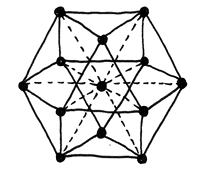
Diagram1 The second alternative is to adopt a foreign language, but one already tried and tested (the route of voluntary colonization or assimilation), or to accept a set of rules with which we are satisfied, but which actually come from another language (again colonization or assimilation by foreign rules), or we decide to create a new language on the basis of rules which have nothing in common with language as such (ex­‑territorial rules), and which experience has proved in another game (for example, gesture, machine language); that is, we set out on the road to experience, or nature.
1.3. According to a number of authors in this book, the critical, crucial absence of transformational processes or, as Immanuel Wallerstein more precisely defined it, the "transformational TimeSpace"2 of the second half of the 20th century was the non­‑existence of political vision, ideological or intellectual paths of construction (or Utopistics in Wallerstein's term), which would motivate changes in society and provide it with a perspective of meaning (leaving aside issues of nationality and racial struggles for self­‑determination).
The modernist project, which in its homogeneity—political and civilizational—culminated before World War II, after 1945 broke into two powerful antithetically operating currents. On the one hand was the constantly strengthening and developing modernization, civilizational and technical, which without precedent rules everyday life on the planet (its contemporary outcome is globalization); on the other, the bankruptcy and increasing crisis of the political project of modernism (communism, and so on). Contemporary modernity stands only on the civilizational pillar, which causes continuously repeated questioning and searching for a corresponding model of social order capable of giving meaning to civilizational development, a different meaning from just uncontrolled self‑directed motion. That naturally leads to many diverse experiments and reversals—to an archaeology of modernist unity, to attempts to resuscitate the original political project of modernism, to lyrical celebrations of revolution, to attempts to block the civilization of "progress," to the resuscitation of premodern utopias, and so on.
With the fall of communism, any possibilities for the political project of modernity definitively collapsed for the West, even just in its virtual form; and the prewar unity of the project was definitively lost, even though Western civilization is in such an advanced stage of modernization that it would not seem possible to secede from it. The West thus found itself at a critical point of the political construction of modernity.

Diagram2 The postcommunist states—which at an ideological level had been up to then the architects of this construction and the upholders for the future of the political project of modernity—renounced this role through their revolution. The reasons for the renunciation were not ideological but factual, practical, and empirical—their state systems were totalitarian, colonialist, or colonized, as well as imperialist, or directed by imperial interests. The question as to whether it is possible to separate the "idea of communism" from the totalitarian practices of the ruling power, from imperialist interventions, and from the colonialism of the communist state, is today a fundamental challenge to the future continuation of the modernist project in the political sphere. We feel that the issue of the future continuation of modernist politics must be presented only in dialectics between totalitarian practices of power (praxis) and ideas (ideologies), through which neither praxis nor ideology is capable of responding independently and at the same time fulfilling the moral and ideological requirements of its own complexity.
1.4. The civilizational progress and non‑totalitarian majority democracy of the West became the main vanishing point of the transformational dreams of the East. "Catching up with the West" was the main aim of the postcolonial countries in transformation. What was the reason for this fascination with the West? It seems that it represented not the West itself, but a fascination with the idea of a return to the natural order.
The revolutions of 1989 unfolded their subconscious imaginative legitimation in binary relationship to the Bolsheviks' revolution in 1917 (and the subsequent colonialist restagings of this revolution in the satellite countries after 1945). The revolution of 1917 was one which destroyed the old, unjust order in the name of a new. The revolutions of 1989 were ones which overturned the new order, which had degraded itself into totalitarianism ("Above all, no more experiments," "No more third ways"). It was a retreat from "experiment" (the "Communist experiment") to "normality," and thus from abnormality to normality, from experiment to balance, to order, to the standard. The political imagination of the revolutionary time revolting against the new, construed order clung to its opposite—a return to the old, to the natural, to spontaneous order.3
Diagram3 The metaphor we used of a revolution in language demonstrates another transposition—the principle of taking over ex­‑territorial rules for the creation of a new language. The right­‑wing political elites were convinced that ex‑territorial market principles (the economy) were a well­‑tried set of principles which would serve as the rules for the creation of a new social order (society) from scratch. The rapid results of this transfer of ex­‑territorial rules were the market economy and the privatization of society and of relationships in society, and this transfer found itself simultaneously at the center of polemics in the transforming countries.
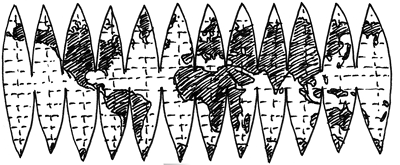
Diagram4 2.1. Everyone has an urge to look for the meaning of the historical, political, cultural, and social events, conventions, and stereotypes (the "Monster of History"), into which he or she has been thrown. We noted at the start that experience of the transformation in "Eastern Europe" represents an independent academic discipline. The region once known as Eastern Europe has an independent specificity in the context of transformational studies, a specificity with its origin in the post­‑World­‑War­‑II division of the world into spheres of interest at the Yalta Conference.
The division of the world by the great powers into West, East, and the Third World can no longer be mechanically accepted and used in the course of understanding the processes of cultural conventions, cultural production, and cultural representation in that region. An automatic acceptance of this division presupposes the recognition of the previously given great­‑power polarities in "cultural material"—cultural production is not looked at a priori as creation, as a contaminating semiosis, but as representative of the cognoscibility of the great powers' relationships of West—East—Third World (not to speak of the Fourth world). Therefore, in the course of examining the transformational processes, we tried to follow a path of searching for trans­‑local transformational specificities reflecting transformations in Greece, Spain, Portugal, South Korea, the Philippines, Indonesia, Chile, Mexico, and Argentina, in an effort to create a new, differentiated map of the world of transformation.
2.2. Our work on Atlas of Transformation took several years and had three phases. Its final form is the sum of this process, in methodology and in knowledge. We will not attempt to reconstruct our journey in the preparation of Atlas, not in chronology, theme nor linearity, because we believe that none of them has universal validity. The taxonomies are only proof of the asynchronicity and heterotopy of the processes of learning.
We have therefore organized the texts alphabetically. The book has a dictionary format, which makes possible the construction of antitheses in a non­‑linear form. Most importantly, for us as much as for the reader, it provides an opportunity to generate one's own trajectory from text to text, one's own uncanonized topography of thinking and ideas about changes.4
2.3. The first stimulus chronologically for the conception of Atlas of Transformation together with a series of exhibitions5 was the need to answer Kafka's question: "What's happened to me?"
We needed to formulate our (phenomeno­‑logical) experience with the world of revolution and transformation explicitly, to search for the boundaries between the role and thinking of an individual and movement in society, of passivity and activity; to search for keys which would give meaning to events in societies, imaginations, and transformations in which we were both passive and active actors. 1989: the Fall of the Berlin Wall or a Revolution? Were we a grain of sand in the sea of Gorbachev's perestroika, or did we take events into our own hands? 1989–2009: did we build a participative democracy, or did we establish supranational capital of the post­‑Fordist epoch? Where are the boundaries of causality between faith in a plural democracy and doubts about the free market?
Atlas later became a reservoir for us, an organism, a machine producing, construing, and de­‑construing knowledge from different fields. This phase could adapt itself to the object of study of the anthropologist, who later him/herself became an anthropologist studying, by an objectivist, depersonalized method, his/her own customs, rituals, and imagination in comparison with other material offered by science. This transfer of positions holds in itself a certain paradox, which evokes a particular measure of sensitivity and revision with a view to a strictly "empirical" description of any sort of theme or object of the humanitarian disciplines. The running of our machine producing knowledge was actually oiled by that sensitive transfer.
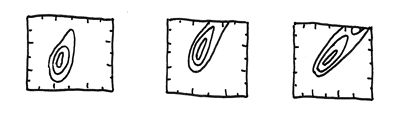
Diagram5 The third phase is the current phase—the confrontation of the return to our own primary experience, which was upset by a new theoretical apparatus in the meantime. The essentialization of primary or secondary knowledge does not seem to be sufficiently satisfying, and requires movement, urges one toward theoretical action or action theory, which both the preceding orders of knowledge contain, but which lead it into a continual instability of interchanges, antagonisms, and contradictions. As far as we would return to the earlier thesis of this text concerning the critical moment of the political construction of modernity, our requirement is not only to find an ideological way out of this crisis but also at once to set about testing it.
3.1. Atlas is an assemblage in which the individual components (entries) do not have their own set place—it is by reading that places are found for them. Just as an atlas begins with introductory maps, so the editors have experimented in offering at the beginning of the book a plurality of diagrams (of the body, machine, landscape, architecture/assemblage, and so on), creating schemes and models of relationships on how one can interpret and order the entries of the dictionary anew each time, but by a different method. There is no "main" diagram; none of them are above any others in the hierarchy. Their (non)spaces can interpenetrate on several levels and meet at several junctions. Each individual virtual assemblage originating in the head of the reader is possible and correct, because their number is not reducible or quantifiable.
3.2. We consider diagrammatic thinking to be part of visual recognition, as an interactive part of our reflections about the present and about changes. Our starting point is that the diagrammatic image offers an alternative (often subjective) semantic ordering of the entries and establishes new relationships and correlations on a primarily non­‑verbal basis between their often distanced points. These connections are not given in any essentialist way, but reveal themselves and become the basis for their subsequent theoretical verbalization. It is only in connection with portraying and visualizing them that the dictionary becomes a rhizomatic structure, confrontational, incomplete, and differentiated at the same time.
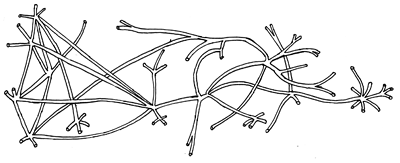
Diagram6 Neither the individual entries nor even the diagrams have an appointed, unified measure; we do not investigate entities only in their isolation, nor do we investigate macro approaches classifying groups of entities. We are aware that the encounters take place on numerous levels, which are not otherwise incompatible. The mixture that originated in this way is not attempting to be an analysis but an instrument for further exploration, a manual for the production of confrontational and antithetical interpretations.
3.3. Atlas consists of 233 items including texts (newly written, as well as a selection of previously published texts), artworks/illustrations and diagrams (newly created as well as borrowed). Each item has been filed under a specific entry. The list of entries was put together by the editors, the editorial board, and the authors of this book. The authors of the topically written entries knew the whole list of entries, but they did not know their content, so they could relate to them only as concepts without specific content. The key to the editors' choice of all the elements corresponded to the broad spectrum of motivations which characterize this publication. The purpose of this publication is the production of difference—in fields, methodologies, politics, dynasties, races, genders, etc.; the active representation of memory (and thus a process of return to the past motivated by the actual needs of the action); and the creation of possible alternatives of the future new order.
Atlas brings together a collection of empirical, symbolic, and critical texts from many academic disciplines—history, political science, art criticism, theory of criticism, literature, visual poetry, and verse—as well as a number of texts which were manifestos in their time. The point of this mass of fields is to create an autonomous space for reflection and the imagination so that it is possible, in the emancipatory movement from primary, objectivist, and engaged thinking, to proceed to activity. It offers themes for criticism, destruction, reflection, intellectual shifts, or imaginative conjunctions.
Zbyněk Baladrán, Vít Havránek
Note
1 / Franz Kafka, The Metamorphosis, trans. David Wyllie, EBook #5200, Project Gutenberg, http://www.gutenberg.org/etext/5200 (accessed April 12, 2010).
2 / Immanuel Wallerstein, Utopistics, The New Press, New York 1998, p. 3; and Immanuel Wallerstein, "The Inventions of TimeSpace Realities: Towards an Understanding of Our Historical Systems," in Unthinking Social Science: The Limits of Nineteenth­‑Century Paradigms, Polity Press, Cambridge 1991, p. 135–148.
3 / Peter Burke, A Social History of Knowledge: From Gutenberg to Diderot, Polity Press, Cambridge 2000.
4 / See Friedrich A. Hayek´s "spontaneous order" in The Road to Serfdom, 1944; The Constitution of Liberty, 1960; Law, Legislation and Liberty, 1973–1979.
5 / Titled "Monument to Transformation." 


An amazing web for an amazing book.

10/9/13

Taller Narraciones Caminadas a cargo de Antonio R Montesinos en la Unia


Taller del Centro de Producción y Experimentación en Contenidos Digitales de PCD-UNIA.

Desde el 7 de octubre al 17 de noviembre de 2013 impartiré el taller NARRACIONES CAMINADAS dentro del programa del Centro de Producción y Experimentación en Contenidos Digitales de PCD-UNIA.

Se trata de un curso semipresencial. Con una parte virtual y con apoyo de sesiones presenciales en la Sede de la UNIA de Málaga los días 11 y 12 de noviembre de 2013 (de 16 a 20 h).

La carga lectiva: 1,5 ECTS (45 horas). 

Durante el taller se creará una historia, y a la vez una cartografía, realizando una serie de paseos por nuestros espacios urbanos cotidianos. Lo real y lo virtual se aúnan para poder realizar una cartografía usando Google-Maps o OpenStreetMap como herramienta. Este plano interactivo se ofrece como guía alternativa de la ciudad, que reflejará los relatos personales y las vivencias de los participantes en el taller.

Presentación: 

Narraciones Caminadas forma parte de un proyecto personal del artista Antonio R. Montesinos donde se cartografían los espacios siguiendo las metodologías narrativas de los videojuegos de aventura gráfica, trabajando en torno a la narración espacial y utilizando el geoetiquetado.
El taller pone en relación la forma en la que exploramos y nos apropiamos de los espacios reales, o urbanos en este caso, y los virtuales. El planteamiento de la actividad es desarrollar un ejercicio lúdico de cartografía, utilizando el caminar y mezclando las formas de habitar uno y otro espacio (real y virtual), para elaborar una narración basada en micro-territorios y micro-realidades de nuestros entornos cotidianos.
Durante el taller se realizarán varias caminatas que después se cartografiarán con herramientas de geoetiquetado basados en el API Google Maps y OpenStreetMap.
Destinatarios:

Te puede gustar participar en este taller si te sientes interesado por los paseos, la psicogeografía, la cartografía otra, los micro-relatos, o la geografía. También a nivel técnico puedes estar interesado: durante el taller aprenderemos como funciona Google-Maps y cómo podemos agregar nuestros propios contenidos
Metodología:

El taller será de carácter semipresencial. Tendrá un total de 45 horas, equivalentes a 1,5 ECTS. De estos 37 horas serán virtuales y 8 presenciales.
La metodología que se seguirá es eminentemente práctica. Se proporcionará a los alumnos, por medio del campus virtual, diferentes recursos, se resolverán dudas y se realizarán ejercicios online. Los alumnos deberán realizar una serie de ejercicios prácticos y tutoriales que les darán capacidades suficientes para realizar el proyecto final. Así mismo, los alumnos realizarán una caminata o deriva por si entorno próximo. Este ejercicio de deriva se documentará y con los materiales recolectados se trabajará en las clases presenciales. Finalmente se comentarán los resultados obtenidos. Todo esto vendrá apoyado por un apoyo constante por medio del campus virtual, diferentes redes sociales y una web realizada específicamente para el taller, donde se podrá acceder a los materiales del curso y a los resultados finales de los alumnos
Programa y contenidos del taller:

1ª Semana (7 de octubre - lunes): Introducción teórica.
Explicación del trabajo de Antonio R Montesinos  y su relación con la práctica del caminar como construcción simbólica del espacio.
Explicación de diferentes conceptos relacionados con el proyecto: la deriva situacionista, la narración espacial, el geoetiquetado, la micro-historia, el arte locativo, etc.
Se comentará el trabajo de algunos artistas que trabajan entorno a la noción del territorio y diferentes formas de cartografía digital para desarrollar su trabajo.
 
2 ª Semana (14 de octubre - lunes): Arte y neocartografía.
Se comentarán nociones básicas de neo-cartografía y se repasarán algunos proyectos artísticos de mapeo on-line. También se repasarán algunas herramientas de cartografía on-line.
 
3 ª Semana (21 de octubre - lunes): Primer contacto con la programación.
Este bloque se dedicará a tomar contacto con las nociones básicas de programación html. Suficiente para crear un pequeño micro-site. Se explicarán 3 horas de html y 3 horas de javascript. Se facilitarán pequeñas plantillas para facilitar el trabajo.
 
4ª Semana (28 de octubre - lunes): Ejercicios prácticos.
Se indicará una parte teórica para la realización de un primer ejercicio práctico con Google-Maps. Se realizará un primer tutorial sobre como insertar Google Maps en tu sitio web sin programación y un segundo tutorial sobre como insertar Google Maps en tu sitio web con programación. Por último se realizará un tercer tutorial sobre como insertar y personalizar Google-Maps en tu sitio web.
 
5ª Semana (4 de noviembre - lunes): Primera deriva.
Se darán instrucciones para la primera deriva de cara al proyecto final. Los alumnos realizarán una caminata por el lugar que ellos decidan. Después se ordenarán los datos recolectados para su implementación en el microsite creado mediante los anteriores ejercicios.
 
6ª Semana: Clases presenciales.
1 Toma de contacto
(11 de noviembre - lunes - 16:00h a 20:00h).
Durante la primera hora se realizará una sesión de taller abierto para atender las dudas
y preguntas del alumnado. La hora siguiente se dedicarán a comenzar el proyecto final por parte de cada uno de los alumnos. Este último bloque se realizará como un taller abierto donde los alumnos trabajarán directamente sobre sus proyectos.
2 Proyecto final (12 de noviembre - martes - 16:00h a 20:00h).
Las dos primeras horas de este bloque se realizará como un taller abierto donde los alumnos trabajarán directamente sobre sus proyectos. Se dedicarán a los últimos detalles
y a subir el contenido a internet.
 
7ª Semana (18 de noviembre - lunes): Entrega.
La sesión estará dedicada a la finalización y entrega de proyectos, así como a cubrir dudas finales y a la evaluación.


Lugar de celebración:
Sede Tecnológica de la UNIA
Av/ Severo Ochoa 16-20, planta 1ª. Málaga Business-Park, Edificio Estepona,
Parque Tecnológico de Andalucía - Campanillas Málaga 29590.
La línea nº 25 de autobuses municipales conecta el Parque Tecnológico de Andalucía (PTA) con el centro de Málaga, con una frecuencia de aproximadamente cada 20 minutos. Horarios y tarifas.
La empresa privada Autocares Olmedo también realiza trayectos hasta el PTA. Horarios y tarifas.  
Precio y matriculación:

Precio: 30 €.
Plazo de matrícula: hasta el 20 de septiembre de 2013.
Matriculación y pago a través de la web de la UNIA (apartado Actividades Académicas>Cursos y Jornadas, en concreto, a través de este enlace).
Más información sobre matriculación en malaga@unia.es
Certificados:

Se otorgará un certificado de aprovechamiento a los participantes que superen los requisitos mínimos de evaluación del taller.