9/1/10

The Inheritance of Rome: Returning to the Eternal City


“Arcadian Landscape with Ruined Temple,”
(after Jan Frans Van Bloemen), engraving, F. Schroeder, c. 1825.


“Wax Intaglios and medallion casts,” Rome, c. 1800.

Una exposición que trata sobre la historia de Roma, la ciudad eterna, dónde se pueden ver estos estupendos grabados.

Topology of a future city


'Temporal bandwidth,' is the width of your present, your now. It is the familiar '[delta-] t' considered as a dependent variable. The more you dwell in the past and in the future, the thicker your bandwidth, the more solid your persona. But the narrower your sense of Now, the more tenuous you are.

[Thomas Pynchon. Gravity's Rainbow]

Topology of a future city proposes a speculative working group or workshop divining, describing and thus constructing a future city in ruins; a series of descriptive urban vectors extrapolated from ghosted electromagnetic, signal and literary traces.

Borrowing techniques from geophysical archaeology (revealing and mapping of geophysical properties), narrative displacements (filmic manipulations of temporality, science fiction), and coded psychogeographics (tracing signs of underground networks), Topology sketches a model for the future city flaneur.

Topology will encompass a series of Berlin-wide walks, interventions, discussions, and film/documentary screenings during Transmediale. Logging of specific physical and signal properties will be undertaken at chosen sites, forming the basis of a series of long-term, psychogeophysical studies within Berlin. Constructed maps and collated measurements are to be combined with fictional extrapolations from psychogeographic derive, using technologies of narrative displacement. The working group will be composed of four core researchers and six participants selected from an open call. Research is to be presented by the core artists and researchers during the Transmediale festival in the form of video documentation and a lecture or group discussion exploring this particular fiction.

Topology is situated within the context of an interdisciplinary mobile research laboratory initiated by _____-micro-research in 2010 and devoted to the use of free software and open hardware within the field of psychogeophysics.

Topology is kindly hosted as part of Transmediale10

Please apply here: http://www.transmediale.de/en/node/11051/


Más, aquí.

The record archive, in process; Dani Gal


The record archive, in process

Gal’s record archive is an ongoing project of collecting vinyl records that sound document historical events of the twentieth century.

The archive contains speeches and interviews by world leaders, wars in sound, peace agreements, human rights struggles and other radio broadcasts of the events that shaped history from the invention of the phonograph to the fall of the Berlin wall.

The phenomena of records that document political and historical events was popular from the 50’s until the late 80’s Most of the records had direct connection to propaganda and for the shaping of a national historical naratives.

The collection underlines how a society turns its historical events into commodities and how sound documentation functions in relation to collective memory.

Para ver más de Dani Gal.

7/1/10

The Found Photo


Más imágenes en The Found Photo.

"Sonic Outlaws" (1995); Craig Baldwin

_____________

_____________

Within days after the release of Negativland's clever parody of U2 and Casey Kasem, recording industry giant Island Records descended upon the band with a battery of lawyers intent on erasing the piece from the history of rock music.


Craig "Tribulation 99" Baldwin follows this and other intellectual property controversies across the contemporary arts scene. Playful and ironic, his cut-and-paste collage-essay surveys the prospects for an "electronic folk culture" in the midst of an increasingly commodified corporate media landscape.

"Gleefully Anarchic!" - Janet Maslin, New York Times

"Baldwin conceptualizes history as a lurid exploitation flick" - J. Hoberman, Village Voice

"Our sense of the shape of creativity and of originality must always be in question if we are to flourish. Sonic Outlaws does precisely that." - Chris Chang, Film Comment

Para verlo completo, ir a Ubu.

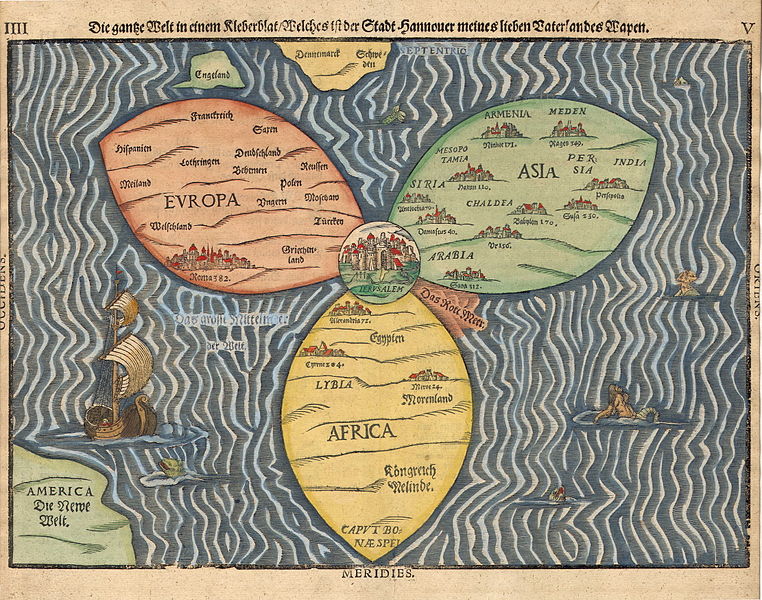
Más mapas: 1581 Bunting clover leaf map y Tabula Peutingeriana


Bünting clover leaf map. A woodcut made in 1581 in Magdeburg. Jerusalem is in the center, surrounded by Europe, Asia and Africa.

Desde la Wikipedia.


The Tabula Peutingeriana (Peutinger table, Peutinger Map) is an itinerarium showing the cursus publicus, the road network in the Roman Empire. The original map of which this is a unique copy was last revised in the fourth or early fifth century.[1] It covers Europe, parts of Asia (Persia, India) and North Africa. The map is named after Konrad Peutinger, a German 15–16th-century humanist and antiquarian. The map was discovered in a library in Worms by Conrad Celtes, who was unable to publish his find before his death and bequeathed the map in 1508 to Peutinger. It is conserved at the Österreichische Nationalbibliothek, Hofburg, Vienna.

También desde la Wikipedia.

6/1/10

Reanimation library


The Reanimation Library seeks to assemble an inspiring collection of resources that will facilitate the production of new creative work and promote reflection and research into the historical, legal, and methodological questions surrounding the adaptive reuse of found materials. It strives to provide the necessary space and tools to allow these activities to flourish, and to foster a climate of spirited collaboration.


(...)

In our culture, libraries have the special privilege of dictating which published materials are deemed culturally worthy and worth preserving. To a degree, those materials that are kept within a collection are important and those that are removed are not. Books and other materials are removed from collections for a variety of different reasons: space is in short supply, materials become physically worn, information becomes outdated, and new editions are produced. Whatever the ultimate reason for the de-accession of an item, one result is that a tremendous amount of printed material disappears from the public sphere of information when it exits the library.

Of particular interest to the Reanimation Library is the loss of visual information that occurs during the aforementioned process of weeding. Even though text is often accompanied by images, collection development policies generally assign little weight to the graphic dimension of a work, unless that work happens to be graphically driven (i.e. a book on a visual artist, graphic design, or an atlas). Most library collection development policies place priority on acquiring items with current textual information and replacing items where that information is lacking or outdated. This priority, coupled with the continual production of new editions as fields of knowledge evolve, create the growing fossil record of outdated books—a veritable feast for image archaeologists. The Reanimation Library is committed to building a collection of materials that are rich in visual information, regardless of the currency of their textual information. The Library serves as a repository and, more pertinently, an access point for such materials.

Contemporary cultural production often draws upon earlier cultural materials. Artists, historians, writers, musicians, and scholars all build their creative and intellectual work on the images, ideas, words, and sounds of previous generations. Pastiche, collage, and sampling are fundamental tools of our creative vocabulary. The Reanimation Library presents a fertile environment for patrons who wish to participate in these creative processes. Shiyali Ramamrita Ranganathan's first law of library science states that "books are for use." Through the belief in and promotion of the idea that a book's intended use is not its only use, the Library reanimates books that have, for whatever reason, fallen out of use.

Más en Reanimation library