Society and Space 30th anniversary lecture. Royal Geographical Society annual conference. University of Edinburgh. 3rd July 2012


27/5/14
Interview with Eyal Weizman by Michael Schapira and Carla Hung
Eyal Weizman is the director of the Centre for Research at
Goldsmiths University in London, a co-founder of the architectural
collective DAAR (Decolonizing Architecture Art Residency) in Beit
Sahour, Palestine, a member of the Human Rights Project at Bard College
in New York, and an editor-at-large for journals such as Cabinet,
Humanity, and Inflexsions. Whereas such a wide range of activities might
lead to a diffusion of thought for some, Weizman’s work reflects an
uncanny ability to draw surprising connections from fields as diverse as
humanitarian law, Deleuzian spatial analysis, military strategy, and
aesthetic theory.
We spoke with Weizman from his home in London on the occasion of the US release of his latest book, The Least of All Possible Evils.
The conversation takes up his recent work on “forensic architecture,”
the role of the image as a unique form of persuasion, and the importance
of how we understand humanitarian crises old and new.
Michael Schapira: I first came across your work in a 2009 BookForum roundtable, “The New Geography,”
with Tom McCarthy, Jeffrey Kastner, and Nato Thompson. What struck me
about your contribution was the ability to make abstract notions of
geopolitical import very concrete through a set of micro-examples, such
as the construction of buildings or the staging of legal tribunals. This
approach was developed to great effect in Hollow Land and
subsequent books. I’m wondering if focusing on these small examples to
illuminate broader political or philosophical themes comes out of your
training as an architect, and how this kind of thinking maps on to
different domains in which you engage, such as legal or political
theory?
Eyal Weizman: I would say that my approach to the built environment,
to politics and to the law is like that of a forensic architect, which
is a subject that I both problematize and develop. This might be so in
two senses: the first is obvious — my work on mapping the West Bank and
the architecture of colonies was used in international courts, as we
were trying to criminalize acts performed on drawing boards.
On the other hand, as a methodology of research I would say that Hollow Land
is constructed like a set of archive probes. These two approaches are
based on a belief that geopolitics, as well as economic, or military
processes, emerges out of a fabric of multiple interactions that can be
reconstituted by close observation. As an architect, my attention is
naturally directed at material organization and form — sometimes large
territorial transformations and sometimes architectural details. Often
the two are connected, as new details and technologies exercise large
effect. But the relation between the architectural level and larger
contextual forces is complex.
I am not sure we can speak any longer about scale though; the
analysis of territories does not happen at a different scale than that
of a single building block, say, as each is assembled through complex
networks and forms of practice that extend far and wide. It is the
meaning of its density and intricacies that matter: where does knowledge
and material arrive from, what economies do they partake in, what can
be assembled by a multiplication of this element, etc.? These multiple
ways of unpacking an object or a spatial condition is what poses the
greatest challenge to forensic architecture as a form of analysis. Of
course, I do not mean forensic architecture in the sense sometimes used
to refer to those surveyors doing court work for the insurance industry,
but as a mode of analysis that extends the scope of what architecture
can do in the world today.
In Hollow Land I discussed the transformation in the use of Jerusalem stone
over the modern history of the city. It shifted from being a structural
element used in 40-30 cm blocks in the Ottoman period to being a mere
cladding detail of about 5-7 cm today. This happens through a set of
legal transformations that take place during the British, the Jordanian
and the Israeli occupation periods. When the city expanded — also into
occupied territories — the stone cladding, mandated by law within the
city, started to mark out its shifting boundaries. Serial type
concrete-structured homes in neighborhoods far away from the historic
city in areas annexed to it could now be presented as part of the ‘holy
city’ of Jerusalem.
I can’t get into more detail regarding this example now, but this is
just to say that it might demonstrate the kind of connections unfolded
by following the networks of relations folded into materiality. The
observations in Hollow Land are mostly structured around such
readings. There are mobile phone antennas that become involved in the
construction of outposts; there are roofing details that function
politically. I try to discuss military technologies that contributed to
strategic change. I would say that my approach would be to always start
with a ferocious and detailed examination of material reality as an
attempt to unfold larger force fields and networks of relations that are
folded into it.
I think that there are some ways in which what I call architecture —
the organization of matter across space — could be seen as a sensor to
those forces that shaped it. Space is a political plastic, in the sense
that its materiality is continuously shaped and reshaped by those
political forces. At the same time, I would also add that the way that
political force is folded into material form is never linear,
mechanical, and direct.
Architecture should thus better be seen as a weak sensor.
It’s not as calibrated as a mercury-in-glass thermometer in that its
relation to the phenomena is not linear. So it’s a kind of sensor that
we need to be very attuned to in order to understand, to read, to
interpret, to debate, and to weave what I hope will be ever more
complicated networks of practices and their interaction with
materiality. This process of interpretation and debate is based on the
weakness of architecture as a sensor: forensic architecture needs the
forum precisely because its findings are ambiguous.
Schapira: One issue you discuss in The Least of All Possible Evils
is attaching a different significance to forensics, looking at the term
in light of its shared entomological inheritance with the forum, which
is a place of debate and the site of legal decisions where evidence
would be put forward. There is now an aesthetic dimension to this — the
image has emerged with a new force as a form of persuasion. I’m
wondering if you can speak more to your reading of forensics, and
perhaps link it with the recent work you’ve done on forensic aesthetics.
Yes, I divide the work on forensics to “fields” and “forums.” Forensic Architecture is grounded in both field-work and forum-work;
fields are the sites of investigation and analysis and forums the
political spaces in which analysis is presented and contested. Each of
theses sites presents a host of architectural and political problems.
In fields, lets say starting with Territories,
I attempted to engage a kind of “archeology” of present conditions as
they could be read, or misread, in architecture. This archeology is not
always undertaken by direct contact with the materiality under analysis,
but with images of it. The spaces that we debate, analyze, or make
claims on behalf of, are very often media products. Similarly, drawing a
map includes synthesizing satellite and aerial images as well as images
from the ground. Some images are created by optics and some by
different sensors that register spectrums beyond the visible. One needs
sensors to read sensors.
So this is a kind of archaeology of spaces as they are captured in
these different forms of capture and registration. You read details,
speckles, pixels and patterns, connect them to larger forces, or at
least you understand the impossibility of doing so, often noting
paradoxes and misrepresentations. We have done this very close reading
of aerial images of colonies in the West Bank, we have read almost all
elements from architectural through infrastructural archaeological to
horticultural ones visible in these images as a set of tools in a
battlefield.
Then there is the forum: a site of interpretation, verification,
argumentation and decision. International courtrooms, tribunals, and
human rights councils are of course the most obvious sites of
contemporary forensics. But there are other political and professional
forums.
Each forum is different. The third component of forensics, beyond the
architectural and aesthetic, is what you need in order to stand between
that “thing” and the forum: an “interpreter.” In ancient Rome it would
be the orator; in our days it is perhaps the scientist, or the
architect, or the geographer — the “expert witness” that translates from
the language of space to the language of the forum. This definition of
forensics might help expand the meaning of the term from the legal
context to all sorts of others. Politics, as it is undertaken, around
the problems of space and its interpretations, is a “forensic politics”
as far I understand it.
Each of the multiple political and legal forums in use today —
professional, scientific, parliamentary or legal — operates by a
different set of protocols of representation and debate. They each have
another frame of analysis. Each embodies dominant political forces and
ideologies — that is to say that each instrumentalizes forensics as a
part of a different ideological structure. In the turbulence of a
changing world, there are also informal, subversive and ad-hoc and
crisis forms of gathering: pop-up assemblies of protest and revolt in
which the debate of financial, architectural (the housing or mortgage
crisis), and geopolitical issues are often articulated.
Forensic architecture should thus be understood not only as dealing
with the interpretation of past events as they register in spatial
products, but about the construction of new forums. It is both an act of
claim-making on the bases of spatial research and potentially an act of
forum-building.
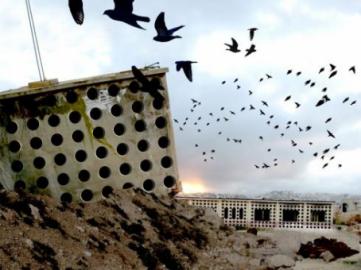
Click images to enlarge.
Carla Hung: This interplay between subjectivity and objectivity has become increasingly important in your work. In The Least of All Possible Evils
there is a moment when the Israeli Wall is being put on trial and not
its architects. So the object is demanding a subjective responsibility
to interpret it in different ways. Is there a displacement of the
subjective person as witness when we start focusing on objects, and is
there also something to be gained by the truth finding of an objective
witness compared to a subjective one?
Here I should return to the other part of your previous question
about “forensic aesthetics” to lead onto the very important point you
raise. Forensic aesthetics, something that Tom Keenan and I developed in
our work on Mengele’s Skull is linked to the notion of decision.
Decision is important in a forensic process because it needs to
determine a debate that can never be conclusive, that is always a matter
of the balance of probability. Just like in a legal case where “beyond a
reasonable doubt” or other measures of probability await a decision or
conviction — a term that combined a guilty verdict with a sense of
constructed belief. Different fields — science, law, and politics — have
different mechanisms for making decisions and checking them.
Forensic aesthetics is in our opinion the way in which the
presentation of a case, by all sorts of techniques of presentation,
gesture and theatrics, allows a particular fact to be made and then a
decision to be undertaken. Decisions may be partially based on the
aesthetics of evidence, in the sense of the way that things appear, but
they imply responsibility because the decision is followed by an action
with consequences.
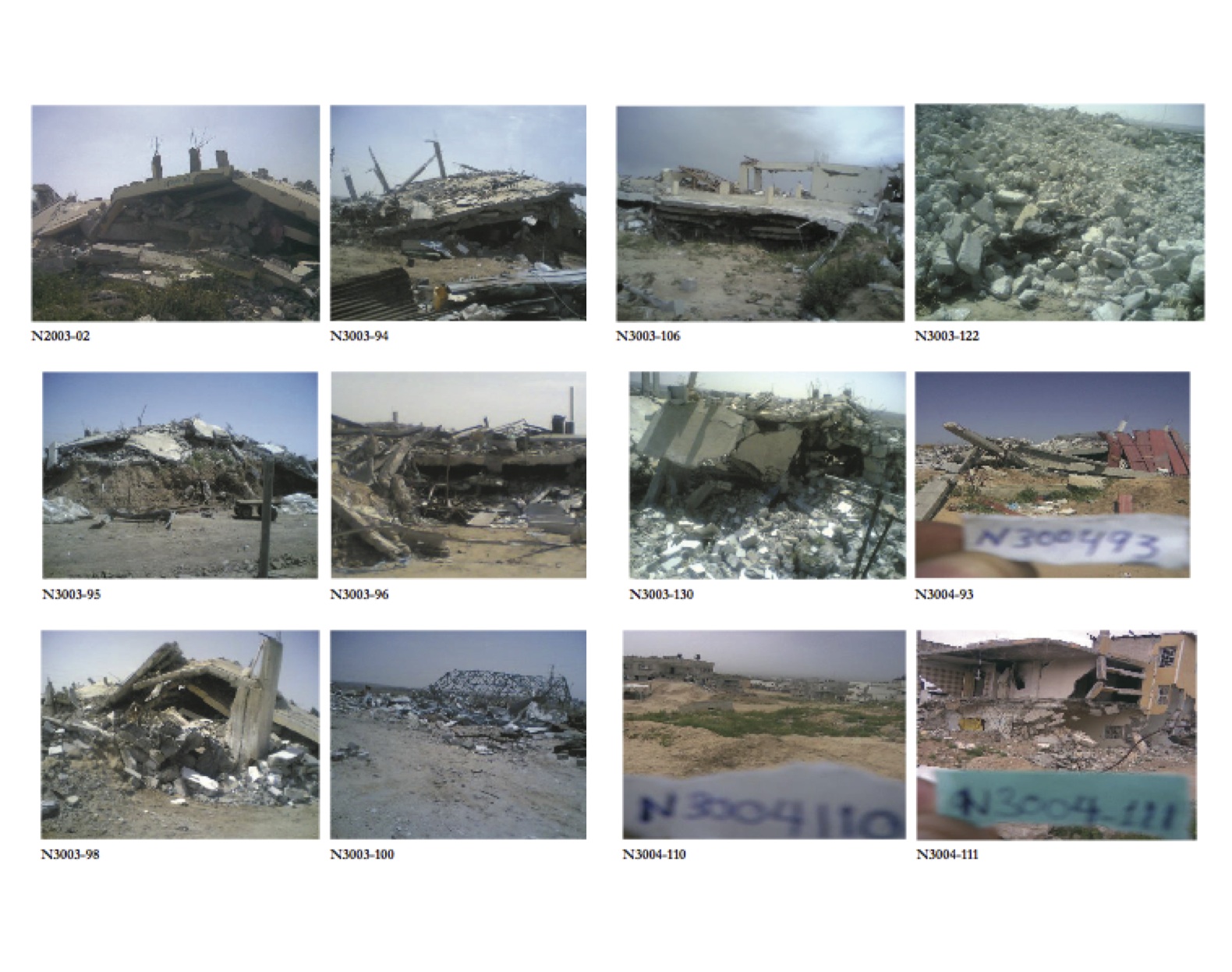
But now the question is what kind of evidence we are talking about,
and here your question about human or non-human, subjective or objective
is important. We looked at an aspect of the history of trials of
international humanitarian law, the laws of war, which sometimes
intersects with the history of criminal law and the techniques and
technologies of forensic science, policing work, and testimony in its
service, but also has its unique genealogy.
In our opinion, very broadly speaking but somehow usefully, you can
divide the history of international law trials into periods in which
different types of evidence were in the foreground. In most legal codes,
evidence is divided into: documentary, testimonial, and physical.
Although, of course, in all cases we observed complex entanglements
between these, at different times, a different form of evidence is being
most structural to our understanding of the event in question, with
aesthetic, political, and ethical consequences.
For example, in the immediate aftermath of WWII Robert Jackson
prosecuted the Nuremberg trial mostly on the basis of documents. Having
just gained an enormous trophy of millions of documents, he engaged in a
certain archival frenzy and tried to base his prosecution strategy on
the words of the German leadership as written in the documents that
circulated through the Nazi state’s nervous system.
There was a fear in involving the survivors themselves, who were
still seen as barely partners for a professional legal process. There
were a lot of displaced people in Germany, survivors, whom he could have
spoken to, but they were seen as unreliable at best, barely humans at
worst. The trial focused on the mechanism of government, decision making
— in a sense of what can be seen in it and learnt from it — it
concentrated on the people at the top and their responsibility for state
actions.
In the 1961 Eichmann trial, the first transformation occurred where
those witnesses who were more or less banned from Nuremberg were taking
center stage. As Arendt correctly objects, most have not directly met
Eichmann. But there was a political attempt by the Israeli state to
enact a kind of national and international pedagogy. This introduces the
victim for the first time and therefore starts what scholars call the
“era of testimony” or the “era of the victim.” The methodologies of
humanitarianism and human rights were enormously influenced by this
introduction of the victim/witness into the methodologies and
epistemologies of international law.
Testimony started appearing not only as an epistemic frame to learn
about things and situations, but also as an ethical, political, and
aesthetical one. To take the side of the oppressed, history was more
receptive to aural traditions, etc. Human rights groups adopted
testimonies of individuals as their main methodology. And through
testimony they demonstrated their support of liberal values of free
speech in taking the side of individuals against repressive
“totalitarian states” as the socialist eastern bloc started being
referred to. Humanitarian groups like MSF (Médecins Sans Frontières)
politicize themselves by adding témoignage to medical aid
starting in the early 1970s. Testimony reframed the way in which we saw
and understood the world in front of us: a world of victims.
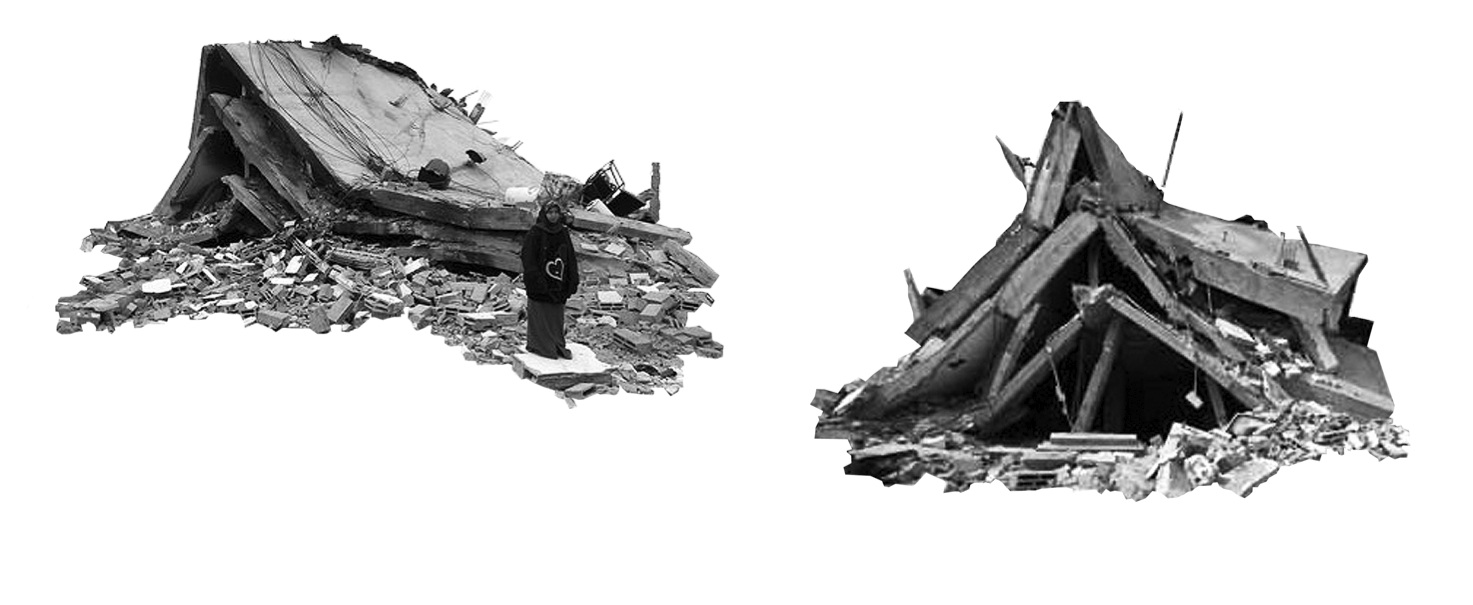
The current shift in emphasis to science, to image analysis, to
materiality, to space is not new: since the industrial and scientific
revolution of the mid-19th century, physical evidence has
gradually become more important. But it hasn’t had such a large effect
on human rights and international law until recently. Something
important has shifted with the self-proclaimed scientific ability to see
more and more data in the physical world, a virtual explosion of
information. Expert witnesses emerge in HR contexts, ex soldiers testify
about the effect of weapons and ammunitions, pathologists replace
interviewers, etc. Although of course testimony is still going strong,
the entire aesthetic field — what is visible, what counts, what is
important to look at, what can be seen, what we put our attention to —
has shifted with this shift in sensibility and new relationships are
formed between testimony and evidence.
This is something that is increasingly reflected or echoed in popular
entertainment. If the psychologist as detective was the embodiment of
the psychologizing era of the witness, the forensic detective is the
popular hero of our time of material investigation.
Hung: If the current drive to materiality and forensic
analysis has penetrated law, humanitarianism, and even aspects of
popular entertainment, has something similar occurred in the news media
as well?
Very often you can see on the front or on the second page of the New York Times satellite images of some “suspected nuclear facilities” in Iran, say.
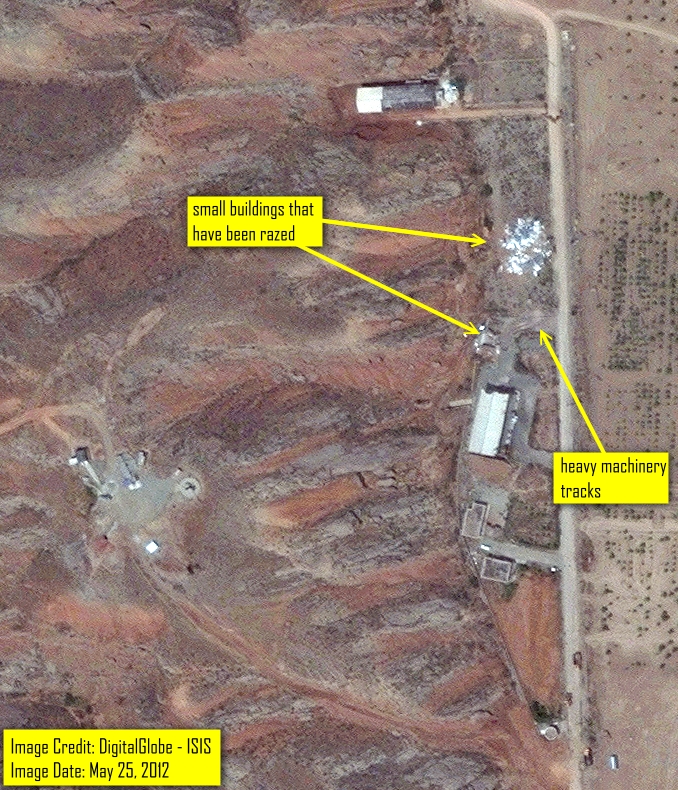
But we can also see the spread of on-the-ground videos shot on cell
phones. The remote imagining of satellite imagery, captured at a higher
altitude than the vertical extension of state sovereignty (national
air-space is cupped by the lowest possible orbit a satellite can travel
upon) now intersects with video activism, filmed and uploaded at close
range at the risk of their makers. In a recent lecture, Rabih Mroué
showed footage from cameras of people being killed while holding the
cameras. For the people filming at the risk of their death this is
obviously a heroic act of truth-telling, but the technologies and cycles
of their availability allow these images to circulate and respond also
to a host of other interests.
So the entangled, or almost simultaneous emergence, of these two very
different forms of media demonstrates the growing appetite of many
international organizations to arbitrate on situations unfolding in
areas hard or impossible for them to access. These technologies allow
alternative political groups, advocates of human rights and also
policy-makers to circumvent state restrictions on data circulation.
Their intersection also transforms the way we interpret the consequences
of violence and experience the sufferings of people far away from us.
When crisis occurs, or is expected to occur, state, UN, or
commercially operated satellites (the latter hope to sell their images
to states or private organizations) start photographing “regions of
interest” around “areas in risk” in higher frequency and at higher
resolution. Because there is a time lag between runs, the act of
violence or destruction is often missed. This is the reason that
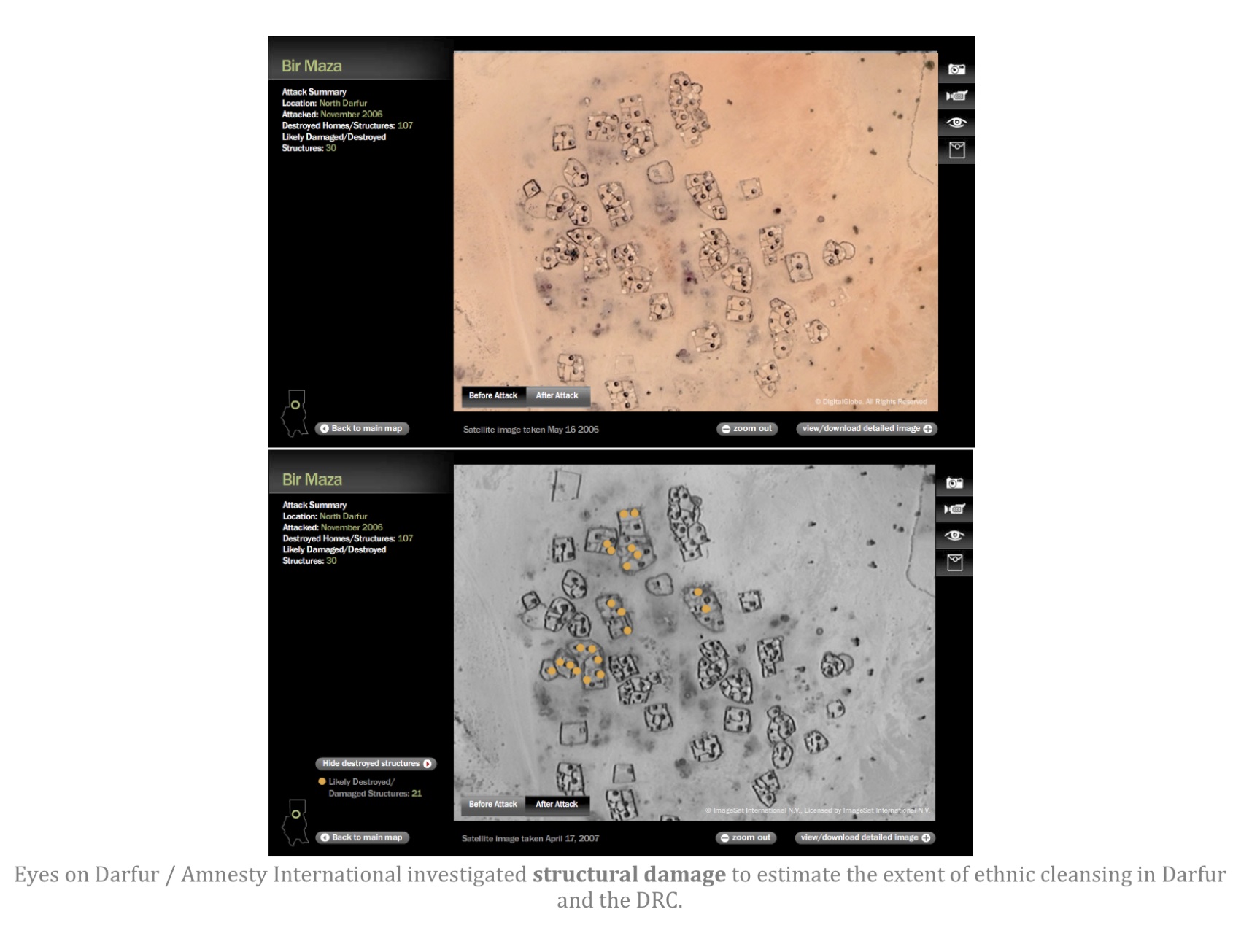
satellite imagery is often presented in “before and after” sequences. To
a great extent before and after images are the very embodiment of an
emergent “forensic time.” While activists’ videos capture the event
itself, the stereoscopic montage of before and after leaves a lacuna at the heart of the event.
In these forms of media, the built environment is seen as the
depository of political events. But can we read and interpret events
from images of trash and rubble? Does a freshly dug out earth mound in
eastern Iran signify — as claims made in its name — the construction of a
new subterranean bunker in which banned weapons are produced? Could we
directly connect earthworks and nuclear process? Does a similar earth
mound now captured by satellites orbiting over Libya, Syria, Darfur or
Sri Lanka signify sites of mass inhumation in common graves? Was a
destroyed building, visible in an “after” photograph, destroyed by
people from the ground, or by their enemies in an aerial attack? Can
satellite-mounted radars, heat sensors, and thermal imaging, capable of
registering wavelengths beyond the visual spectrum, detect the
fractional temperature variations of changing vegetation patterns in
previously cultivated fields, now falling foul in absence of their
farmers? Can genocide, ethnic cleaning and other crimes against humanity
be indeed confirmed by visualizing the invisible ranges of the
spectrum?
Now there is a lot of testimony from Darfur, but this is not what we
want to hear. We want to see the evidence. I think the implication of
this is that there is a certain silencing of testimony; it’s overpowered
by evidence. Another example can be seen in Gaza when the Goldstone
report shifts its methodological balance from testimony to physical
evidence like pathology, weapons studies, and forensic architecture
performed on damaged buildings. What they are saying in fact is that we
cannot listen to or believe testimony in Gaza from the Palestinians —
because they are politically manipulated by Hamas. ….
So very often we have situations where testimony is not mobilized in a
way that it should be, as a kind of intertwined assemblage of
conversation between the material and immaterial, between human and
non-human, between the subject and the object. Rather the object starts
taking the place of the subject, and when it takes it a lot of other
things happen.
Schapira: You see another aspect of this right at the beginning of The Least of All Possible Evils.
There is photograph of a man explaining a complicated equation on a
white board, and we learn that this equation is meant to mathematically
demonstrate how Hamas can be dismantled by killing key operatives. This
adoption of a supposedly more scientific or objective point of view is
meant to render judgment and tactics more reliable. I’m wondering if
perhaps this new moment in humanitarianism and the prosecution of war
that operates under these forms of calculations has more of an effect on
the practice of these interventions, or how we understand them?
In a shift to materiality the object can emerge always and only as an
object of calculation. These are questions of numbers, and questions of
numbers operate in relation to thresholds. Does the death and
destruction caused in Gaza amount to war crimes? To violations of human
rights? To crimes against humanity? Technically these are not only
quantitative but qualitative questions, but they are influenced by
figures.
War itself becomes increasingly a matter of calculations the more
computered and “smart” the military hardware becomes. Violence is of
course unpredictable but, allergic to indeterminacy as militaries are,
there are ongoing attempts to harness this chaos into calculations. The
next stage after that of smart weapons was the development of techniques
of damage calculation — how much destruction targeted explosions might
cause. It is an “art form” that combines blast dynamics with structural
engineering. There is software — today it’s called Fast Collateral
Damage (FAST-CD), before it was called “Bugsplat”, this horrible title —
for calculating civilian casualties.
Once militaries can present themselves with estimates regarding the
number of casualties — although these could be widely wrong — they have
to make decisions in relation to this predicted number. Legally — and
militaries have to increasingly operate in a legal environment — they
have to justify this level of death by conjuring an economy that is
organized around the legal principle of proportionality. In the
beginning of the Iraq War the proportionality calculations of the
Pentagon allowed the killing of up to 29 civilians for every
political/military leader.
I think that this teaches us two things about the contemporary use of
humanitarian principles. One is on the level of justification. We know
in the context of the Libya intervention that there were geopolitical,
economic, and migratory interests of European states to change the
regime, and they tried to give the war a humanitarian justification. The
other level is that humanitarian law enters the logic of the very
organization of violence — how violence is structured, dispensed,
distributed, etc. Both aspects must be avoided at all cost!
Schapira: This is a more general question, I guess again
about method, but more particularly about your use of theory. Some
people will dismiss high theory as being inapplicable to experience or
an over-jargonized form of academic discourse. Yet by looking at the
training of the Israel Defense Forces (IDF) you show how some of these
theoretical insights find uptake in very concrete military strategies —
e.g. inverting urban space by moving within buildings as opposed to in
the streets. Do you think that even if people are dismissive of certain
theorists, they are nonetheless marking something like a saturation of
thought that eventually does find its way into practice? For example,
you just mentioned the use of smart technology in things like drone
strikes. Might this have to do with issues of territoriality, or people
talking about the decline of sovereignty in the nation-state?
I think that there is a kind of co-evolution between the production of concepts — if this is what philosophy is after Deleuze
— and practical experience on the level of politics, the military, or
the level of resistance. Concepts are most often produced as an
entanglement of practice and thinking. The case of OTRI (Operational
Theory Research Institute) that I wrote about in Hollow Land is
almost a caricature of the way in which some very basic readings of
Deleuze structured forms of maneuver. But more than that they function
as the introduction of a new language into the IDF that is aimed to
change hierarchies of command within it.
Today the frontier is elsewhere: new optical and imaging
technologies, new modes of analysis and interpretation, give rise to new
political concepts. I think that’s a part of the forensic imagination.
New imaging technologies connect to the geopolitics of state borders,
both by state agents and their militaries and by civil society trying to
reclaim these tools itself. It is between those scales — geopolitics
and image production — that I see my work operating, both as a critique
and as a form of involvement in that field of the production of images
in relation to conflicts.
20/5/14
10/4/14
3/3/14
Everything is Collective


Everything Is Collective
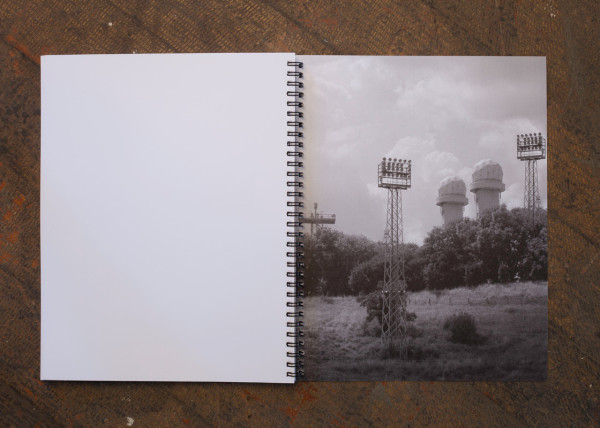
Work from Deliberate Operations 1 [2].
“‘DELIBERATE OPERATIONS reflects the EIC’s view of how it conducts considered and sustained operations in space and sets the foundation for developing other fundamentals, tactics, techniques, and procedures. These operations are designed and/or spontaneously realized to reveal or conceal certain features of the environment. This volume serves as a record of those interactions and a guide to other practitioners…” – Everything Is Collective
1/3/14
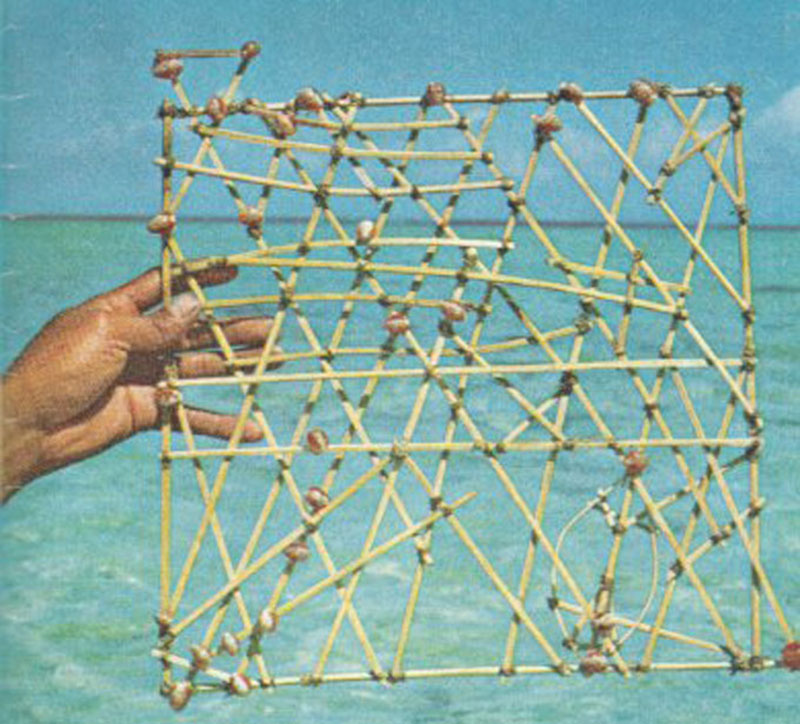
Sculptural Cartography: How The Marshall Islands Inhabitants Used Stick Charts to Map the Waves
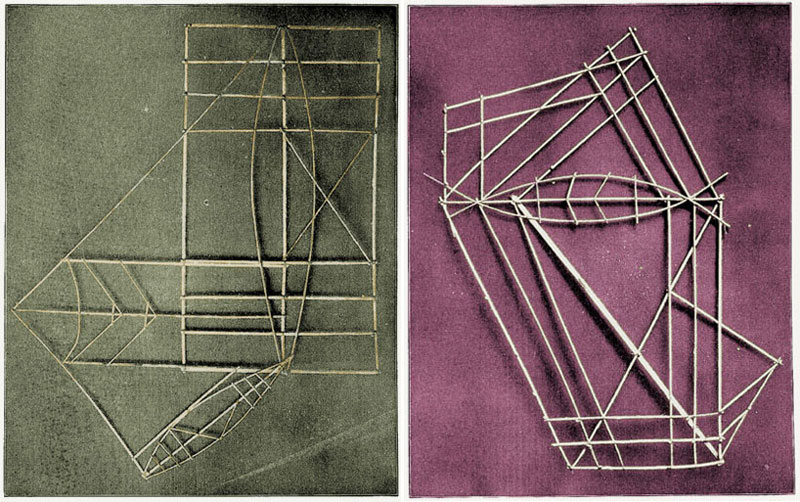
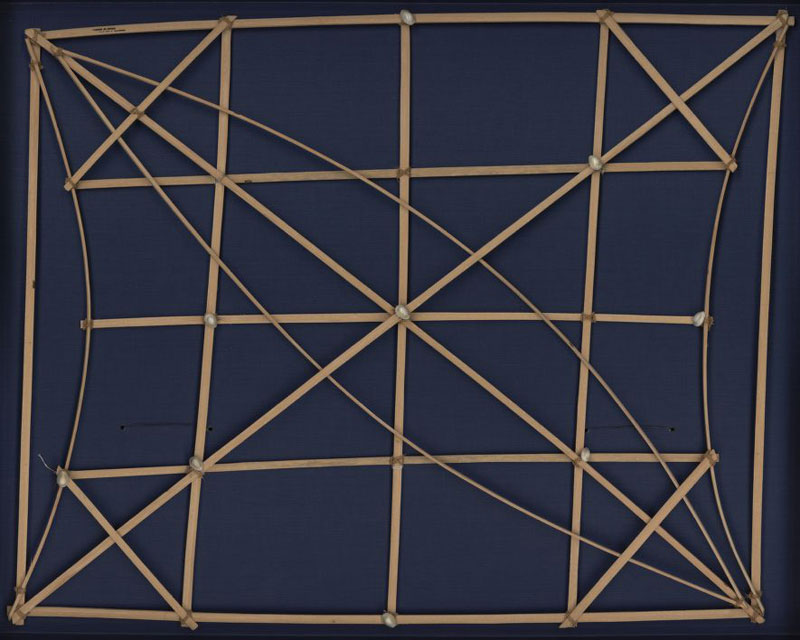
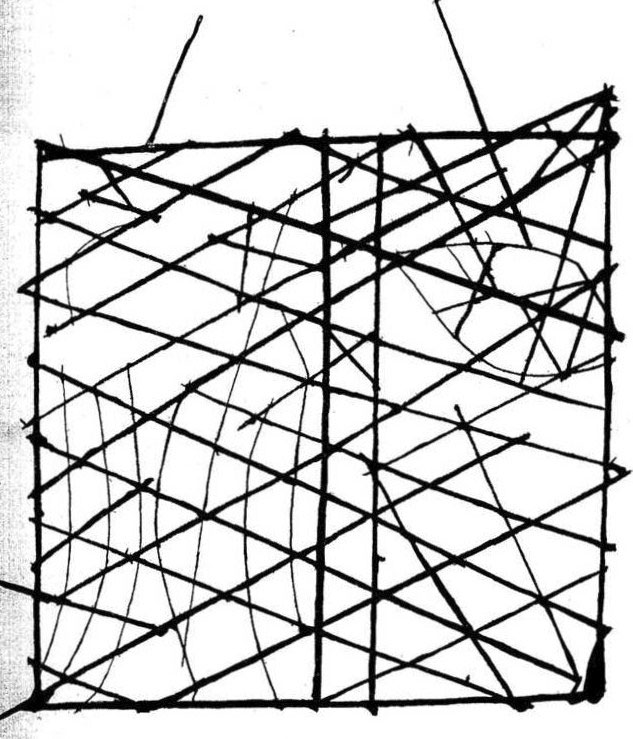
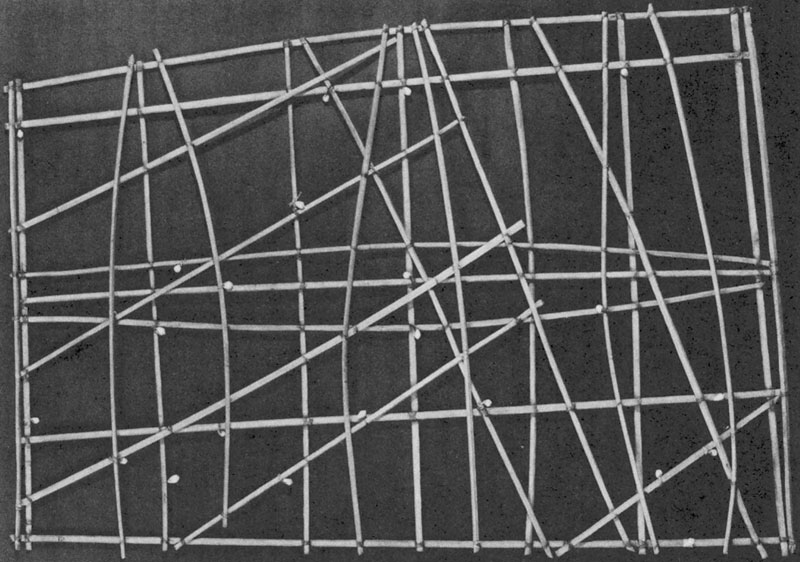
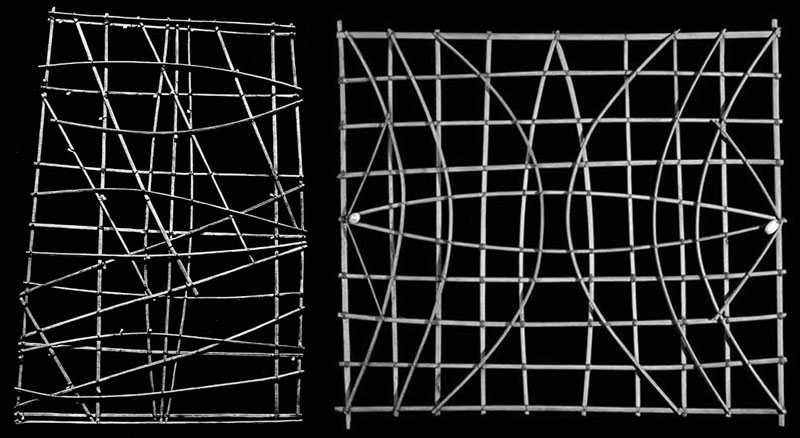
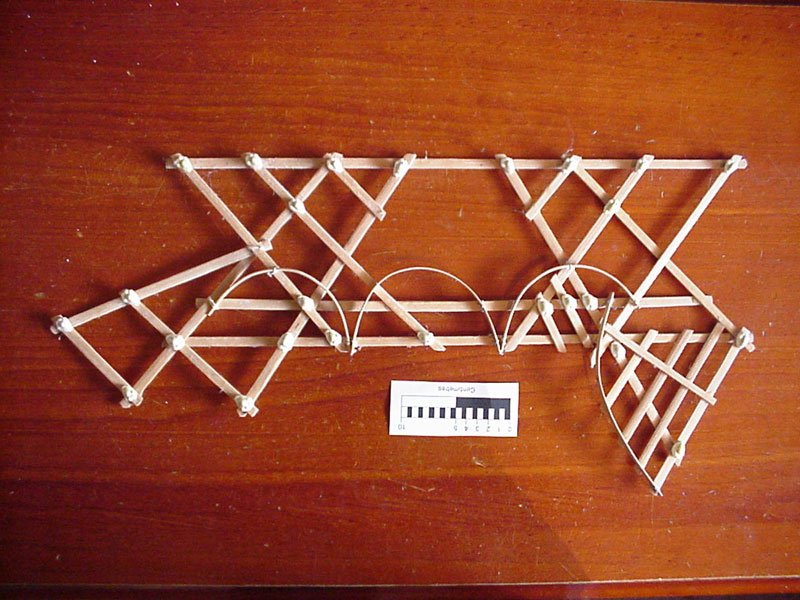
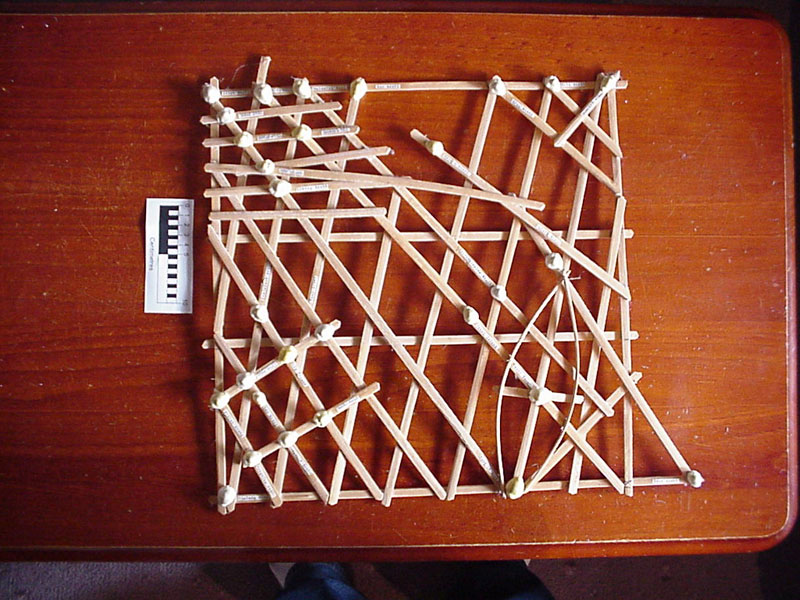
The stick charts were the main tool the Marshallese used to navigate on canoe across the islands of the Pacific Ocean, until WWII. Lacking astrolabes, sextants or even a compass, they would rely on maps made up by midribs of coconut fronds tied together to form an open framework. The location of the islands was represented by shells tied to the framework or by the lashed junction of two or more sticks. The threads were used to map ocean swells, the prevailing ocean surface wave-crests and the directions they followed to approach an island. The stick charts represented a very interesting form of cartography encoding informations not traditionally included in navigation maps.
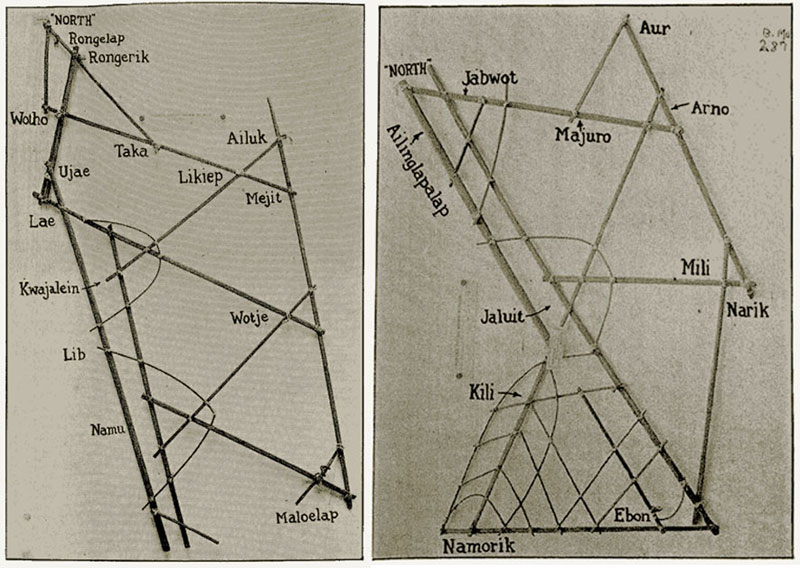
Each chart stick is unique and was made by an individual navigator who was therefore the only person able to fully interpret and use it. The maps were not taken along during navigation, but studied and memorized prior to a trip. The Marshallese navigator would crouch down or lying prone in the canoe to feel how the hull was being pitched and rolled by underlying swells.
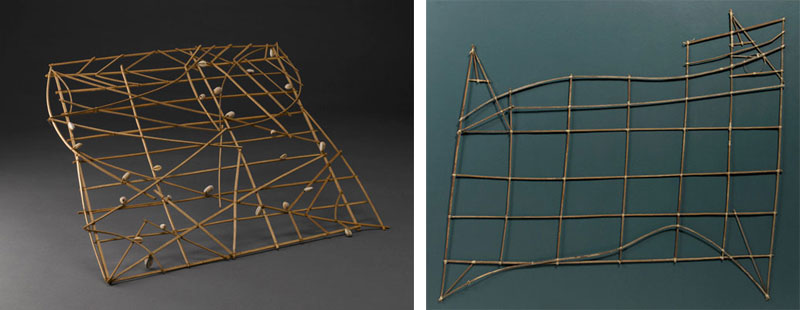
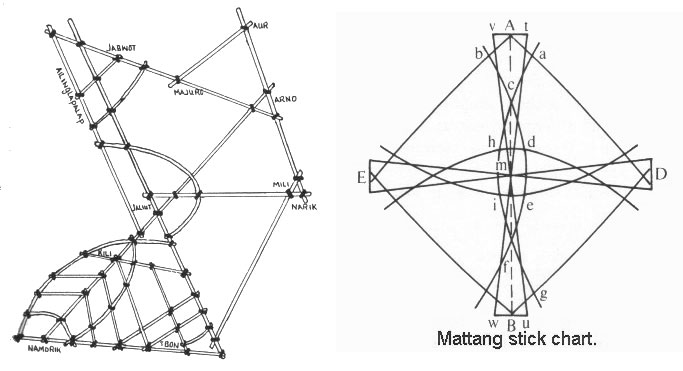
There are three main categories of stick charts: Mattang, Meddo (or Medo), and Rebbelib (or Rebbelith).
The Mattang stick chart was an abstract chart used for instructions and for teaching principles of reading how islands disrupt swells.
The Meddo chart showed actual islands and their relative or exact positions.
The Rebbelib charts portrayed the same information as a Meddo chart, but unlike them, included all or most of one or both chains of islands.
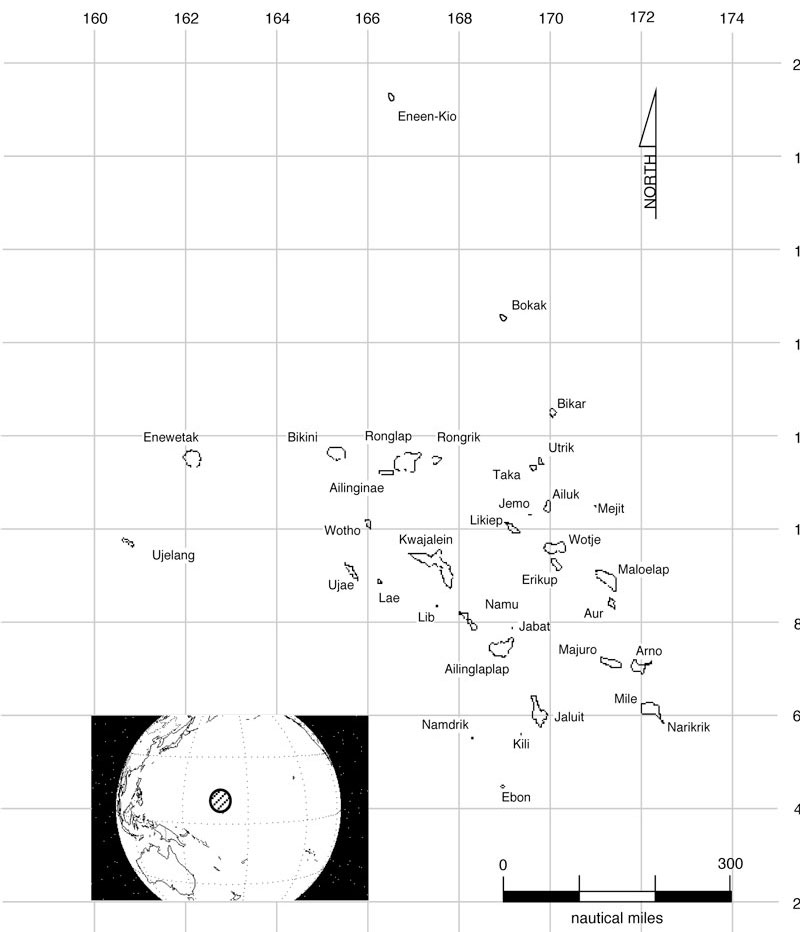
Map and Global Position of the Marshall Islands
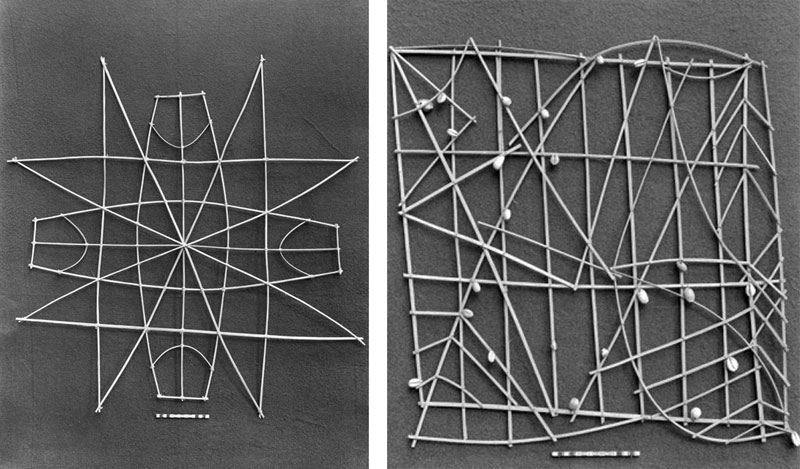
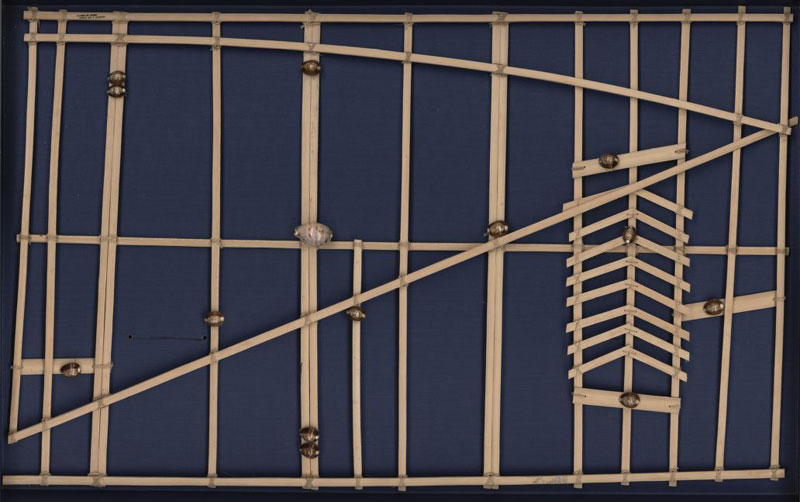
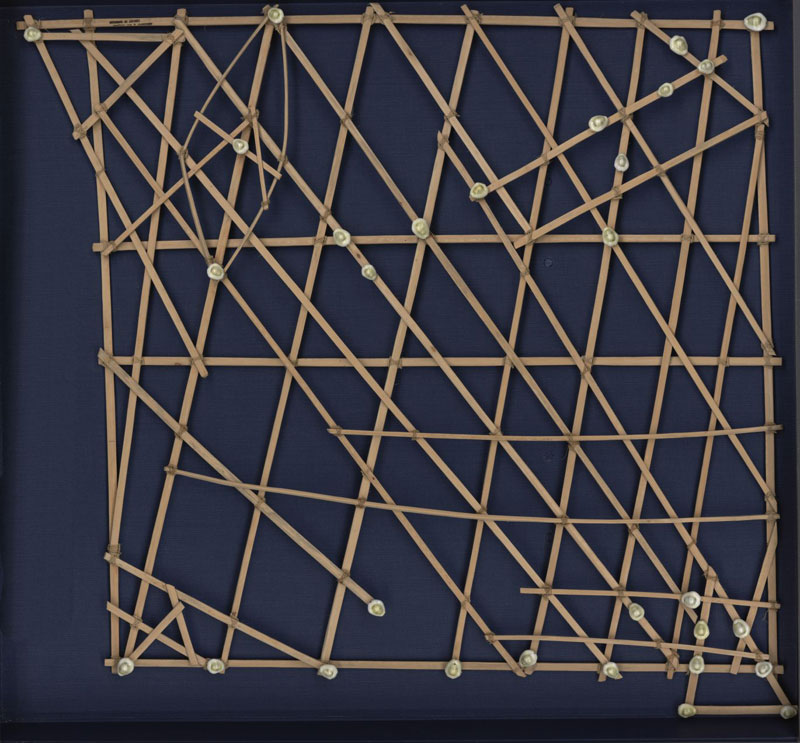
Contributed by Antonio R. Montesinos.
11/1/14
Fernando García Dory; "Las élites se han adueñado del arte";BEA ESPEJO | Publicado el 22/03/2013 |
Campo adentro es uno de los proyectos artísticos más interesantes actualmente en nuestro país. Nació en 2010 como una plataforma de investigación sobre arte, agricultura y medio rural, y se ha formalizado en residencias para artistas, debates y exposiciones como la que ahora llega a Matadero Madrid. Hablamos con el responsable, el artista Fernando García Dory, sobre el campo, la ciudad y la naturaleza. También interior.
 Fernando García Dory. Foto: Cristina Rocha
Su último proyecto, Campo adentro, que inició en 2010, se relaciona directamente con ello. Han sido tres años en los que ha tenido lugar una conferencia internacional, una fase de producción con un programa de residencias en 12 comunidades autónomas con 22 artistas en total y presentaciones y exposiciones como la que hasta el domingo presentan en Matadero Madrid. Representa quizás el final de una etapa y el comienzo para él de investigación de nuevas formas y campos. "Hace poco, hablando con una comisaria, me decía que el proyecto le parecía más cercano al Artists Placement Group - APG de Latham y Steveni en los 70, o a la idea que lleva a Boetti a regentar el One-Hotel donde invita a otros artistas a explorar ese rincón en la periferia que era Kabul", dice.

Campo adentro en Matadero Madrid. Febrero, 2013
Campo a través
El nombre, Campo adentro, remite a un lugar físico, mar adentro, lejos de la costa, un paisaje inestable, y otro psíquico, interior, a los adentros, un territorio lleno, también, de corrientes variables. El proyecto reflexiona sobre la idea de territorio, geopolítica, cultura e identidad en las relaciones entre campo y ciudad en España. Mucho tiene eso que ver eso con que Fernando García Dory haya crecido entre las montañas de Cangas de Onís, en Asturias. "Siento una enorme gratitud y admiración hacia la gente del campo. Hay verdaderos monumentos trabajando allí, de una dignidad y grandeza sin pretensiones, como árboles viejos", dice.El suyo es un perfil de artista singular, algo atípico. Trabaja sin galería, el capital que más valora es el simbólico y entre sus últimas piezas hay una pequeña producción de quesos artesanales. Aunque su relación con el lácteo viene de lejos. En 2010, como cierre de una Conferencia Internacional en el Museo Reina Sofía, organizó Agri-Cultura 1, un mercado de quesos en la Cuesta del Moyano, en intercambio con los libreros. Hace menos, el pasado octubre y en el marco de ForoSur, en Cáceres, hizo los llevó hasta degustación "organoléptica-política", decía. "Me defino como artista aunque lo entiendo como un work in progress. Lo que hago es plantear ideas, encuentros, posibles formas de entender las cosas, de mirarlas. Hasta ahora, siguiendo una idea de educación estética expandida, me ha tocado ser 'hombre de acción'. En el fondo, no soy más que un 'ciudadano activo político', en el sentido de implicarse con la polis. Hemos perdido la costumbre del esfuerzo que eso conlleva. Por un lado, me siento responsable con el legado que han dejado otros artistas que han creído en el desarrollo humano antes que nosotros. Por otro, trabajo también con la contemplación y la experimentación formal. Ese lado subjetivo de la práctica artística complementa el más objetivo y subversivo. De hecho, el arte se da en la combinación de ambos. Eso es lo grande del arte, que es una forma de vida, de toma de conciencia. Es una herramienta múltiple, un cobijo al que arrimarse. También algo divertido, placentero", añade.

El colectivo de artistas Espada y Monleón. Residencia en Puente Pumar. Cantabria.
-¿Con qué objetivos nació en 2010 Campo adentro?
-El objetivo era abrir un ámbito de trabajo para el arte en nuestro país, analizar las propuestas que se vienen lanzando desde el movimiento campesino y ver el posible papel del arte en procesos de cambios sociales. La idea ha sido crear una estructura política y social, una plataforma de colaboración entre el gobierno estatal, los agentes e instituciones artísticas y el movimiento social rural. Plantear un debate sobre el futuro del medio rural y la idea que de él se tiene en el mundo del arte.
-Y, ¿qué es lo rural?
-Es un modo de organización social y de uso de recursos. El campo es la causa de la ciudad, aunque no son lugares opuesto. Ni el campo es lo bueno ni la ciudad lo malo. Lo que ocurre es que tácticamente el campo puede ser una vía, más o menos simbólica, de otras cosas. Significa situarse en un lugar donde las cosas pueden funcionar de otro modo. El control de los recursos comunes, la alimentación o la tierra son vitales en la actual fase de expansión del capitalismo.
-Habla de lugares y de ritmos. ¿Qué rol juega la idea de nomadismo y movilidad?
-Por un lado, remite a no acomodarse a nada, a cuestionar como base del arte. Por otro, me permite ser consciente del peligro de asumir la identidad neo-nómada que se nos ofrece como un súmmum del modelo capitalista: sin generar vínculos, en constante flujo bajo nuevos estímulos, el global player o nómada rico.
-Tres años después de poner en marcha Campo adentro, ¿cuáles son las conclusiones?
-Hemos visto que los agentes rurales todavía tienen que entender mejor los mecanismos culturales y apropiarse de ellos, y eso lleva tiempo y trabajo. La administración es incapaz de generar políticas de un mínimo compromiso, y el mundo del arte está más blindado de lo que podría pensarse. Aunque es cierto que va abriéndose paso a una sensibilidad que juega a favor del cambio, como hemos visto en la última Documenta.
Cultivos y recolectas
Fernando García Dory habla de los múltiples actores que componen el proyecto, desde el Ministerios de Cultura, Medioambiente y Agricultura a comisarios como Charles Esche, Chus Martínez o Vicente Todolí, y artistas como Carmen Cañibano y su proyecto Tiempos de trabajo en Prado, Zamora; Bárbara Fluxá, Fernando Martín y José Bernal y su trabajo en La Vera, Cáceres; los recuerdos de Patricia Esquivias en las tierras toledanas; la intervención en Malpartida de Mario García Torres; el mercado propuesto por Can Altay en Carrícola, Valencia... Imposible citarlos a todos.Entre líneas, Campo adentro habla de relaciones humanas y enlaces afectivos. "La esencia de la agricultura es el cultivo, el cuidado", añade García Dory. La formalización del proyecto va más allá del arte relacional, tan significativo en los 90. Se trata, más bien, de un "arte relacional antagónico": "Es un término de Claire Bishop y viene a decir que, más allá de un feliz momento de empatía y colaboración, los vínculos entre artista y público deben abrir espacios de crítica y transformación. Es lo que pretendía cuando en LABoral construí, con las maderas de una instalación de Rirkrit Tiravanija, paradigma del arte relacional, una réplica de la habitación donde los pastores celebran consejo y donde se llevó a cabo una asamblea de la Federación Estatal de Pastores. El arte toma entonces todo el sentido.
-¿Cómo puede el arte tener una implicación social real?
-Sé que el arte tiene una implicación social real. Lo que no sé del todo es cómo puede llegar a ser efectiva. Ando trasteando con posibles formas. Lo que está claro es que hacer un arte impotente o no funcional es empobrecedor, necio y suicida.

El artista Antonio Ballester. Residencia en La Gomera. Canarias
-¿Cree que el arte es elitista?
-Creo más bien que las élites se han apropiado del arte. No hay una forma de universalizar el arte sin hacerlo del conocimiento, la educación. Ambas cosas son todavía hoy, en buena medida, un privilegio de clase...
-Háblanos de tus proyectos futuros. ¿En qué nuevas vías de investigación estás trabajando ahora?
-Campo adentro pasa a ser posible engranaje de formación y asentamiento rural, y comercialización. Arranca ahora con un Grupo de Investigación "Ecologías del sistema del arte, nuevos territorio y paisajes en cultura contemporánea" que se desarrolla en Matadero Madrid y otros lugares, un terreno experimental en la ciudad llamado Nuevo Jardín de Dalias. Me gusta la idea de un proyecto acerca de un movimiento u organización, ejercicios de curvaturas hacia un tiempo y espacio de colaboración y ensayos de nuevos modelos de arte. Extender esta metodología en otros contextos como Escandinavia, Francia, Inglaterra y Rusia. Allí me llamaron para intervenir en un antiguo kolvjós de 900, que ahora experimenta sobre New Rural Arts, y quiero plantear algo que combina producción teatral, música y apicultura. Dentro de la idea de incubar proyectos mínimos o aparatos para-institucionales, sostenibles, útiles, que siguen su luego su curso, catalizar de otro modo, ando con la creación de una Escuela Elemental de Artesanías en Mallorca, como forma de retomar otras formas de hacer y conocer, y de regeneración económica local; Y volver a una esfera más íntima o propia: un libro de dibujos para niños , y unas esculturas a modo de artefactos emocionales. Pensar en la representación como ámbito de transformación. Y las formas de habitar el instante y los espacios y acuerdos sobre su uso: de una coreografía, a un rito o escenificaciones, la actuación como propuesta hacia el otro, como vínculo posible. Me parece necesario el paso de una confrontación más frontal a formas más sutiles y ambiguas, de cuestionar y plantear alternativas. Y en la medida de lo posible, viajar poco, leer y escribir sobre unas valoraciones de años pasados.

INLAND Station. 15.02.2013. Foto: Lorena Fernández
Suscribirse a:
Entradas (Atom)