5/11/12

Lines of flight: urban resistance, dreamscapes and social play; Lorena Muñoz-Alonso, 2012

Some theoretical notes concerning the exhibition Desire Lines

Wayfarer, your footprints
are the way, and nothing else;
wayfarer, there is no path,
you make the path by walking.1
 Antonio Machado, Campos de Castilla, 1912

Exactly one hundred years ago, in one of his most memorable poems, Antonio Machado exhorted us to become more conscious of our choices, to assume what is perhaps the most transcendental responsibility of our existence as individuals: forging our own path in life rather than being swept along by social pressure, fear or the paralysing shadow of apathy. In that poem, the path is a metaphor for life, a powerful image no less apt for being somewhat hackneyed. It is the perfect allegory for an existential journey, with all of its inherent forks, choices and decisions.
‘Desire lines’ is the name given to the alternative trails that emerge in a landscape— chosen itineraries eroded by wayfarers’ footprints, initially in an improvised manner that follows a transgressive urge, until they are consolidated and widened as a result of the kind of subversion that surpasses the individual to become collective. No path is ever made by one individual: it requires a group. It takes the repeated footsteps of many people to create these indelible marks.
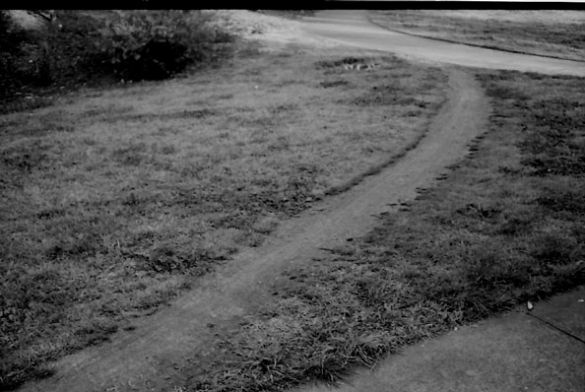
Image of a desire line

This metaphor, which evokes both real and imaginary paths, is the starting point for the exhibition, which features the work of eleven international artists who explore subversive ways of navigating, using and living the city.  The eleven works selected for Desire Lines take the urban fabric to be a complex, contradictory realm, brimming with possibilities. A broad stage with the capacity to both repress our deepest, destabilising desires and act as a catalyst for atavistic spirits of resistance that can trigger collective action. In this scenario the figure of the artist is key, as the embodiment of the metropolitan denizen. The artist is the city dweller par excellence, often roaming like a nomad from one metropolis to another, leading a type of existence that normally verges on the precarious—one of the many results of the gentrification process that the urban theorist and economist Richard Florida has been studying since the beginning of the 21st century2—and therefore being a privileged witness to the joys and miseries of life in the big city.

If the artist exemplifies the citizen, he is thus the hero of the urban odyssey that billions of us face every day. The influential essay The Practice of Everyday Life3 (1984) by the theorist and scholar Michel de Certeau is dedicated to the “ordinary man. To a common hero, an ubiquitous character, walking in countless thousands on the streets. […] This anonymous hero is very ancient. He is the murmuring voice of societies. […] We witness the advent of the number. It comes along with democracy, the large city, administrations, cybernetics. It is a flexible and continuous mass, woven tight like a fabric with no rips nor darned patches, a multitude of quantified heroes who lose names and faces as they become the ciphered river of the streets, a mobile language of computations and rationalities that belong to no one.” It is hard to think of a more eloquent and poignant way to express the loss of identity and agency that the individual endures within an oppressive urban context. The artists and works featured in this show attempt to incite resistance to this situation, to remind us that we can choose our own path; that sometimes empowerment is found in the most inconsequential and impromptu decisions and actions.

De Certeau described these activities, imbued with a tremendous subversive potential, as ‘tactics’, as opposed to ‘strategies’ –the institutional processes that establish the rules and conventions that govern societies. Tactics are the creative opportunities that operate between the gaps and slips of conventional thought and the patterns of everyday life. Of the contemporary philosophers who have promoted this type of liberating, playful, non-conformist behaviour, one of the most instrumental was undoubtedly Guy Debord, leader and founding member of the Situationist International (IS). This revolutionary group, created in 1957, reached its peak of influence with the publication of Society of the Spectacle (1967)4 and the subsequent May ’68 protests in Paris, a movement that borrowed both its ideas and most enduring slogans (such as the famous “Ne travaillez jamais!”). The group’s philosophy was based on the construction of ‘situations’ or environments in which one or more individuals were stimulated to critically analyse their everyday lives so they could identify and pursue their true desires. These ideas, developed by the artist Constant Nieuwenhuys alongside Debord, eventually crystallised into a fully fledged plan of action. Constant dedicated years to this project, entitled New Babylon, where he applied the concepts of what he called ‘unitary urbanism’. Because the Situationist critique of 20th-century urbanism questioned above all the degree of citizen participation, this “new Babylon” proposed a new form of urban planning based mostly on the concepts of mobility and play. Rather than a conventional urban development plan, this model fostered critical activities designed to promote participation in the city through a ‘mobile space of play’ and the construction of ‘situations’.
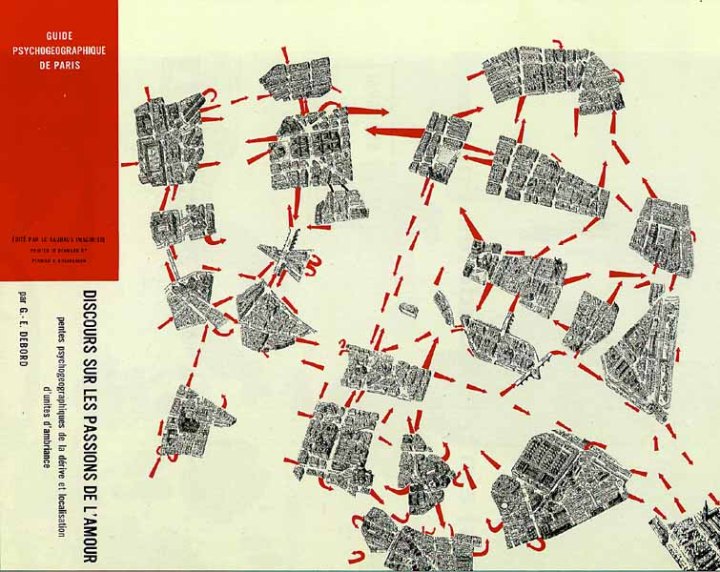

Guy Debord, Guide Psychogeographique de Paris: Discours Sur Les Passions D’Amour, 1957
The idea of play, of understanding the city as a space in which to act out our most pressing desires, is central to this philosophy and is put into practice through the exercise of ‘drifting’ (dérive):
One of the basic Situationist practices is the ‘dérive’, a technique of rapid passage through varied ambiances. ‘Dérives’ involve playful, constructive behaviour and awareness of psychogeographical effects, and are thus quite different from the classic notions of journey or stroll. In a ‘dérive’ one or more persons during a certain period drop their relations, their work and leisure activities, and all their other usual motives for movement and action, and let themselves be drawn by the attractions of the terrain and the encounters they find there. 5

Guy Debord, “Theory of the Dérive”

The notion of drifting as productive or constructive play is particularly relevant in the context of this exhibition: play in the sense in which Dutch historian and cultural theorist Johan Huizinga explored it in his controversial essay Homo Ludens6, written in 1938, a time of utter political and social turmoil when the idea of play seemed, at best, a far-fetched irony and, at worst, an inappropriate and rather sick joke. According to Huizinga, the notion of play is inherent to the human condition and even predates it, as evidenced by the fact that it is found in the vast majority of animal species. Huizinga argued that the intrinsic value of play, besides being essential to the generation of culture, is that it permeates archetypal activities of human society such as language, myths and rituals. Rejecting the notion of play as something that is “not serious”, Huizinga explained that play creates a transitory order (or a set of rules), a community of players and a feeling of tension or instability, thus generating collective situations and social exchanges that constitute the first step towards the creation of ‘cultures’.


Anna Halprin, City Dance, 1976-1977. Performance on the streets of San Francisco

For example, Looking Up (2001) by Francis Alÿs, a work present in this exhibition, is a video documentation of an action in which the artist walks into the middle of Mexico City’s busy Plaza del Zócalo and, standing impassively on the same spot, starts looking up at the sky. A group of passers-by, surprised and curious, gradually gather behind the artist, trying to see for themselves the elusive sight he is so keenly observing. Looking Up is, in many ways, a practical joke turned into an artwork, but it is a joke that unveils some distinctive human traits: for instance, the fact that groups tend to follow a leader like a herd of animals, often without the slightest guarantee of a worthwhile outcome. More positively, Looking Up examines curiosity and play as agents that mobilise groups, reassuring us of our capacity to respond to events collectively.

The need to overcome that passive ‘herd’ mentality was also staunchly advocated by Gilles Deleuze and Félix Guattari in their seminal philosophical treatise Anti-Oedipus7 (1972), which denounced and challenged the human urge to repress oneself by means of ‘territories’ such as work, family, political parties or education: in short, any social construct born out of the exercise of power relations. To combat this drive and achieve what they called ‘deterritorialisation’, thereby triggering a chain reaction leading to change, it is necessary to forge ‘lines of flight’: brand-new paths in which one can break away from the material of the past.

That such ‘lines of flight’ seem to recall the concept of desire lines is no mere coincidence. For Deleuze and Guattari, desire (never in its strictly sexual sense) is the real force that can mobilise our freer and inevitably more transgressive impulses. This is why the aforementioned ‘territories’, from the workplace to the city, are such excellent machines for repressing our desires, making us docile and obedient as a result of the eternal battle between the social machines and us, the desiring-machines. As Deleuze and Guattari argue so eloquently throughout Anti-Oedipus, desire is socially repressed because any sign of uncontrolled behaviour has the capacity to destabilise the prescribed symbolic order. The lines that stem from desire can sabotage hegemony.

Desire lines—the real and imaginary ones—are an unmistakable symptom of the transgressive capacity of an individual desire that becomes a collective impulse. They symbolise the small acts of urban resistance that emerge from a strong impulse to deviate from the paths created and imposed by others. Regardless of the form these disruptions might take within the symbolic order—games, poetic acts, jokes, minor sabotages or a revolutionary and violent explosion—such transgressions can and should be extrapolated onto the field of human existential behaviour. They should be valued for what they are worth and used as tools for reviving the sensation, buried beneath layers of bureaucracy and social norms, that every life, every fate, is unique and worth fighting for, from the smallest routine struggle to the most pyrrhic battle. When disobedience leaves such a tangible mark, one must acknowledge it and take notice, rather than turning a blind eye, as evidenced by the protests that have shaken the world over these last two years, 2011 and 2012, from the 15 May Movement to the worldwide demonstrations of Occupy.

The works featured in Desire Lines represent different spirits of insurgence as well as tactics for appropriating and celebrating the city’s latent creative potential. We are honoured that artists as inspiring as Lawrence Abu Hamdan, Mark Aerial Waller, Francis Alÿs, Francisca Benítez, Mircea Cantor, Filipa César, Cyprien Gaillard, Regina de Miguel, Laura Oldfield Ford, Alejandra Salinas and Aeron Bergman, and John Smith have accepted our invitation to participate in this project and allowed us to exhibit their stimulating works, lending consistency to a set of enthusiastic ideas. It’s the turn of the audience now. We hope this journey is as enriching for them as it has been for the two curators.
-
This essay is part of the catalogue of the exhibition Desire Lines, curated by Lorena Muñoz-Alonso & Bárbara Rodríguez Muñoz.
The exhibition will open on the 21st of November 2012 at the Espai Cultural Caja Madrid in Barcelona and will run until the 13t of January 2012.
Catalogue design by David G. Uzquiza.
-
Bibliography
1. This poem belongs to the anthology Campos de Castilla which Antonio Machado first published in 1912. Campos de Castilla, Madrid,Cátedra, 1992. Translation by the author of the essay.
2. Richard Florida, The Rise of the Creative Class: And How It’s Transforming Work, Leisure, Community and Everyday Life, New York, Basic Books, 2002.
3.  Michel de Certeau, L’invention du quotidien, tome 1: Arts de faire, Paris, Gallimard, 1990. (Published in English as The Practice of Everyday Life.)
4. Guy Debord, La sociéte du spectacle, Paris, Buchet-Chastel, 1967. (Published in English as The Society of the Spectacle.)
5. Théorie de la dérive was originally published in Internationale Situationniste no. 2 (Paris, December 1958). A slightly different version had appeared in 1956 in the Belgian Surrealist magazine Les Lèvres Nues no. 9. (Published in English as “Theory of the Dérive”.)
6. Johan Huizinga, Homo Ludens, Boston, Beacon Press, 1955.
7. Gilles Deleuze and Félix Guattari, Capitalisme et schizophrénie. L’anti-Œdipe, Paris, Les Éditions de Minuit, 1972. (Published in English as Anti-Oedipus: Capitalism and Schizophrenia.)


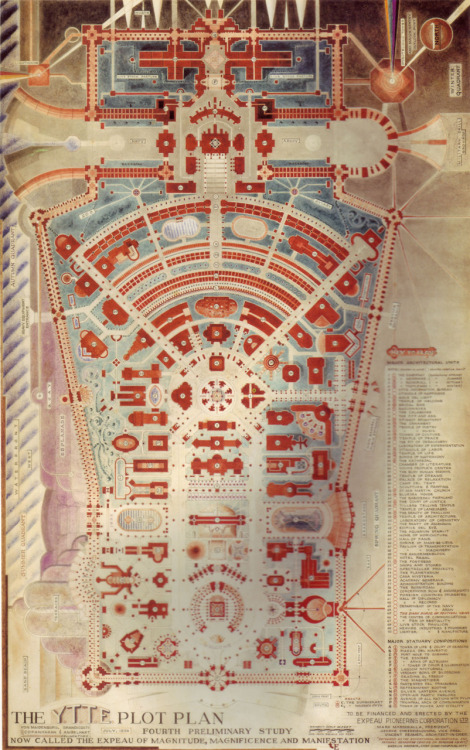

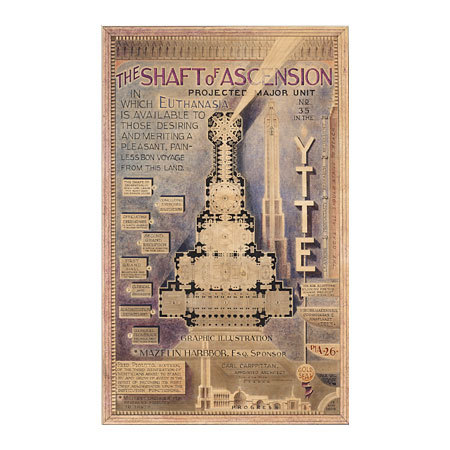
Achilles Gildo Rizzoli (1896–1981), anonymous during his lifetime, has since his death become celebrated as an outsider artist. He is an unusual example of an "outsider" artist who had considerable formal training in drawing.
Born in Marin County, California, Rizzoli lived near the U.S. city of San Francisco, where he was employed as an architectural draftsman. After his death, a group of elaborate drawings came to light, many in the form of maps and architectural renderings that described an imaginary world exposition (much of which was designated "Y.T.T.E.," for "Yield To Total Elation"). The drawings include "portraits" of his mother (whom he lived with until her death in 1937) and neighborhood children "symbolically sketched" in the form of fanciful neo-baroque buildings.
Rizzoli published one novel, The Colonnade (1931), under the pseudonym Peter Metermaid.
A film was made about his life and work, called Yield to Total Elation: The Life and Art of Achilles Rizzoli.


1/11/12

56 Broken Kindle Screens; Sebastian Schmieg and Silvio Lorusso, 2012

 
56 Broken Kindle Screens, 2012 is a collaboration project  by Sebastian Schmieg and Silvio Lorusso_
"56 Broken Kindle Screens is a print on demand paperback that consists of found photos depicting broken Kindle screens. The Kindle is Amazon's e-reading device which is by default connected to the company's book store. 
The book takes as its starting point the peculiar aesthetic of broken E Ink displays and serves as an examination into the reading device's materiality. As the screens break, they become collages composed of different pages, cover illustrations and interface elements."

19/9/12

Proponen un experimento para transferir información entre el pasado y el futuro


"El vacío, tal y como lo entendemos clásicamente, es un estado completamente desprovisto de materia, pero cuánticamente está lleno de partículas virtuales: Es lo que se conoce como fluctuaciones cuánticas del vacío", explica Borja Peropadre, investigador del Instituto de Física Fundamental (CSIC). Investigadores de este centro y de la Universidad de Waterloo (Canadá) proponen un experimento que permite la transferencia de información entre el pasado y el futuro usando este vacío cuántico. Los científicos han conseguido explotar sus propiedades utilizando la emergente tecnología de los circuitos superconductores, según un trabajo que publican en la revista Physical Review Letters.
"Gracias a esas fluctuaciones, es posible hacer que el vacío esté entrelazado en el tiempo; es decir, el vacío que hay ahora y el que habrá en un instante de tiempo posterior, presentan fuertes correlaciones cuánticas", aclara Peropadre. Por su parte, el director del estudio, Carlos Sabín, destaca el papel de los circuitos superconductores:"Permiten reproducir la interacción entre materia y radiación, pero con un grado de control asombroso. No sólo ayudan a controlar la intensidad de la interacción entre átomos y luz, sino también el tiempo que dura la misma. Gracias a ello, hemos podido amplificar efectos cuánticos que, de otra forma, serían imposibles de detectar".
Los científicos han entrelazado con fuerza átomos P del pasado con los F del futuro
De este modo, haciendo interaccionar fuertemente dos átomos P (pasado) y F (futuro) con el vacío de un campo cuántico en distintos instantes de tiempo, los científicos han encontrado que P y F acaban fuertemente entrelazados. "Es importante señalar que no sólo es que los átomos no hayan interaccionado entre ellos, sino que en un mundo clásico, ni siquiera sabrían de su existencia mutua", comentan los investigadores.


Futuras memorías cuánticas


Desde el punto de vista tecnológico, una aplicación "muy importante" -según los autores- de este resultado es el uso de esta transferencia de entrelazamiento para fabricar en el futuro memorias cuánticas, capaces de retener este tipo de información. "Codificando el estado de un átomo P en el vacío de un campo cuántico, podremos recuperarlo pasado un tiempo en el átomo F", señala Peropadre. "Y esa información de P, que está siendo ‘memorizada' por el vacío, será transferida después al átomo F sin pérdida de información. Todo ello gracias a la extracción de las correlaciones temporales del vacío".

Contemporary Cartographies. Drawing Thought at CaixaForum, 2012.


Michael Druks. Druksland–Physical and Socia, 15 January 1974, 11.30 am., 1974.
© Michael Druks. Fotografía: England & Co Gallery, London


We map our world in order to gain a glimpse of the reality in which we live.
Since time immemorial, maps have been used to represent, translate and
encode all kinds of physical, mental and emotional territories. Our
representation of the world has evolved in recent centuries and, today, with
globalisation and the Internet, traditional concepts of time and space, along
with methods for representing the world and knowledge, have been
definitively transformed. In response to this paradigm shift, contemporary
artists question systems of representation and suggest new formulas for
classifying reality. The ultimate aim of Contemporary Cartographies.
Drawing Thought, an exhibition that seeks to draw a map formed by
cartographies created by twentieth- and twenty-first century artists, is to
invite the visitor to question both the systems of representation that we use
and the ideas that underpin them. The exhibition, organised and produced
by ”la Caixa” Foundation, is comprises more than 140 works in a wide
range of formats – from maps and drawings to video installations and
digital art – on loan from the collections of several major contemporary art
galleries. The artists represented include such essential figures as
Salvador Dalí, Paul Klee, Marcel Duchamp, Yves Klein, Gordon Matta-Clark,
Richard Hamilton, Mona Hatoum and Richard Long, shoulder-to-shoulder
with a roster of contemporary artists, including Art & Language, Artur
Barrio, Carolee Schneemann, Ana Mendieta, Erick Beltrán, On Kawara,
Alighiero Boetti, Thomas Hirschhorn and Francis Alÿs, amongst others.
Finally, the exhibition is completed by a series of revealing documents
drawn up by experts from other fields, such as Santiago Ramón y Cajal,
Lewis Carroll and Carl Gustav Jung.


Contemporary Cartographies. Drawing Thought. Organised and produced by:
”la Caixa” Foundation. Dates: 25 July - 28 October 2012. Place: CaixaForum
Barcelona (Av. de Francesc Ferrer i Guàrdia, 6-8). Curator: Helena Tatay.


(...)

 4
Physical, mental and emotional territories

Humans have always needed to design and build structures in order to
understand the chaos that is life. Maps break down reality into fragments,
enabling it to be presented in the shape of tables. In this way, we translate and
codify, not only physical space, but also knowledge, feelings, desires and life
experiences. 

Representing the Earth on a plane, projecting a three-dimensional object in two
dimensions, was an astounding transformation. This process enables us to
grasp the idea of space, which has shaped European thinking. As the
geographer Franco Farinelli notes, since the beginning of European knowledge
there has been no other way of knowing things except through their image. It is
difficult for us to go beyond their appearance, their representation.

In the seventeenth century, classifications and phenomena began to be drawn
on a plane. Mapmaking knowledge was combined with statistical skills. In this
way, data maps emerged, helping to visualise knowledge and converting it into
science. A century later, linked to the colonial expansion of certain European
countries, scientific cartography came into being. At the same time, maps of
emotions began to appear in French salons hosted by women. Since then,
maps have been used to represent and make visible physical, mental and
emotional territories of all kinds.

In the twentieth century, technical advances such as the airplane and
photograph, which enabled reality to be reproduced exactly, wrought changes in
the way the world was represented. Moreover, non-material communication –
the telegraph and the telephone  – caused the “crisis of space” that was so ably
reflected by the cubists.

Internet finally dispelled all traditional concepts of time and space. The
contemporary space is a heterogeneous space. We are aware that we live in a
network of relations and material and non-material flows, but we still do not
possess a model to represent this invisible network. We live in tension between
what we were and can think and these new things that we are unable to
represent.

This exhibition explores a theme that has unattainable ramifications. Based on
art (a microspace for freedom in which models of knowledge can be
reconsidered and redefined) it proposes a map – arbitrary, subjective and
incomplete, like all maps – of the cartographies formulated by twentieth-century
and contemporary artists. This map invites us to question the systems of
representation that we use, and the ideas that underlie them.

 Artists:
Artistas:
Ignasi Aballí, Francis Alÿs, Efrén Álvarez, Giovanni Anselmo, Art & Language, Zbynék Baladrán, Artur Barrio, Lothar Baumgarthen, Erick Beltrán, Zarina Bhimji, Ursula Biemann, Cezary Bodzianowski, Alighiero Boettti, Christian Boltanski, Marcel Broodthaers, Stanley Brown, Trisha Brown, Bureau d'Études, Los Carpinteros, Constant, Raimond Chaves y Gilda Mantilla, Salvador Dalí, Guy Debord, Michael Drucks, Marcel Duchamp, El Lissitzky, Valie Export, Evru, Öyvind Fahlström, Félix González-Torres, Milan Grygar, Richard Hamilton, Zarina Hashmi, Mona Hatoum, David Hammons, Thomas Hirschhorn, Bas Jan Ader, On Kawara, Allan Kaprow, William Kentridge, Robert Kinmont, Paul Klee, Yves Klein, Hilma af Klint, Guillermo Kuitca, Emma Kunz, Mark Lombardi, Rogelio López Cuenca, Richard Long, Cristina Lucas, Anna Maria Maiolino, Kris Martin, Gordon Matta-Clark, Ana Mendieta, Norah Napaljarri Nelson, Dorothy Napangardi, Rivane Neuenschwander, Perejaume, Grayson Perry, Santiago Ramón y Cajal, Vahida Ramujkic, Till Roeskens, Rotor, Ralph Rumney, Ed Ruscha, Carolee Schneemann, Robert Smithson, Saul Steinberg, Hiroshi Sugimoto, Willy Tjungurrayi, Joaquín Torres García, Isidoro Valcárcel Medina, Adriana Varejao, Oriol Vilapuig, Kara Walker, Adolf Wölfli.


More in the web of CaixaForum.
More info in the Pdf.
Very nice tumblr of the curator, Helena Tatay.

And i have to say that i´m more than happy to be in the links section.

TEATRO GEOGRAFICO ANTIGUO Y MODERNO DEL REYNO DE SICILIA, 1686


Se trata de un extraordinario atlas militar, en el que destaca particularmente la cantidad, calidad y naturaleza de sus ilustraciones.
Aunque en sus páginas encontramos representaciones de fortalezas y un especial protagonismo de las murallas y los sistemas defensivos en sus vistas de ciudades, el Teatro Geográfico destaca por la pluralidad de ilustraciones que contiene, que son mucho más heterogéneas que las de un mero atlas militar. Encontramos representados desde los principales monumentos civiles y religiosos de Palermo y Mesina, a escenas mitológicas ligadas a la isla o representaciones de actos institucionales de la corte virreinal.

9/9/12

Project ‘Ground Truth’ - How Google Builds It’s Maps

Fascinating article on the workings on Google Maps and how it relates to the bigger picture of personal information technology - via The Atlantic:
Behind every Google Map, there is a much more complex map that’s the key to your queries but hidden from your view. The deep map contains the logic of places: their no-left-turns and freeway on-ramps, speed limits and traffic conditions. This is the data that you’re drawing from when you ask Google to navigate you from point A to point B — and last week, Google showed me the internal map and demonstrated how it was built. It’s the first time the company has let anyone watch how the project it calls GT, or “Ground Truth,” actually works.
The company opened up at a key moment in its evolution. The company began as an online search company that made money almost exclusively from selling ads based on what you were querying for. But then the mobile world exploded. Where you’re searching has become almost important as what you’re searching. Google responded by creating an operating system, brand, and ecosystem in Android that has become the only significant rival to Apple’s iOS.
And for good reason. If Google’s mission is to organize all the world’s information, the most important challenge — far larger than indexing the web — is to take the world’s physical information and make it accessible and useful.
“If you look at the offline world, the real world in which we live, that information is not entirely online,” Manik Gupta, the senior product manager for Google Maps, told me. “Increasingly as we go about our lives, we are trying to bridge that gap between what we see in the real world and [the online world], and Maps really plays that part.”
More Here

Founded here.