Mostrando entradas con la etiqueta anatomía. Mostrar todas las entradas

19/5/10

Psiquifotos


Camino Galicia, J. Manual práctico de exploración y examen de las facultades mentales. Imprenta A. Marzo. Madrid, 1924.


López Ibor, J.J. El libro de la vida sexual. Ed. Danae. Barcelona, 1968.


“Arc de cercle” en un hombre. Charcot - Richer, 1885


Es una pena que en el gran blog psiquifotos, las imágenes no sean de más calidad..aún así, recomendamos la visita para ver la gran cantidad de material posteado sobre las relaciones entre fotografía, arte y psiquitaría, introduciendo, entre otras cosas, mucho material bibligráfico de fuentes del territorio español.

30/3/10

Physical and Intellectual Measurement, Eugenetics y Francis Galton


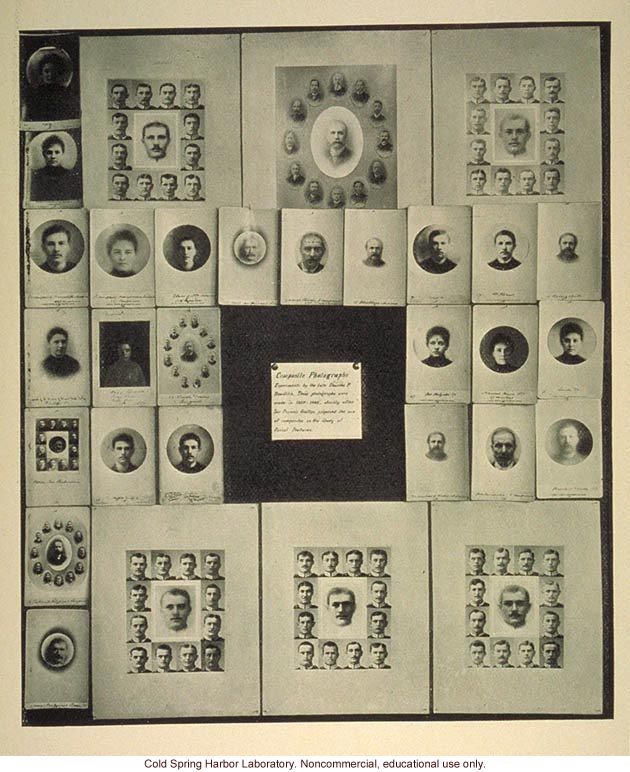
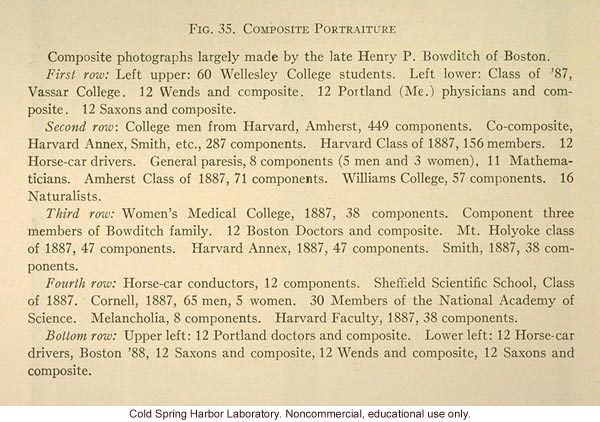
"Composite portraiture," Fig. 35, 1921


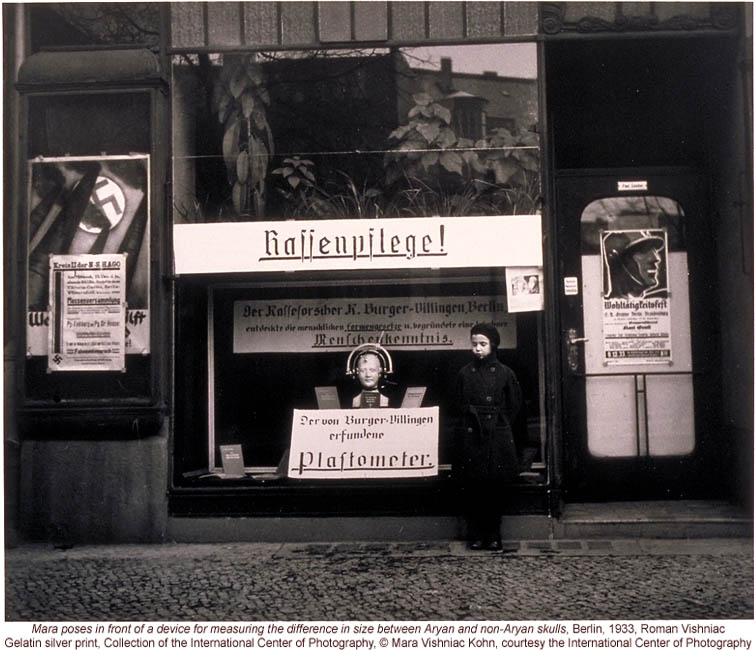
Nazi propaganda in Berlin storefront, including anthropometric device for measuring differences between Aryan & Non-Aryan skulls (by Roman Vishniac), 1933


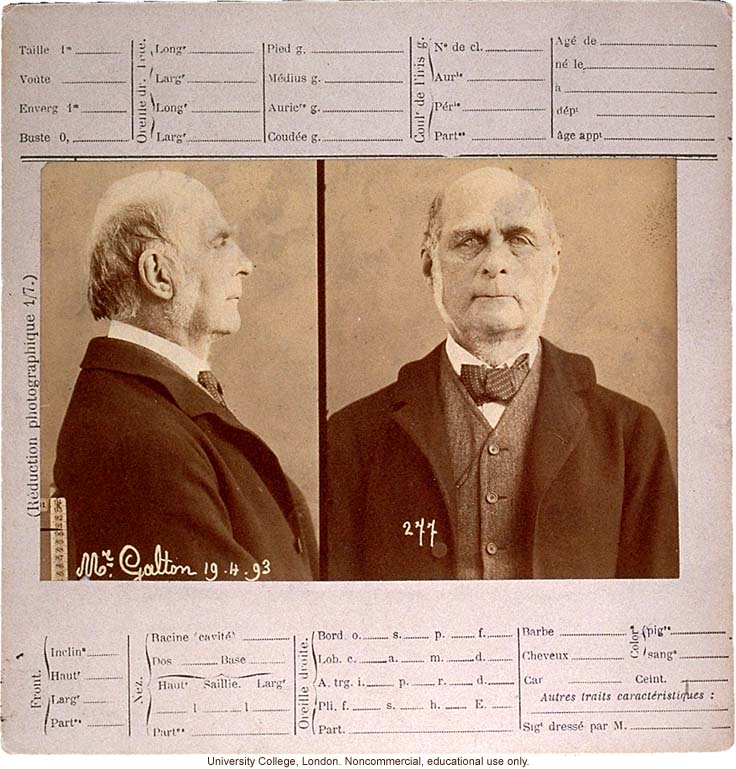
Anthropometry card of Francis Galton, with profile and full-face photos and spaces for key body measurements, taken by Alphonse Bertillon, 1893


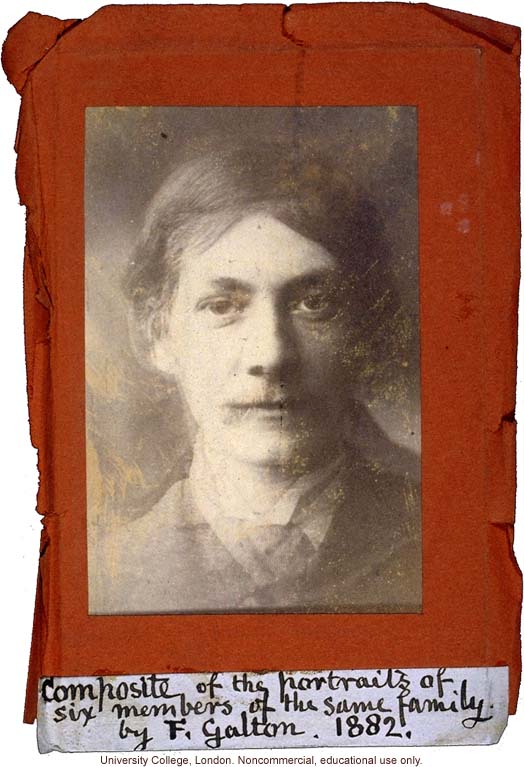
Composite of the portraits of six members of the same family. By F. Galton. 1882.


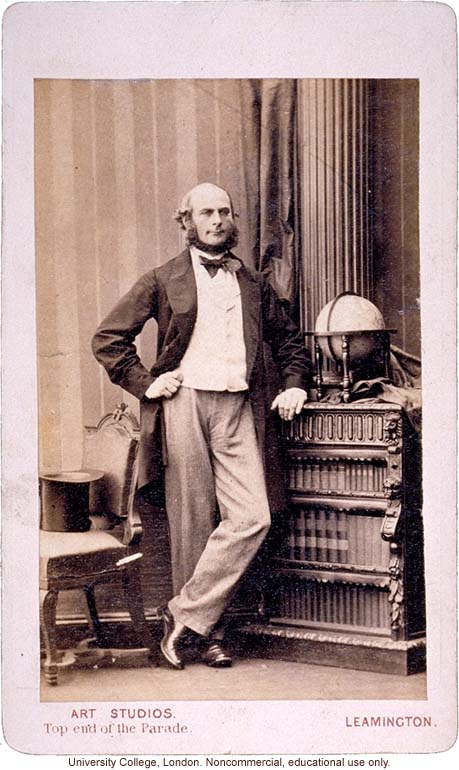
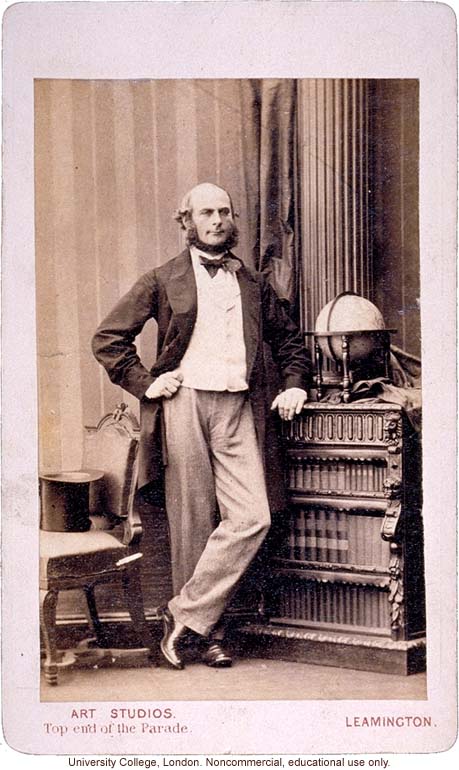
Francis Galton carte de visite portrait, standing
, 1864


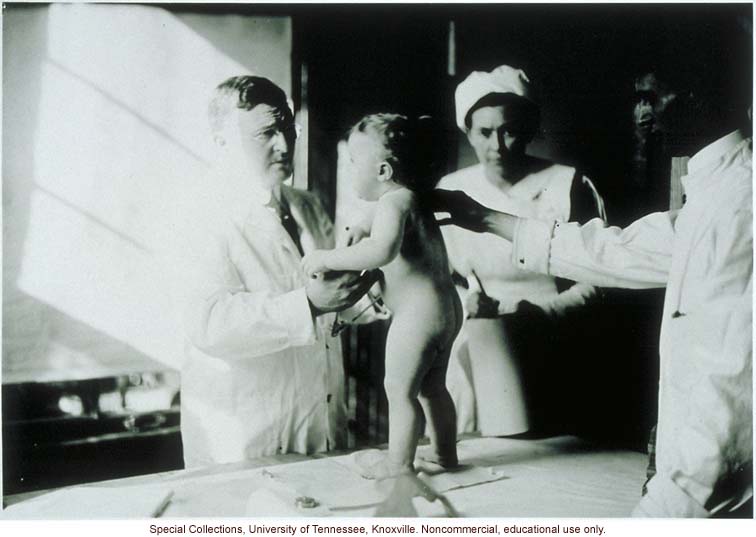
Infant being examined for a Better Babies Contest
, 1910


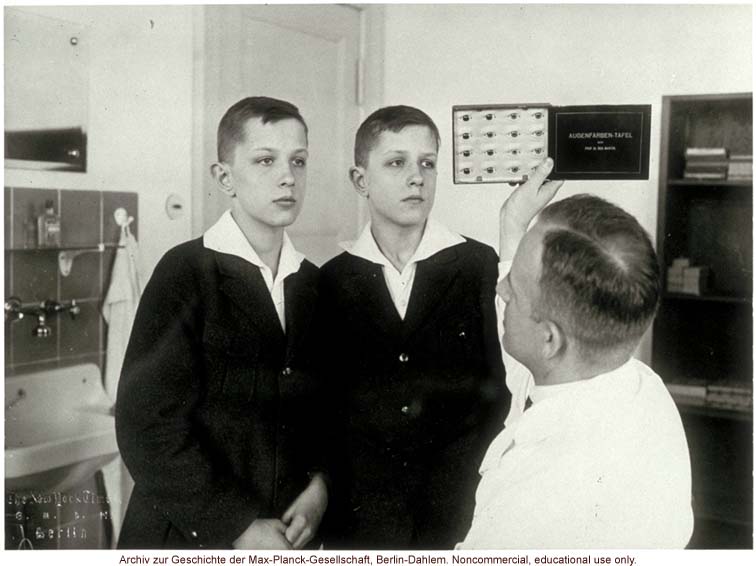
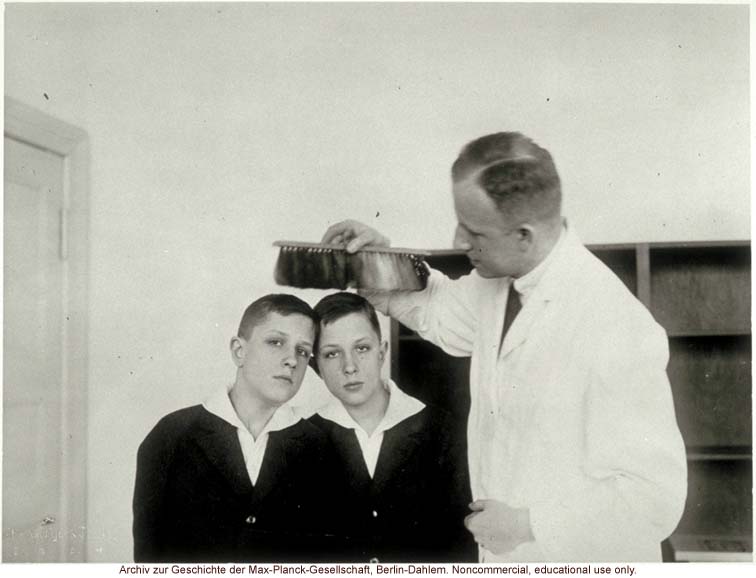
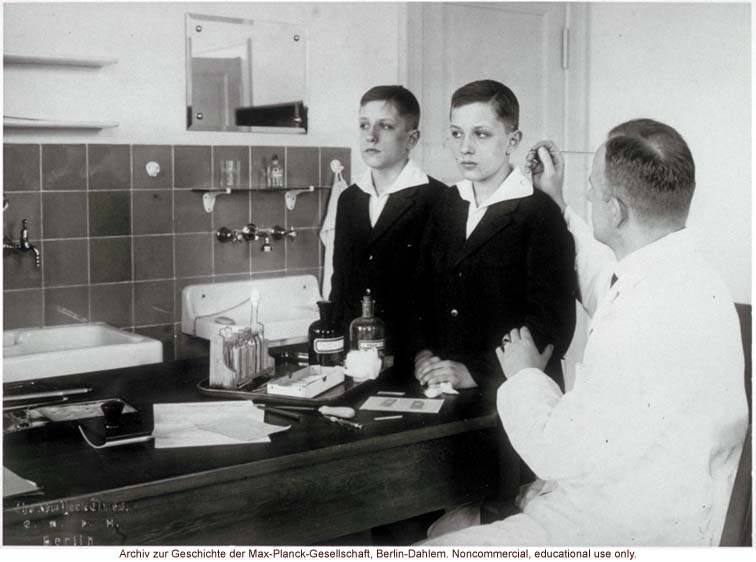
12-year-old male twins undergoing anthropometric study by Otmar Freiherr von Verschuer


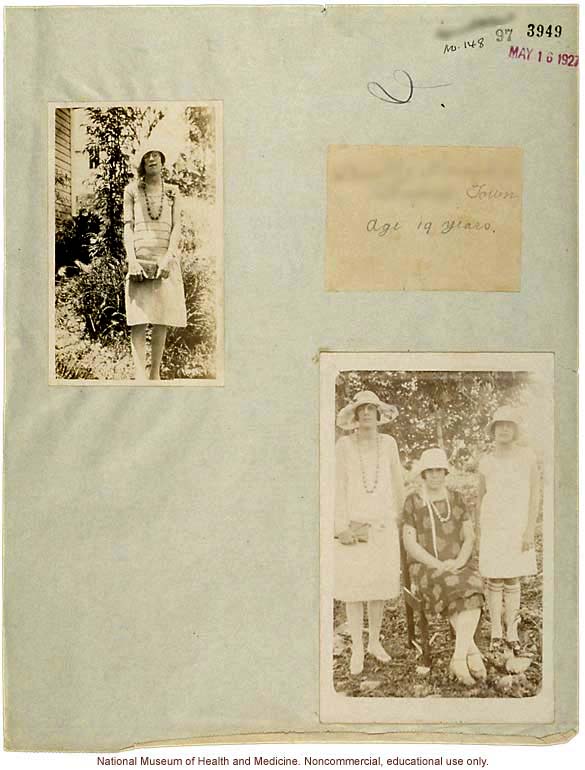
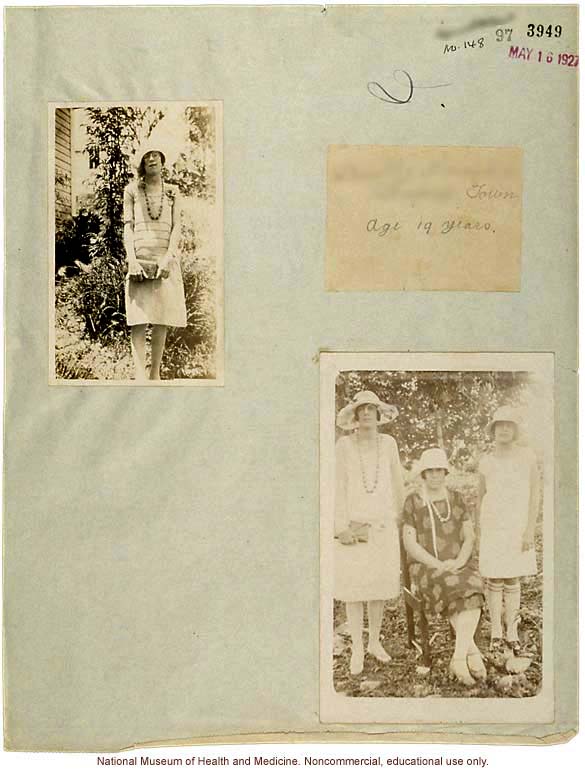
Seaford Town female anthropometric case: photos, measurements, finger prints, Schedule 3; by Morris Steggerda for Race Crossing in Jamaica, 1927


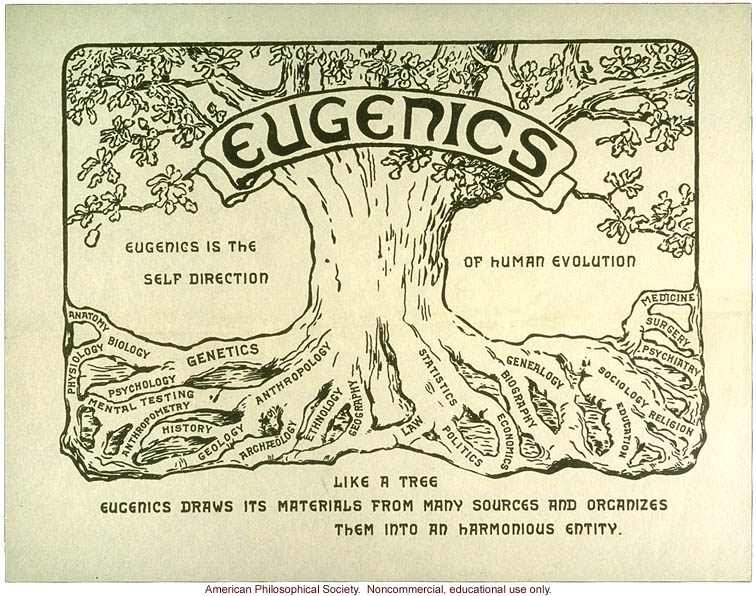
Eugenics tree logo, 1925


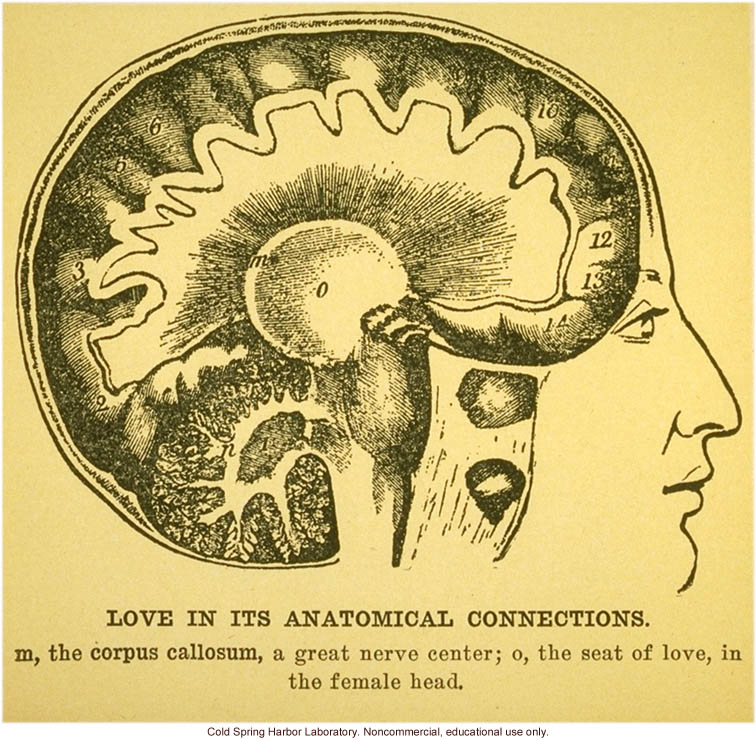
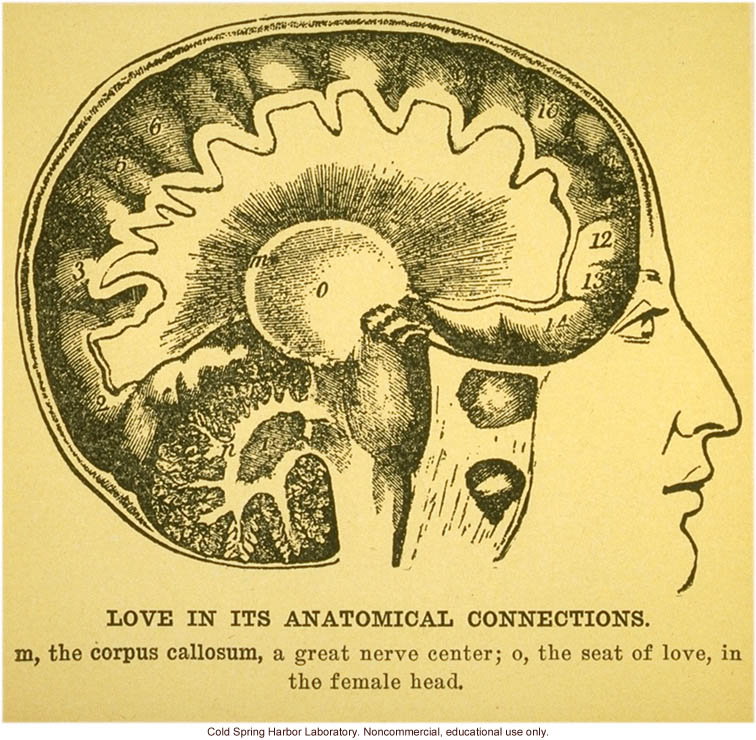
"Love in its anatomical connections"
, 1930


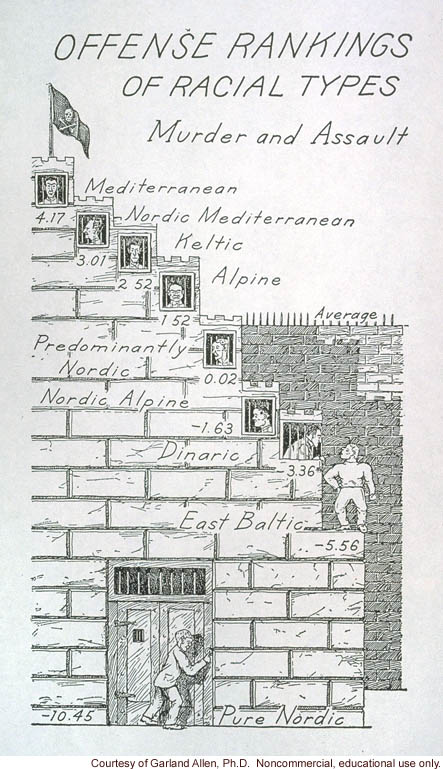
"Offense rankings of racial types: murder and assault"


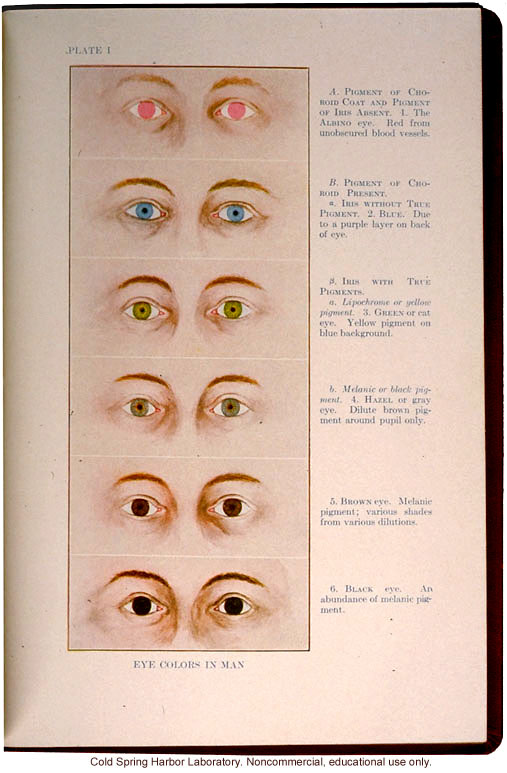
"Eye Colors in Man," from The Trait Book, ERO Bulliten No. 6, by Charles B. Davenport, 1912


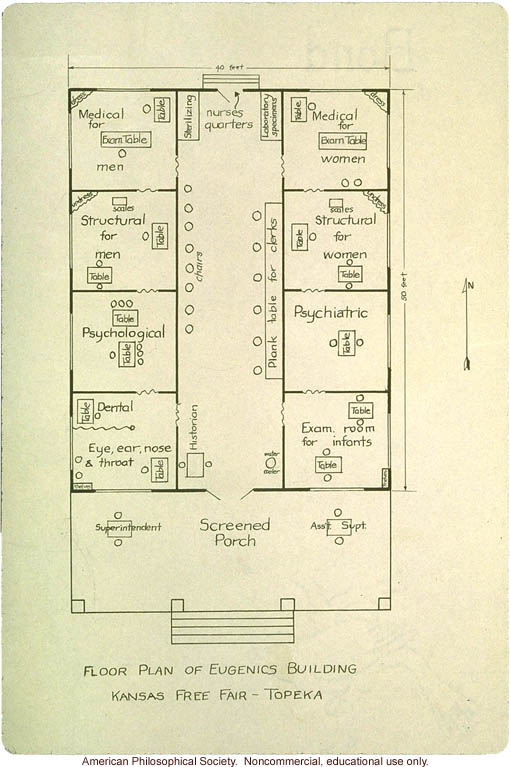
Floor plan Eugenics Building at Kansas Free Fair - Topeka, 1924


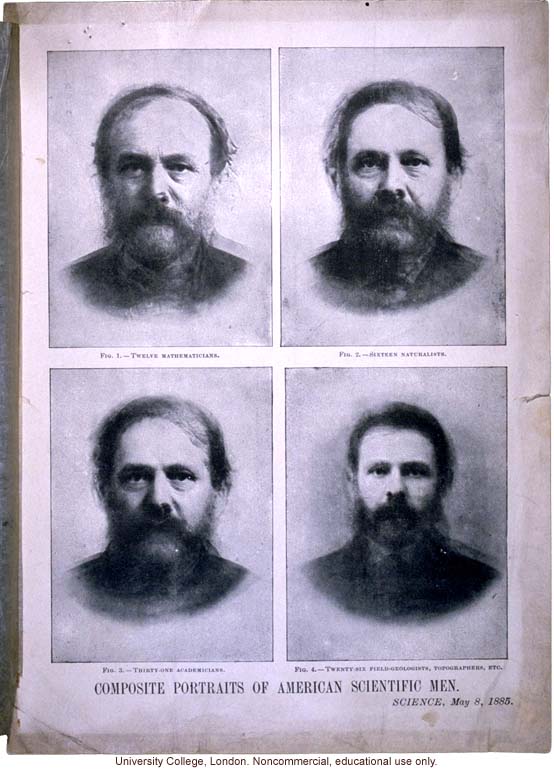
"Composite Portraits of Scientific Men," by Francis Galton, Science (5/8/1885)

Francis Galton imbued eugenics with a penchant for measuring all aspects of the human body. Galton relied heavily on the system for human physical measurements (anthropometry) developed by the French criminologist Alphonse Bertillon. Measurements of variation in human form provided much of the data upon which he and his student Karl Pearson developed modern statistics. American eugenicists hoped to use anthropometry to back up their claims about the superiority of the white race and people of northern/western European origin. Public schools, prisons, and mental hospitals all presented large "captive" populations to measure. Draftees into WWI provided a trove of data from which to determine the prototype (White) "American male" to compare to men of other races and ethnicities.

In most cases, it is not clear what point eugenicists were trying to make with their comparisons of body measurements. Apart from athletic prowess, no relationship has ever been shown between bodily measurements and intelligence or other behavioral attributes. Eugenicists also failed to take into account variables — such as differences in nutrition and health care — that could affect human development and account for differences between groups.

Intelligence tests took human measurement to new levels. In 1905, the French psychologist Alfred Binet developed a measure of "mental age" to help steer elementary students to academic or vocational tracks. Under this system, a child of average intelligence has a mental age equal to his chronological age. By 1910, Binet's mental age was used to generate an intelligence quotient or IQ (mental age/chronological age x 100). IQ scores range from 0 to 200 and fit a bell-shaped curve, with an average IQ of 100. Normal intelligence ranges from 86 to 115. Terms like "moron," "imbecile," and "idiot" described persons with IQs below 86, while "bright" and "genius" were used for scores above 115.

Eugenicists rapidly employed IQ or other intelligence tests to compare different racial and ethnic groups. These comparisons purportedly showed whites were more intelligent than blacks, native-born Americans were more intelligent than immigrants, and northern Europeans were more intelligent than southern Europeans. Educational psychologists believed IQ tests measured innate intelligence, but mostly they measured knowledge of white American culture and language. This underestimated the intelligence of new immigrants and disenfranchised Americans.


Para saber más de esta ida de pinza, visita el Eugenicsarchive. Atención a lo que llevaban las ideas del polímata Galton.
Cómo es algo difícil de navegar la página, aquí os dejo el archivo de imágenes.

25/1/10

You Are Here: Personal Geographies and Other Maps of the Imagination; Katherine Harmon, 2004


The map is a subtle and beautiful art form that is often held for its merest and most mundane of functions: to get its reader from point A to point B. But a map, deconstructed, is so much more. As graphical representations of our geographic world, maps figuratively contain within them the living and changing lives of us all. Someday, perhaps, maps will be as dynamic as the worlds they detail. As with the charmed maps of J.K. Rowling's Harry Potter series, the symbols of the map will move and change with the movements of the objects they represent. For now, however, we must rely upon our imaginations to invoke the richness only hinted at on paper.

In You Are Here: Personal Geographies and Other Maps of the Imagination, Katharine Harmon has shared her own love of maps by collecting a broad-ranging variety of art form. Not content to praise the intrinsic art of the geographic map, Harmon calls our attention to the labors of imaginative mapmakers who have charted regions emotional, biological, historical, culinary, and…well, you name it, it's in there.
She begins with a petroglyphic map from 2500 B.C., and launches from there into a chapter on personal geographies, all of which explore the body and mind of the human animal. These include such maps as "Main Route of Expedition Through the Alimentary Canal," acupuncture diagrams, and group dream maps. Outstanding in this collection is Adolf Wolfli's maps of the "Island Neveranger." Wolfli was a schizophrenic committed to a mental asylum in Germany at the age of 31, who, while confined, produced a startlingly rich output of imaginative work that included maps from his richly imagined world. These are highly detailed and wonderfully colored works from Wolfli's rich imaginary iconography.
The next chapter, titled, "At Home in the World," is equally diverse. A poem from Howard Horowitz typeset into the shape of Manhattan Island took the author one-and-a-half years to write. This poem-map is quite stunning, but pales next to a the intricately detailed map of Srinigar, a village in Kashmir, India, that was hand-embroidered on a wool and cloth shawl in the 19th century. Works from celebrated artists appear here also such as a map from illustrator, John Held Jr., known for his early 20th century caricatures, and William Wegman's "Vacationland," a postcard collage in oils celebrating tourist attractions.
The final chapter, "Realms of Fantasy," focuses in on geographic maps of fantastic or fictional realms. These vary from Julia Ricketts' colorfully abstract "Notations on a River," which explores the interplay of natural and man-made landforms, to Mark Bennett's highly detailed map of the Town of Mayberry. My personal favorite in this section is a map entitled "The Great Bear," in which artist, Simon Patterson, transposes the names of historical figures onto a universally recognizable map of the London Underground. Tube riders can jump on the Blue Line at Michelangelo, change to the Yellow Line and take that East to Plato. Transferring to the Red Line can take the rider to Rupert Murdoch, Louis Pasteur, or even Dick Cheney.

Years before the publication of You Are Here, I met an artist whose painted upon GIS maps of various world regions. I was thoroughly captivated then, and I still am. Perhaps, as Katharine Harmon suggests, we humans have an innate urge to map.

Today, inspired by You Are Here, I built a "map" of plastic pails, shovels, and other sandbox toys with my children. I laid the foundation, a starting point and an ending point with roads drawn into the sand to connect the two, and then invited my kids to join in. Before it was over, they had built quite a sandbox menagerie that included roads, lakes, bridges, and even an amusement park, all symbolically arranged in sand and plastic toys. I don't know if it was innately motivated, but it sure was cool.

Info desde aquí.

11/10/09

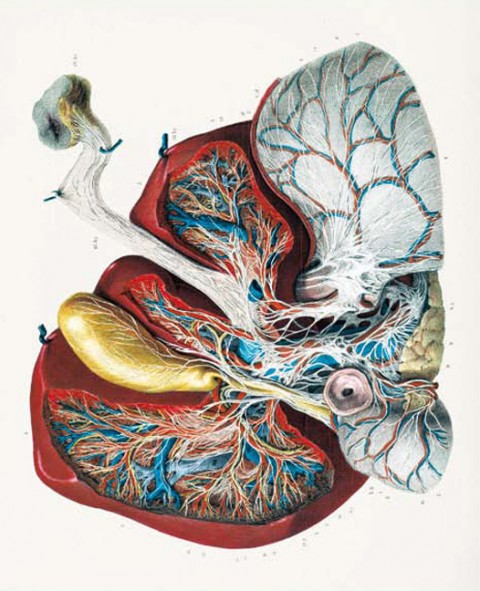
J.M. Bourgery's Atlas of Human Anatomy and Surgery


Mapping the human body

One of the most remarkable works in the whole history of anatomy: J.M. Bourgery's Atlas of Human Anatomy and Surgery


A monumental work of the 19th century

Anatomical knowledge was for a long time limited to data gathered from the dissection of animals by Galen (c. 130 - c. 200), a Greek physician who practised in Pergamon and Rome, and whose influence was considerable right up until the 16th century. In the Middle Ages, the only work on anatomy truly worthy of the name was that of Mondino dei Luzzi (c. 1275-1326), written in 1319 and titled Anathomia; taking up the data of Galen, he made some interesting observations on the basis of human dissections he had undertaken in 1315. These works were disseminated in the form of manuscript copies and were very sparsely illustrated. With the invention of printing by Johann Genfleisch, alias Gutenberg (pre-1397-1468) in about 1450, the dissemination of knowledge was to increase by leaps and bounds. The so-called incunabula, in other words works printed before 1500, include the first edition of the Anathomia of dei Luzzi, printed in 1478. The anatomical drawings of Leonardo da Vinci (1452-1519), 228 handdrawn plates of incredible scientific quality, occupy a very marginal place, because they were never edited and were ignored by the scholars of the day. Published for the first time in 1898, they had no impact on the development of the subject. In 1543 the work by André Vésale (1514-1564), De humani corporis fabrica, was published in Basle; it is indisputably the most outstanding book in the whole history of anatomy both in respect of its concept and of its aesthetic qualities. The publication of this work represented a veritable scientific revolution, providing a new vision of Man by replacing Galen's speculative studies and his extrapolations from animal anatomy by systematic dissections of the human body. Vésale's work comprises 25 superb plates separate from the text, and numerous figures within the text, all of them woodcuts, probably the work of Jan Stephan von Calcar, who belonged to Titian's circle. This book, of which a second improved edition appeared in 1555, and which went through several more, had a considerable impact and was copied by numerous authors.


La primera imagen que nos lanzó en la busqueda de este maravilloso Atlas of Human Anatomy and Surgery (re-editado por Taschen) la encontramos ilustrando la portada del fabuloso libro El rival de Prometeo, Vidas de autómatas ilustres con una edición deliciosa muy cuidada a cargo de la no menos fabulosa Marta Peirano.

Japanese anatomical charts


En morbid anatomy tienen una muy buena colección de imágenes en torno a la cartografía del cuerpo, cómo este ejemplo de una entrada sobre imágenes de anatomía japonesa. Más aquí, aquí y aquí.