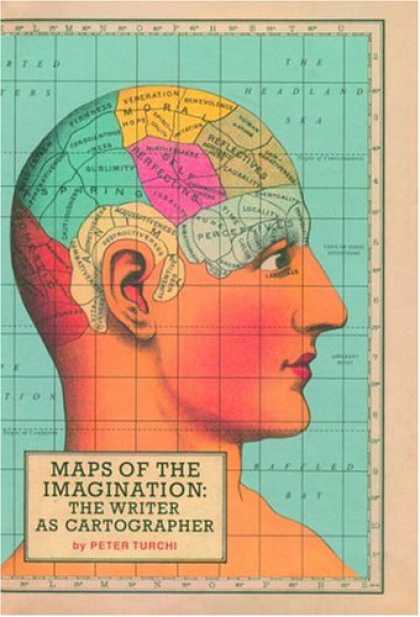
The map is a subtle and beautiful art form that is often held for its merest and most mundane of functions: to get its reader from point A to point B. But a map, deconstructed, is so much more. As graphical representations of our geographic world, maps figuratively contain within them the living and changing lives of us all. Someday, perhaps, maps will be as dynamic as the worlds they detail. As with the charmed maps of J.K. Rowling's Harry Potter series, the symbols of the map will move and change with the movements of the objects they represent. For now, however, we must rely upon our imaginations to invoke the richness only hinted at on paper.
In You Are Here: Personal Geographies and Other Maps of the Imagination, Katharine Harmon has shared her own love of maps by collecting a broad-ranging variety of art form. Not content to praise the intrinsic art of the geographic map, Harmon calls our attention to the labors of imaginative mapmakers who have charted regions emotional, biological, historical, culinary, and…well, you name it, it's in there.
In You Are Here: Personal Geographies and Other Maps of the Imagination, Katharine Harmon has shared her own love of maps by collecting a broad-ranging variety of art form. Not content to praise the intrinsic art of the geographic map, Harmon calls our attention to the labors of imaginative mapmakers who have charted regions emotional, biological, historical, culinary, and…well, you name it, it's in there.
She begins with a petroglyphic map from 2500 B.C., and launches from there into a chapter on personal geographies, all of which explore the body and mind of the human animal. These include such maps as "Main Route of Expedition Through the Alimentary Canal," acupuncture diagrams, and group dream maps. Outstanding in this collection is Adolf Wolfli's maps of the "Island Neveranger." Wolfli was a schizophrenic committed to a mental asylum in Germany at the age of 31, who, while confined, produced a startlingly rich output of imaginative work that included maps from his richly imagined world. These are highly detailed and wonderfully colored works from Wolfli's rich imaginary iconography.
The next chapter, titled, "At Home in the World," is equally diverse. A poem from Howard Horowitz typeset into the shape of Manhattan Island took the author one-and-a-half years to write. This poem-map is quite stunning, but pales next to a the intricately detailed map of Srinigar, a village in Kashmir, India, that was hand-embroidered on a wool and cloth shawl in the 19th century. Works from celebrated artists appear here also such as a map from illustrator, John Held Jr., known for his early 20th century caricatures, and William Wegman's "Vacationland," a postcard collage in oils celebrating tourist attractions.
The final chapter, "Realms of Fantasy," focuses in on geographic maps of fantastic or fictional realms. These vary from Julia Ricketts' colorfully abstract "Notations on a River," which explores the interplay of natural and man-made landforms, to Mark Bennett's highly detailed map of the Town of Mayberry. My personal favorite in this section is a map entitled "The Great Bear," in which artist, Simon Patterson, transposes the names of historical figures onto a universally recognizable map of the London Underground. Tube riders can jump on the Blue Line at Michelangelo, change to the Yellow Line and take that East to Plato. Transferring to the Red Line can take the rider to Rupert Murdoch, Louis Pasteur, or even Dick Cheney.
Years before the publication of You Are Here, I met an artist whose painted upon GIS maps of various world regions. I was thoroughly captivated then, and I still am. Perhaps, as Katharine Harmon suggests, we humans have an innate urge to map.
Today, inspired by You Are Here, I built a "map" of plastic pails, shovels, and other sandbox toys with my children. I laid the foundation, a starting point and an ending point with roads drawn into the sand to connect the two, and then invited my kids to join in. Before it was over, they had built quite a sandbox menagerie that included roads, lakes, bridges, and even an amusement park, all symbolically arranged in sand and plastic toys. I don't know if it was innately motivated, but it sure was cool.
Info desde aquí.
Years before the publication of You Are Here, I met an artist whose painted upon GIS maps of various world regions. I was thoroughly captivated then, and I still am. Perhaps, as Katharine Harmon suggests, we humans have an innate urge to map.
Today, inspired by You Are Here, I built a "map" of plastic pails, shovels, and other sandbox toys with my children. I laid the foundation, a starting point and an ending point with roads drawn into the sand to connect the two, and then invited my kids to join in. Before it was over, they had built quite a sandbox menagerie that included roads, lakes, bridges, and even an amusement park, all symbolically arranged in sand and plastic toys. I don't know if it was innately motivated, but it sure was cool.
Info desde aquí.