14/5/15

Julieta Aranda & Ana Teixeira Pinto — Turk, Toaster, Task Rabbit ; Supercommunity; e-flux journal 56th Venice Biennale, 2015

Vandals take over virtual Denmark in Minecraft and trash it with American pride.
This is a text about the utopia of a frictionless space defined by perfect reception and its discontents.
In the late eighteenth century a chess-playing automaton toured the courts of Europe. Known as the “Mechanical Turk,” the automaton defeated Napoleon and Benjamin Franklin before being exposed as a hoax: hiding in its innards, a human operator was, in fact, moving the chess pieces. In a way, this was a reverse Turing test, predating Turing: a kind of labor in which it is required that humans pass for machines—with all that this passing entails, mainly a forfeiting of needs and rights, and more importantly, a forfeiting of time. In 2005 Amazon resurrected the “Turk” but generalized its principle: the Amazon Mechanical Turk is a crowd-sourcing internet marketplace that “enables individuals and businesses to coordinate the use of human intelligence to perform tasks that computers are currently unable to do.”( See Wikipedia entry on Amazon Mechanical Turk →)

Technically speaking, every mechanism usurps a human function. Automation has a political unconscious: behind every attempt at automating the production process lies what Barbrook and Cameron called the “quest for the perfect slave,” who will never rebel or ask for a raise. (Richard Barbrook and Andy Cameron, “The Californian Ideology,” Mute, vol. 1, no. 3 (Autumn 1995)  )

Since the first Industrial Revolution, several waves of techno-utopianism have sought to extract slave-like labor from automatic machinery. But whereas technology is usually expected to render work obsolete, to free laborers from the curse of labor, in reality it tends to render workers more pliable and prone to exploitation, and ends up extracting machine-like labor from automated humans.

Automation also breeds technically challenged pockets, cracks, and fissures, which need to be filled by humans. It is within these zones of friction between the social and the economic that one finds mechanical turks and task rabbits: labor that cannot unionize and to whom you do not even owe the courtesy of offering a hot cocoa for shoveling the snow out of your driveway.

In the wake of the USSR’s demise, Wired magazine ran a cover story titled “The Long Boom,” which claimed that, no longer encumbered by political strife and ideological antagonism, the world would witness unending market-driven prosperity and unabated growth. (The header read: “We’re facing twenty-five years of prosperity, freedom, and a better environment for the whole world. You got a problem with that?” )

 The convergence of media, computing, and telecommunications would inevitably beget freedom and direct democracy. But the fall of the Berlin Wall didn’t mark the beginning of a global democratic era—rather, its opposite. As a United States senator once said, the European welfare state was an aberration, an effect of the Cold War; once Communism had been defeated, social democracy became redundant.
German Chancellor Angela Merkel tests a robotic arm while visiting one of the leading producers of industrial robots in the KUKA factory in Augsburg, Germany. The <em>New York Times</em> recently referenced the company in its coverage of the increasing automation of assembly lines in China. See <a  data-cke-saved-href="http://www.nytimes.com/2015/04/25/technology/robotica-cheaper-robots-fewer-workers.html?_r=0" href="http://www.nytimes.com/2015/04/25/technology/robotica-cheaper-robots-fewer-workers.html?_r=0" target=“new”>→</a>
German Chancellor Angela Merkel tests a robotic arm while visiting one of the leading producers of industrial robots in the KUKA factory in Augsburg, Germany. The New York Times recently referenced the company in its coverage of the increasing automation of assembly lines in China. See
Though the internet was hailed as a solution to all kinds of perennial problems—blogs will solve the issue of the corporate consolidation of the press; Bitcoin will solve currency manipulation and rampant corruption in financial markets; social media will fix the democratic deficit—the digital economy entails a shift from a formal to an informal economy, which replaces formal benefits, like salaries, pensions, and social safety nets, with “likes” and barter, while the formal benefits accrue to the very few. (Social theorist Jaron Lanier points to the case of Instagram, sold for a billion dollars but employing only thirteen people, as an example of how the internet is shrinking the economy—clearly, Instagram’s “users” are the ones producing its value, yet their work is not formally rewarded.)


Under the twin pressures of financialization and what is called “the sharing economy,” capital has emancipated itself from its direct relationship to labor—which is not to say that it has done away with work; it has just overcome the need to pay formal salaries, along with the claim to formal possessions. As Anthony Marcellini has put it, “every new technological advance means that we get to do for free work that we used to be paid for, and that we get to lease the things that before we were able to own.”The idea of citizenship, with all its rights and social obligations, has faded and given way to the citizen-as-user, and the main function of the state has simply become to guarantee that credit is converted back onto cash payments, no matter how much misery such conversion causes. In Living in the End Times, Slavoj Žižek contends that the (brief) marriage of capitalism and democracy is over, but what seems to be also over is the (rather longer) affair between capitalism and the middle classes. While countries have shifted from being the providers of services (health care, education, welfare) to being the procurers of—mostly financial—services, corporations behave more and more like countries. These new multinational corporate states are not bound by the constraints of physical geography, but this doesn’t mean that they are boundless territories. As the digital sphere becomes incorporated, a virtual geography starts to become apparent. In order to better grasp its constitution, we must accept that it does not intend to function as a 1:1 representation of real space, (When physical states attempt to map themselves in this territory, the failure of this attempt at representation becomes apparent. In March 2014, the Danish Ministry of the Environment released a 1:1 topographical map of the entire country of Denmark in Minecraft, only to have it attacked by American hackers within two weeks. The hackers smuggled game “dynamite” into the map, planted American flags, and razed entire cities.)

or to become a virtual equivalent to reality, because it is not defined by contiguous space, nor is it defined by the standard markers of the nation-state (race, religion, language, colonization). Rather, it is structured around notions of profit, and it doesn’t limit itself to the physical sphere; it actually cuts into both personal space and time, extracting information and monitoring your geolocation in the process of defining itself and its own boundaries. Curtailing the potentiality of the medium, a not-quite-obsolete authority enters into operation. Instead of a seamless World Wide Web, we are faced with the creation of artificial borders: the corporate sandboxing of the digital sphere.(It is no accident that this is the name for it, and a sandbox is where children play.)
 
How do digital borders manifest? In the sandboxing of devices made by Apple, which prohibits the use of third-party apps and penalizes the jailbreaking of iPhones. Or in China’s internet policy, which determines the bounds of Google. These invisible borders were also apparent in January 2014 when cellphone users in Ukraine who happened to be near the scene of the Maidan clashes received text messages saying, “Dear subscriber, you are registered as a participant in a mass riot.” Willingly or not, these users were about to cross the border between the good and the bad Kiev.

Though social media was hailed as the enabler of the Arab Spring, the millions who took to the streets achieved no political gains, and, in the wake of Snowden’s revelations, an even darker picture of a corporate, surveillance-driven internet began to emerge. Displacing and complicating the image of the internet as a space of limitless possibility, the World Wide Web, like the Lacanian mother, was split in two. (Lacan argues that since babies cannot conceptualize ambivalence, they split the image of the mother into the “good” nurturing mother and the “bad” absent mother.)

 Instead of a good internet, based on communication and community, we are now faced with the bad internet, a tool of corporate surveillance and political punishment. Everywhere, the global circulation of images and commodities goes hand in hand with increasing partitions in the social sphere: segregation, cultural difference, inequality.
"Hello World!" is often used to illustrate basic syntax of a programming language and to verify that a system is operating correctly. Here, a device prints the sentence onto brioche toast.
If we understand digital space as a territory in its own right, we need to scrutinize how said territory is being mapped. This is not happening with Borgesian fidelity, (“In that Empire, the Art of Cartography attained such Perfection that the map of a single Province occupied the entirety of a City, and the map of the Empire, the entirety of a Province. In time, those Unconscionable Maps no longer satisfied, and the Cartographers Guilds struck a Map of the Empire whose size was that of the Empire, and which coincided point for point with it. The following Generations, who were not so fond of the Study of Cartography as their Forebears had been, saw that that vast map was Useless, and not without some Pitilessness was it, that they delivered it up to the Inclemencies of Sun and Winters. In the Deserts of the West, still today, there are Tattered Ruins of that Map, inhabited by Animals and Beggars; in all the Land there is no other Relic of the Disciplines of Geography.” Jorge Luis Borges, March 1946 edition of Los Anales de Buenos Aires, vol. 1, no. 3.) 

as the corporate interests that are trying to describe this territory are not concerned with accuracy or diversity, nor are they interested in the imaginary (in old maps, unknown lands were often inhabited by fantastical beings, like sea serpents, monstrous beasts, or mermaids, whereas the maps of the digital world are being drawn in Silicon Valley, with little regard for mapping unique or differentiating characteristics of space). Instead of imagining how one could inhabit the spaces being mapped, the digital topographers labor to create a homogeneous landscape where a user is a user is a user, disregarding the social and cultural “accidents” in the landscape, and filling the unknowns in the map with replicas of themselves.
President Obama is hugged by a koala bear before the start of the first G20 meeting on November 15, 2014 in Brisbane, Australia.
In her seminal essay “The Cyborg Manifesto,” Donna Haraway argues that the effect of a digital ontology is the effacement of all oppositions. Instead of firm dichotomies, the distinction between “human and animal,” between “organism and machine,” and between “physical and non-physical,” are increasingly leaky; everything becomes “nothing but signals, electromagnetic waves, a section of a spectrum.” The digital frontier carried the promise of a postpolitical condition, free of agonism and struggle; and of an economy of abundance instead of an economy of scarcity. But the California dream was a weak utopia: the frictionless space of perfect technological reception is a first-world effect. The conditions in which innovation is produced have nothing to do with the conditions into which it is deployed. Or, to put it in William Gibson’s words, “The future is already here. It’s just not evenly distributed.” (Quoted in The Economist, December 4, 2003.)

The many remain as a digital brute force, the garbage men of post-Fordism, a collective headless body performing menial tasks. Either on- or off-line, “slave labor cannot be obtained without somebody being enslaved,” and no technological fix will be able to solve our social problems because technology itself engenders them. (Barbrook and Cameron, “The Californian Ideology.” )

No technology is immaterial or self-sustaining, and its high level of energy consumption degrades both the social and the natural environment; it produces material, animal, and human waste. (In Baotou, Mongolia, the byproduct of rare earth mineral mining has created a vast toxic lake that spans several kilometers. Baotou’s main exports are neodymium—used to produce lightweight magnets for in-ear headphones, cellphone microphones, and computer hard drives—and cerium oxide, mostly used to polish touchscreens on smartphones and tablets. One Kindle consumes the resources of four dozen books and has the carbon footprint of a hundred.)

The production of digital/affective devices, which double as control mechanisms, is dependent on the decimation of every digitally underrepresented region of the world. As this new geography displaces the old, the digital subject becomes more visible than the physical subject. While the circulation of celebrities, luxury goods, liberal professionals, tourists, and financial flows occupies the whole field of visibility, refugees, seasonal workers, immigrants, and illegal aliens are rendered invisible.
A vast toxic lake surrounds Baotou, Mongolia, the result of mining and processing the region's rare earth minerals.
What does the future look like for those lacking digital representation? And what does it look like for those who are overrepresented—the digitally obese? If the conditions under which I exist are too precarious for me to be considered a user in this new landscape, I may be destined for extinction, or I may already be extinct, part of a barren, obsolete present that will soon be discontinued.

But it may be that the constitution of this subject is not yet fully graspable, and that in the rush to create the conditions for its viability, we have neglected to generate the tools to understand the atomized psychological space that she inhabits. If subjectivity was a function of private property, what happens when all the frameworks of ownership are incorporated?(General Motors and John Deere have argued that copyright law cannot conflate ownership of a vehicle with ownership of the underlying computer software. In response, lawmakers in Minnesota and New York have introduced “Fair Repair” legislation that asserts an owner’s right to repair electronic equipment they’ve purchased. )

Even though the digital obeys physical laws that locate it within the material world, digital bodies are not fully recognized, and there is an ever-widening gap between how the treatment of a subject is prescribed, and how the subject is constructed. Take the example of the person who is institutionalized and has to surrender her digital devices so that she will be forced to interact only with her real friends, even though her relationships are at this moment dependent on her being able to reach them through the very same devices that are being taken away. This atomized space, which has opened up because of our reliance on technology, imbues devices with an affective quality, akin to that of transitional objects to a subject whose hetero-affective other is not necessarily human—the “selfie” is no longer analogous to a self-portrait, but functions rather as some kind of degraded mirror stage for this child of technology that sees the internet as her mother.

The logic of old-media temporality was color-coded: contemporary Africa was black and white, just like Dickensian England. To boot: the third world’s present belongs to the first world’s past. In the diffuse world of post-Fordist economies, all matter is in permanent motion, and all temporalities are spatialized. Online, every social form gets to have a second life; everything is an image; and all images are up for grabs. The Space Race has been revived as an extension of digital incorporation, but the fantasy of a cultural totality is full of cracks, and the increasingly pervasive vectors of global communication are by far more chaotic than one would care to suggest. Clerics in the UAE have chosen to distance themselves from this frontier narrative, issuing a fatwa that prohibits Muslims from joining any Mars expedition. (The UAE has deemed that there is no righteous reason for humans to travel to Mars; were Muslims to perish attempting the trip, their death would be considered akin to suicide. Reportedly, around five hundred Saudis and other Arabs applied online for the Mars One mission (the first prospective martian colony, the brainchild of a Dutch Company).)

The US Department of Defense regularly posts drone-captured footage on its official YouTube channel; known as “drone porn,” these videos show recorded attacks and targeted killings. One could point to the reciprocal relationship they establish with the executions—typically beheadings—posted by fundamentalist insurgent groups: the more “drone porn” treats human casualties as metadata, the more gruesome Islamic State videos become. Rather than images of asymmetrical warfare, we could say that these are images at war (literally, with each other) over the image of the digital body. Although it is not possible to map the physical self onto the digital self, one could perhaps say that, in the guise of a Hegelian totality, an essence manifests itself in its alienation: every phenomenon is also defined by what it negates, falsifies, denies.

The internet doesn’t exist, but its effects are real—our electronic highways are littered with roadkill. Marx’s greatest achievement—unparalleled to this day—was to render capital’s operations visible. At present, conspiracy theory is the poor person’s critique of ideology. Though optical technologies produce images of virtually everything, the greatest problem is opacity. As the visual became fully mediated, technology severed the link between image and representation.
Mars One aims to establish the first human colony on Mars by 2027.
Is it possible that, as Hito Steyerl suggests, the gap between the two forms of representation—political on the one hand, cultural on the other—is a constitutive feature of communication technologies and social media? Are the mechanisms that enable cultural participation simultaneously generating political exclusion?(See Tony Wood, “Reserve Armies of the Imagination,” New Left Review 82 (July–August 2013) →)

Up until now a case has been made for the idea that the technical takes precedence over the social. But the internet is political before being technical. The consolidation of financial vectors runs parallel to the total disintegration of social bonds: the more integrated the algorithmic mapping, the more scattered social relations become. Across a dispersed marketplace, most of us are barred from all but a consumptive relation to “the global village.” The idea of a cultural totally (the internet as a single technological entity) displaces social erosion, but what appears as the medium’s phenomenology is in fact its ideology. The image of the internet is the degraded cipher for the total logic of capital.

Maybe the transition from analog to digital media can be seen as an aesthetic rather than an ontological problem. Representing nature as spectacle and the biosphere as totality,(To paraphrase Kerstin Stakemeier, “Lunch Bytes: On Art and Digital Media” conference, Haus der Kulturen der Welt, Berlin.)

the “postinternet condition” can perhaps be best described as a style(As suggested recently by Philipp Ekardt at the “Lunch Bytes: On Art and Digital Media” conference, Haus der Kulturen der Welt, Berlin.)
 
 : what Emily Apter has called “oneworldedness” (Emily Apter, “On Oneworldedness: Or Paranoia as a World System,” American Literary History, vol. 18, no. 2 (Summer 2006): 365–389. )


(another name for Empire), or what Diedrich Diederichsen has described as a “vulgar Latourian fairy-tale,” or an “aesthetics of affectivity” (“Lunch Bytes” conference.)


coupled with a mobilization of nature at the service of a human agenda—a common theme in Romanticism, which is about to be intensified by the introduction of the Internet of Things—conflated with Warholian currency (appropriation, debasement, iconophilia) and symbolist themes and tropes (liquidity, the over-humanization of nature, existential ennui, pastiche, esotericism, disaffection). What we call “third nature” can also be seen as reified history, while what masquerades as convention is actually allegory.
 

Once nature has disappeared, everything becomes a human sign, but whether the convergence of computing with bioengineering will bring about a “technological singularity” or result in a digital theme park is yet unclear. By 2020 there will be nearly twenty-six billion devices connected to the Internet of Things—twenty-six billion talking toasters, probably equipped with endearing interfaces—but the sublation of nature into culture will coincide with the consolidation of corporate ownership. The more technology merges with biology the more it becomes opaque qua technology; the more opaque this technology, the more transparent it renders its users. Our object-world will become ever more animated and lively, only that toaster will no longer be truly ours.

In spite of the political, economic, and ecological crisis of the last few years, the new social forms and categories that have emerged have failed to constitute themselves politically, and it’s hard to fathom what form change could take. In the absence of a collective horizon, the new (second) Industrial Revolution might not lead to the future but to the past, to a Victorian phantasmagoria of sorts, supplemented by consumer gadgetry and semiotic fetishism. A place akin to the Zone in Andrei Tarkovsky’s Stalker, a sentient environment able to materialize all your dreams—but with a twist.

×


4/2/15

Never trust a corporation to do a library's job; Andy Baio, January, 2015.

As Google abandons its past, Internet archivists step in to save our collective memory


Google wrote its mission statement in 1999, a year after launch, setting the course for the company’s next decade:
“Google’s mission is to organize the world’s information and make it universally accessible and useful.”
For years, Google’s mission included the preservation of the past.
In 2001, Google made their first acquisition, the Deja archives. The largest collection of Usenet archives, Google relaunched it as Google Groups, supplemented with archived messages going back to 1981.
In 2004, Google Books signaled the company’s intention to scan every known book, partnering with libraries and developing its own book scanner capable of digitizing 1,000 pages per hour.
In 2006, Google News Archive launched, with historical news articles dating back 200 years. In 2008, they expanded it to include their own digitization efforts, scanning newspapers that were never online.

In the last five years, starting around 2010, the shifting priorities of Google’s management left these archival projects in limbo, or abandoned entirely.
After a series of redesigns, Google Groups is effectively dead for research purposes. The archives, while still online, have no means of searching by date.
Google News Archives are dead, killed off in 2011, now directing searchers to just use Google.
Google Books is still online, but curtailed their scanning efforts in recent years, likely discouraged by a decade of legal wrangling still in appeal. The official blog stopped updating in 2012 and the Twitter account’s been dormant since February 2013.
Even Google Search, their flagship product, stopped focusing on the history of the web. In 2011, Google removed the Timeline view letting users filter search results by date, while a series of major changes to their search ranking algorithm increasingly favored freshness over older pages from established sources. (To the detriment of some.)


Two months ago, Larry Page said the company’s outgrown its 14-year-old mission statement. Its ambitions have grown, and its priorities have shifted.
Google in 2015 is focused on the present and future. Its social and mobile efforts, experiments with robotics and artificial intelligence, self-driving vehicles and fiberoptics.
As it turns out, organizing the world’s information isn’t always profitable. Projects that preserve the past for the public good aren’t really a big profit center. Old Google knew that, but didn’t seem to care.
The desire to preserve the past died along with 20% time, Google Labs, and the spirit of haphazard experimentation.
Google may have dropped the ball on the past, but fortunately, someone was there to pick it up.


The Internet Archive is mostly known for archiving the web, a task the San Francisco-based nonprofit has tirelessly done since 1996, two years before Google was founded.
The Wayback Machine now indexes over 435 billion webpages going back nearly 20 years, the largest archive of the web.
For most people, it ends there. But that’s barely scratching the surface.
Most don’t know that the Internet Archive also hosts:
That last item, the software collection, may start to change public perception and awareness of the Internet Archive.


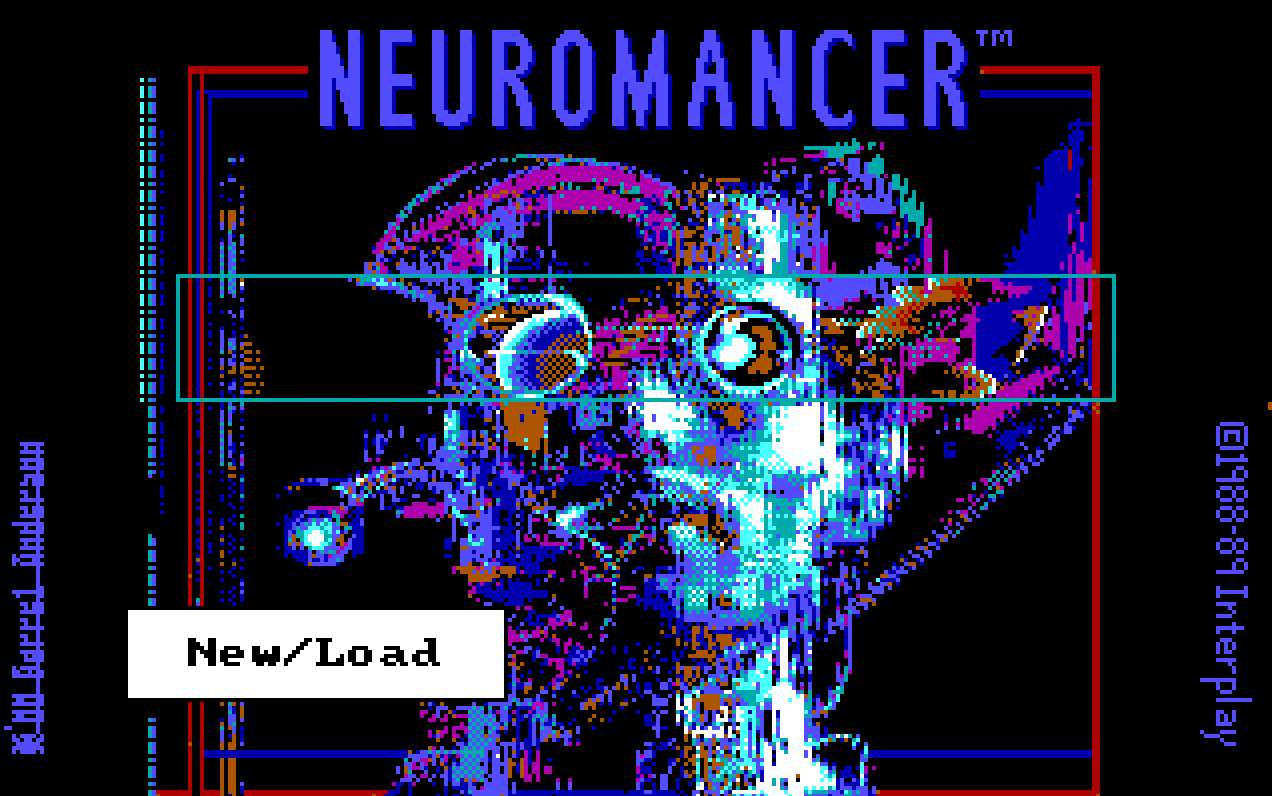
Title screen from 1988's Neuromancer. Soundtrack by Devo. Yes, really.

Spearheaded by archivist/filmmaker Jason Scott, the software preservation effort began on his own site in 2004 with a massive collection of shareware CD-ROMs from the BBS age.
After he joined the Internet Archive as an employee, he started shoveling all that vintage software onto their servers, along with software gathered from historic FTP sites, shareware websites, tape archives, and anything else he could find.
But actually using old software can be rough even for experienced geeks, often requiring a maze of outdated archival utilities, obscure file formats, and emulators to run.
In October 2011, Jason Scott wrote a call-to-arms aimed at making computer history accessible and ubiquitous — by porting classic systems to the browser.
“Without sounding too superlative, I think this will change computer history forever. The ability to bring software up and running into any browser window will enable instant, clear recall and reference of the computing experience to millions.”
The project started attempting a Javascript port of MESS, the incredible open-source project to emulate over 900 different computers, consoles, and hardware platforms, everything from the Atari 2600 and Commodore 64 to your old Speak & Spell and Texas Instruments graphic calculator.

Two years later, it was all real.
In October 2013, the Internet Archive tested the waters with the Historical Software Collection, 64 historic games and applications from computing history playable in the browser. No installation required — just one click, and you were trying out Spacewar! for the PDP-1, VisiCalc for the Apple II, or Pitfall for the Atari 2600.
By Christmas, they launched The Console Living Room, nearly 3,000 games from a dozen different consoles. Popular systems like the ColecoVision and Sega Genesis were represented, but also obscure and hard-to-find consoles like the Fairchild Channel F and Watara SuperVision.
A year later, they launched the Internet Arcade — hundreds of classic arcade games emulated with JSMAME, part of the JSMESS package.

Earlier this month, the Archive made headlines with the latest addition to its collection: nearly 2,300 vintage MS-DOS games, playable in the browser.
A technical breakthrough, the games are played on the popular DOSBox emulator, ported to Javascript by one brilliant, talented engineer.
The experience of clicking a link and playing a game you haven’t seen in 25 years is magical, and many other people felt the same way.
News of the MS-DOS Game Collection got widespread media coverage, including The Washington Post, The Verge, and The Guardian, with thousands of people hitting the site every minute.
Millions of people are discovering software they’ve never seen before, or revisiting games from their past. People are making Let’s Play videos of 30-year-old games, played in a Chrome tab.


When this launched, there were dozens of confused comments from people wondering what old videogames has to do with Internet history.
In my mind, this stems from mistaken perception issues of the Internet Archive as solely an institution saving webpages.
But their mission and motto is much broader:
Universal access to all knowledge.
The Internet Archive is not Google.
The Internet Archive is a chaotic, beautiful mess. It’s not well-organized, and its tools for browsing and searching the wealth of material on there are still rudimentary, but getting better.
But this software emulation project feels, to me, like the kind of thing Google would have tried in 2003. Big, bold, technically challenging, and for the greater good.
This effort is the perfect articulation of what makes the Internet Archive great — with repercussions for the future we won’t fully appreciate for years.
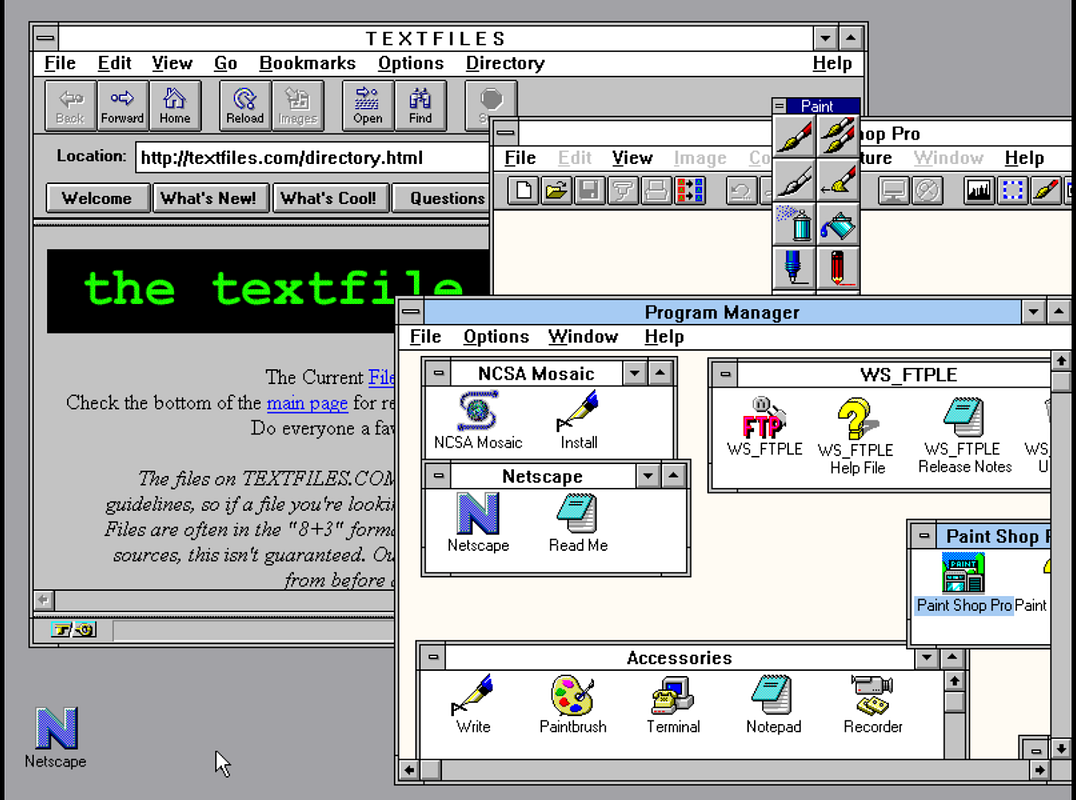
But here’s a glimpse: last week, one of the JSMESS developers managed to get Netscape running on Windows 3.1 with functional networking. All of computing history is within our grasp, accessible from a single click, and this is the first step.


I played Solitaire while I waited for Trumpet Winsock to connect to the Internet. In a Chrome tab.
It’s not just about games — that’s just the hook.
It’s about preserving our digital history, which as we know now, is as easy to delete as 15 years of GeoCities.
We can’t expect for-profit corporations to care about the past, but we can support the independent, nonprofit organizations that do.


From here.

15/11/14

Borrowed Energy; Timotheus Vermeulen talks to philosopher Rosi Braidotti; September 2014.

Timotheus Vermeulen talks to philosopher Rosi Braidotti about the pitfalls of speculative realism, the movement that has created a buzz in the art world 

image
Alisa Baremboym, Untitled, 2012, ceramic, USB cable and gender changer, 27 × 17 × 12 cm. Courtesy the artist and 47 Canal, New York
Over the last few years, there have been seemingly countless exhibitions and symposia about the philosophical movement known as speculative realism; indeed, the German art journal Texte zur Kunst devoted a themed issue to it earlier this year. A philosophy that foregrounds speculation was always going to offer points of entry for artists, whose discipline trades in imagination, but few would have predicted the speed with which it’s been picked up by them.
As writers and artists associated with speculative realism are eager to point out, the first thing to understand is that it is not a single philosophy. Rather, it is a label for a broad range of different ideas. Some of these are concerned with science, others with commodity culture, still others with ecology; there are hefty declamations à la Alain Badiou, and sprawling blog essays in the spirit of Gilles Deleuze. Indeed, the 2007 academic conference at Goldsmiths College in London, which lent speculative realism its name, featured four philosophers – Ray Brassier, Iain Hamilton Grant, Graham Harman and Quentin Meillassoux – whose thinking exhibits considerable differences. What their positions have in common, however, and what have given them this collective label, are their attempts to think beyond the limits of what we, as human beings, were long considered able to think, speculating instead about the nature of the non-human: cotton, stones, mosquitoes, the world around us.
If we are to believe the speculative realists, philosophy since Kant has been premised on the idea that we can only know the world in which we live, in so far as we can perceive it through our senses. Every discussion about the nature of the world is inevitably a discussion about us discussing it: about our vantage point, our intentions and so on. The term for this is ‘correlationism’: one already implies the other.
The speculative realists accuse Kant of placing a mirror between us and the world, forcing us to look at ourselves looking. Others are blamed for annotating the mirror: a thought by Hegel scribbled in the centre; a Schopenhauer Post-it at the bottom; a doodle by Derrida in the corner. Kant and his offspring may describe this as ontology (the study of being) but, in fact, they are busying themselves with epistemology (the study of knowledge).
This is a very particular reading of a very particular Kant – it is not the Kant of the Critique of Judgement (1790), nor of the numerous essays on history he published over the course of 15 years, in which he proposed an attitude to the world that Eva Schaper has described in terms of an ‘as if’ – words that are remarkably similar to Meillassoux’s peut-être or ‘may-being’: how things could be. As Rosi Braidotti – one of the most important feminist philosophers of our time – points out in the following interview, correlationist anthropocentrism was a topic of debate long before the speculative realists joined in, not least among Deleuze scholars. It is certainly true, though, that there have been thinkers who have taken Kant’s cautiously correlationist claim as a given and who accept a logic that prioritizes the self over the other.
As far as I understand it, there are, by and large, two different strategies the speculative realists have come up with in order to speculate about the world around them. The first one is to shatter the Kantian mirror. The speculative realist can now look at the world unobscured by any reflection of himself or comments from others. (I say ‘himself’ as almost all speculative realists are men, in stark contrast to those associated with the congenial currents of new materialism or, to a lesser extent, object-oriented ontology.)
The second strategy is not to shatter the mirror but to turn it around, so that it faces away from the subjects towards the world: the world is in a relationship with itself. It is beyond me how we might describe this scenario, but since books have been written about it, I can only assume it must be possible.
However, in many ways, I find speculative realism stimulating, and I can understand why others feel an affinity with it. I am part of a generation that is tired of the endless epistemological discussions of modern philosophy, in large parts paralysed by the closed-circuit narcissism of post-structuralism. The speculative realists – if only by demonstrating that there are alternatives, or possibilities that currently seem unrealizable – have revived the debate.
That said, an apparent tendency to treat social and economic discourses as mere side aspects of organic evolution, or a disregard for issues of race and gender – a problem that, to be sure, some speculative realists such as Levi Bryant and Steven Shaviro are ready to acknowledge – has, unsurprisingly, brought about vehement criticism from neo-Marxist, feminist, queer theory and critical race theory camps.
Braidotti is one of the founders of neo-materialist feminism, a current that has been particularly critical of the speculative realists. The author of such canonical books as Nomadic Subjects (1994), Metamorphoses: Towards a Materialist Theory of Becoming (2002), Nomadic Theory (2011) and, most recently, The Posthuman (2013), Braidotti has spent her career updating post-structuralist theories of the subject to acknowledge material conditions. One of her key arguments is that, in order to counteract the influence of advanced capitalism, we need to mimic its logic. Though appreciative of the interest the speculative realists express in matter, she is also fiercely critical of their disregard for the epistemology of the subject.


Timotheus Vermeulen
You were trained in the tradition of post-structuralism but quickly abandoned the models associated with that tradition – semiotics, deconstruction – for Deleuzian theory. In your writings on nomadism, you have been rethinking the historical subject; in your work on cosmopolitanism and feminism, you revised the boundaries of the political subject; and now, in your recent book on the posthuman, you have begun reconsidering the centrality of the human altogether.
Rosi Braidotti
Well, I am no longer young and have a long itinerary! My decision to break with the post-structuralists was conscious, up to a point. It stemmed both from an intellectual dissatisfaction and from personal disappointment. As for the latter, I came to Paris in 1977 on an Australian scholarship to study with Foucault. At the time, he was making a name for himself in France but had not yet been discovered by the Americans and the British, though there were some Australians reading him. At his lectures, however, I found him to be quite misogynistic. His seminars were no place for women. It remains one of the tragedies of women’s studies, therefore, that his work – the few unfinished paragraphs and footnotes devoted to women – became such a reference point. I experienced similarly gendered politics with Lacan, who out of personal frustration destroyed the career of his student Luce Irigaray. Intellectually – in spite of all the respect I had and have for him – I became impatient with Derrida’s meta-method of deconstruction. It was always deconstruction: that was his method; that was his answer. I felt much more at home in the seminars of Deleuze, which, at the time, I did not always understand but intuitively, in my gut, agreed with. Instead of deconstruction, Deleuze talked of reconstruction. Here were new theories of the subject, new notions of ethics!

TV Your own work has been shaped by the attempt to develop new, affirmative and productive theories of the subject. Your best-known concept, probably, is the nomadic – even Pussy Riot were reportedly influenced by it. Could you explain what you mean by it?
RB What is important to understand is that the nomadic is a navigational tool, not a concept. It is intended as a way of navigating the conditions of the present, of advanced capitalism. I always say that there are three components to it: the analytical, the normative and what I call the programmatic or utopian. The analytical part consists of a critical cartography. It tries to map what it means to live at this particular moment in time. These parameters of advanced capitalism can be characterized best, simply put, as those of displacement and mobility. We are all displaced, we are all mobile. Some of this displacement and mobility may be experienced positively, such as through Skyping and Erasmus exchanges, but much of it is disruptive. Just think of the uprootedness and homelessness many refugees and migrants have to endure; or think of the banality of commuting.
I take the nomadic to be normative in so far as it describes, or should describe, an ethics. The cartography of an earlier stage of capitalism could be drawn up along the lines of dualities: self and other, master and slave, culture and nature. Hegel and Marx, therefore, developed a normative and increasingly programmatic ethics of dialectics, an ethics premised on the principle of duality, of the two, the binary, thesis and antithesis. We have now moved from the dualistic system they describe, however, to a monistic one. One that is continuous and coterminous with itself. We must accept that capitalism will not break. It may bend, but it will not break. As Deleuze and Guattari pointed out, it is flexible: capitalism is able to adapt to any given state formation, to Dutch social democracy as easily as to Chinese authoritarianism. This does not mean that we cannot fight capitalism but, rather, that we need to adopt adequate techniques to do so. The perverse political economy of controlled mobility and opportunism calls for new analytical tools. If we want to navigate, let alone manipulate, this system, we need to change our ethics, fight negativity with affirmation, inertia with creativity. The result is a subject that is multiple and becoming, constantly in flux. Just as the dialectical subject was the subject thought fit to overturn a dualist system, the multiple, processual one is the one able to pervert the flexible system.
Let me be clear here: I do not wish to suggest that we should accept capitalism. Contrary to what some old neo-Leninists have suggested, nomadic politics is not defeatism. I see it as working from within the belly of the beast, opening up space for alternatives. I am of this world; there is no other. So I can’t just wait for another kind of future to arrive. If the analytic allows us to identify our own belonging in the very structure that we’re trying to undo, the normative tells us that – with humility, acumen and a little bit of help from our friends – we can go about reterritorializing it.

image
Swoon, Swimming Cities, 2012, mixed media. Courtesy: the artist; photograph: Tod Seelie

TV What makes the project of the nomadic programmatic, or utopian?
RB Let’s call it programmatic; maybe that’s a better term than utopian here. I call to actively embrace this ethic of affirmation. We need to borrow the energy from the future to overturn the conditions of the present. It’s called love of the world. We do it all the time, not perhaps in philosophy but in our daily lives. Picture what you don’t have yet; anticipate what we want to become. We need to empower people to will, to want, to desire, a different world, to extract – to reterritorialize, indeed – from the misery of the present joyful, positive, affirmative relations and practices. Ethics will guide affirmative politics.

TV In your work on both nomadism and posthumanism, you pay a lot of attention to the materiality of life. You share this appreciation for matter, especially the non- or not-yet-human matter you describe in your latest book, with the speculative realists. Is this where you meet?
RB Like nomadism, posthumanism is a navigational tool. It tries to make sense and make the most of the all-encompassing scientific, technological saturation of our social and bodily space. Our bodies mutate and conjoin with media, each of which has its own distinct logic – often a code or algorithm. What interests me about the speculative realists, or at least those of them whose work I am most familiar with – Bryant, Harman, Timothy Morton – is their treatment of the object as a self-organizing entity. Here, they extend our thinking about the limits of the human subject and its relationship to the world around it.

TV Where does your thinking diverge from theirs?
RB There are two or three things that I don’t fully get about the speculative realists. First of all, the treatment of objects as self-organizing entities is not in itself new. Media and science fiction scholars – like Jussi Parikka now, or Donna Haraway before him – have been theorizing objects along these lines for years. Similarly, the emphasis on matter, and the continuity between matter and mind, and between human bodies and the world in which they live, is not new either. It has always been at the core of Spinozist, Deleuzian and materialist feminist studies, including those of Simone de Beauvoir, Haraway and my own. I am surprised, sometimes even shocked, that their discussions and bibliographies make little mention of these debates. How can you wipe out the whole of Deleuzian studies in one footnote? ‘The Deleuzian quest, even process ontology really, is correlationist.’ Excuse me? What are you saying? Is that all Deleuze deserves? My political culture – feminism – never existed! Bryant makes these throwaway comments: ‘Oh yeah, 1970s feminism.’ Their mums, right? 1970s feminism: What is that? It’s a planet, it’s a galaxy. It includes De Beauvoir, Irigaray and Deleuzian studies. The disrespect, the competitiveness: that’s bad scholarship. This really needs to be said because it makes the conversation extremely difficult. I’ve read the stuff; I do my duty. I doubt they have ever read anything I wrote but, if they have, it doesn’t show. I can only describe this in terms of a political economy of negative affects.
Second, and in line with this, they make caricatures of some of these debates. What they don’t see, or don’t want to see – for I certainly think there is some chicanery involved here – is that the switch to Spinoza is a switch to the radical materiality of the body; the entire body thinks. You don’t think with the mind; you think with the entire fleshed existence. So they start from an assumption about correlationism that is overdetermined by a number of deletions and flagrant bibliographical ommissions. It is a very narrow point. And I don’t understand why they do this to everybody: Deleuze isn’t good; feminism isn’t good; media theory (however much they use it) isn’t good. We disagree on what the unit of reference for thinking is. For me, it’s the body immersed in radically immanent relations. You don’t think in a mind that fantasizes a relation between being and knowing. No serious critical thinker does that any more, or has for some time. So we have a fundamental difference in the starting point.

TV Though you and many of the speculative realists seem to have similar concerns when it comes to the relationship between subject and object, they appear to abandon the human subject altogether while you wish to re-theorize it.
RB For me, the human or posthuman subject is still very important, if only because we experience everything from a position that is human. Of course, as we speak, scientists working in robotics are cloning the scent of dogs, or the radars and sonars of other species like spiders and bats. So, within a posthuman reality, multiple standpoints can be taken. But you cannot step outside the slab of matter that you inhabit. The limits of your skin – porous, highly intelligent skin that processes information as we go – are the limits of your perception. Complex, multiple – but not infinite.
I agree with the distinction Katherine Hayles makes between anthropocentrism and anthropomorphism. You can be a posthumanist and post-anthropocentric thinker. In fact, in advanced capitalism, in which the human species is but one of the marketable species, we are all already post-anthropocentric. But I don’t think we can leap out of our anthropomorphism by will. We can’t. We always imagine from our own bodies – and why should we, considering that we still live on a planet populated by humanoids who think of themselves as humans, in different ways, with different points of reference? Our very embodiment is a limit, as well as a threshold; our flesh is framed by the morphology of the human body, it is also always already sexed and hence differentiated.
The so-called speculative realists tend to be paradoxically dis-embedded and dis-embodied: they are really speaking from nowhere, though they try to hide it. They are unable to account for where they are speaking from. To me, however important it is that we concern ourselves with a-subjective or non-human matter, the politics of locations of the subject is something we cannot let go. What we should be speaking about are extended minds, distributed cognition, experiments with forms of affirmative relational ethics that take these parameters into account.

Rosi Braidotti and Timotheus Vermeulen
is Distinguished University Professor at Utrecht University and director of the Centre for the Humanities in Utrecht, the Netherlands. She was the founding professor of Gender Studies in the Humanities at Utrecht and the first scientific director of the Netherlands Research School of Women’s Studies. Recent books include Nomadic Subjects (2011, second revised edition of the 1994 original) and Posthuman (2013).
Timotheus Vermeulen is Assistant Professor in Cultural Theory at Radboud University Nijmegen, the Netherlands, where he also heads the Centre for New Aesthetics. He is co-founding editor of the academic arts and culture webzine Notes on Metamodernism.

From Frieze.

8/11/14

Georges Didi-Huberman: "Yo no sé lo que es el arte"

De la representación al pensamiento. El ensayista francés, uno de los especialistas más reconocidos en teoría de la imagen, afirma que no se puede separar la dimensión emocional de la intelectual, que en la historia no hay relaciones de causa-consecuencia y que la belleza no existe en sí misma sino que se manifiesta en la singularidad de cada acontecimiento
Por   | Para LA NACION

 
Saca cuidadosamente la lapicera fuente negra de su estuche de cuero marrón -gastado en su justa medida- para hacer un dibujo que ilustre la idea central de esta entrevista. Sobre una hoja en blanco despliega dos imágenes contrastantes que expresan su manera de ver el mundo. Una flecha vertical que cae en exactos noventa grados sobre un pequeño y preciso bloque pintado de negro. A la derecha de la hoja, un núcleo de trazos negros anudados, azarosos, aparentemente incomprensibles. Y es allí, en esa diferencia -y en su preferencia por el segundo dibujo-, donde se condensa el núcleo de esta entrevista. Georges Didi-Huberman visitó Buenos Aires, invitado por la Universidad Nacional de Tres de Febrero. El francés, profesor en la École des Hautes Études en Sciences Sociales de París, es uno de los especialistas más reconocidos en cuestiones relativas a la imagen. Imágenes que, como su dibujo, no son meras representaciones sino pensamientos en sí mismos.

Autor de textos clave como Ante la imagen. Pregunta formulada a los fines de una historia del arte (1990), Lo que vemos, lo que nos mira (1992), Ante el tiempo. Historia del arte y anacronismo de las imágenes (2000), La imagen superviviente: Historia del arte y tiempo de los fantasmas según Aby Warburg (2002), Supervivencia de las luciérnagas (2009) y Pueblos expuestos, pueblos figurantes (2012) -el último de sus textos traducido al castellano-, Didi-Huberman se ha ocupado de desplegar interpretaciones centrales tanto para la filosofía del arte como para la de la historia. En un arco teórico que se sostiene en los trabajos de Aby Warburg, Walter Benjamin y Georges Bataille, es también un intelectual al estilo francés: atento a la esfera pública y sensible a estrategias alternativas para poner en funcionamiento la reflexión teórica más allá de la academia. Así, también se ha ocupado de curar muestras como ATLAS. Cómo llevar el mundo a cuestas, presentada en el Museo Reina Sofía de Madrid en 2010.

-Su primera visita a Buenos Aires se debe a su participación en el seminario Pensar con imágenes. ¿En qué medida esa frase describe su aproximación al arte?

-Me gusta mucho ese título. De hecho, la primera frase de mi primer libro fue "La pintura piensa". Solemos creer que las imágenes son algo más bien emocional, sensible, alejado del pensamiento racional, pero el pensamiento está fuertemente asociado a ellas. Para analizarlas es necesario ponerlas en relación entre sí. Algo similar sucede con las palabras. Si yo digo la palabra suelta ?pueblo', no puedo saber qué se piensa del pueblo. Con las imágenes pasa lo mismo. Por eso me interesa poner en conexión las imágenes entre sí a través de un recurso constante a la idea de montaje. Lo importante es poner en relación las imágenes porque ellas no hablan en forma aislada.

-Pero la dimensión emocional de las imágenes forma parte de su reflexión.

-Rechazo separar la dimensión emocional y la intelectual. Creo que también las imágenes y las palabras entran en relación. Todo va junto. En este momento le estoy hablando a usted pero también la miro a los ojos. Y no lograría comprenderla sólo por lo que me dice. Si la comprendo es también porque la miro. Para mí no hay una separación entre lo sensible y lo intelectual. Dicho esto, la cuestión de la emoción es central. En ese sentido, los románticos alemanes son los precursores del surrealismo pero también del estructuralismo. El romanticismo alemán siempre tuvo interés en la estructura. Levi-Strauss también era un romántico. Y en este caso queda claro nuevamente que no hay emociones puras. Lo que hay es una emoción del pensamiento. Tampoco hay pensamientos aislados, separados de la emoción; de lo contrario, el pensamiento no podría captar su objeto. Por eso las imágenes son tan difíciles de analizar. Yo solía ver a mi padre, que era pintor, trabajar en su taller todos los días y una de las cosas que más recuerdo es el modo en que se aproximaba y se alejaba del lienzo una y otra vez, involucrando el cuerpo en su trabajo pero necesitando también de cierta distancia. En la actividad del pensamiento podemos hacer lo mismo. Si miramos de cerca, hay cosas que se nos escapan y si miramos de lejos, al estilo de los grandes filósofos, nos involucramos en una actividad que resulta insuficiente. La emoción es el momento en que uno está muy cerca: cuando se superponen la mirada y el tacto. Tomar distancia es importante para ejercer la crítica pero si uno sólo se aleja, es inevitable que se pierda el fenómeno.

-¿Esto obliga a revisar cómo registramos el Holocausto u otras masacres? Lo digo por la polémica que usted sostuvo con Claude Lanzmann rechazando la supuesta irrepresentabilidad de esos acontecimientos.

-La paradoja es que cuando uno ve Shoah de Lanzmann, película admirable, la aproximación es inevitablemente muy emotiva: en escenas clásicas como la del peluquero uno a la vez reflexiona y llora. Y está bien que así suceda.

-Usted ha señalado la falta de representaciones artísticas sobre la Guerra de Argelia. ¿Eso tiene que ver con la negación, con la culpa o con la vergüenza francesas?

-El problema fundamental es histórico: ¿dónde vamos a encontrar un archivo sobre esa guerra? En la década de 1980 hubo un genocidio en Camboya, cerca de la frontera tailandesa, contra los hmong, pueblo que, por haber colaborado con franceses y americanos, fue considerado traidor. Así, resultaron exterminados sistemáticamente por los camboyanos. No hay registro de esa matanza. Sólo años después el fotógrafo australiano Philip Blenkinsop llegó a la zona para retratar a los sobrevivientes. Es lo único que tenemos. En el caso nazi, por el contrario, hubo un archivo. Tenemos imágenes. De Argelia sólo hay algunas muy escasas, tomadas por soldados franceses. Creo que esa ausencia de imágenes está vinculada a la vergüenza. Pero para archivar nuestra historia es imprescindible lograr que alguien decida fijar una memoria.

-El modo en que lo fantasmal de las imágenes del pasado pervive en el presente -que se deriva de su lectura de Aby Warburg- lleva a la melancolía

-Los fantasmas no son sólo melancólicos. También los hay histéricos. La idea warburgiana de supervivencia explica cómo imágenes y motivos pasados perviven en el arte, pero eso no implica necesariamente melancolía.

-¿Qué recuperó Donatello del arte clásico, con el que no llegó a tener contacto, para diseñar las imágenes de sus sarcófagos?

-Vio la representación del amor, del placer, de la alegría. No es una cuestión de melancolía. Así que la idea de superviviencia no está necesariamente asociada a ella. En este sentido me gustaría evocar una frase muy clara de Walter Benjamin: "Hay que organizar el pesimismo ". De hecho, en la literatura judía escrita, incluso en la era de los pogromos, el pesimismo es considerado un pecado. La melancolía está allí pero hay que hacer otra historia con ella.

-Esta objeción al pesimismo que aparece en su metáfora de las luciérnagas (los desclasados, los perdedores) que, aun en tiempos de oscuridad, iluminan como destellos el mundo ¿revive la idea de esperanza de Ernst Bloch?

-Mi propuesta es muy cercana a su pensamiento. Bloch tiene una descripción muy hermosa para esto: habla de la "imagen deseo". Y es eso lo que me interesa. A mí no me preocupan estas cuestiones en términos de la lógica del inconsciente, de la repetición, etcétera. Me interesan como deseo. El deseo es una reorganización de la memoria, no es algo que viene del futuro.

-¿Eso implica impugnar los modos más clásicos de ver la acción transformadora de la política y la historia misma?

-Yo no soy un pensador político que advierte el papel de la imagen a la manera de Jacques Rancière. Soy un pensador de la imagen que reflexiona sobre su dimensión política. Eso habla de lo que él y yo tenemos de diferente pero a la vez, de lo que nos acerca. Entre otras cosas, poder pensar la emancipación desde otra perspectiva. Voy a hacer un dibujo para mostrarle a qué me refiero. Una cosa es el pensamiento tradicional, donde esta flecha vertical pretende afirmar la existencia de una causa, y otra muy distinta es una raíz caótica, azarosa, como esta otra [muestra ambos dibujos]. Recuerdo una planta del Parque Lage de Río de Janeiro, donde Glauber Rocha filmó Tierra en trance, una planta que también aparece en su film en el marco de esa extraordinaria vegetación tropical. La planta tiene esta forma magnífica, radical, alejada de cualquier pretensión de raíz única, directa. Para Glauber Rocha (como para mí), la raíz es precisamente la ausencia de una raíz. Es eso además lo que hacen Aby Warburg, Marc Bloch y todos los grandes historiadores. En la historia no hay una fuente. No hay relación causa-consecuencia sino una suerte de río que fluye. El origen no esta aquí -en la imagen vertical- sino en estos trazos desordenados. Es una revuelta. Hay dos modelos. El que yo prefiero es el modelo de superviviencia que tiene una concepción radical de la raíz.

-Ha señalado que lo informe del arte choca con la belleza como forma perfecta. ¿Significa que, al modo de Arthur Danto, está dispuesto a expulsar la idea de belleza como partícipe de la definición de arte?

-Yo no sé lo que es una definición ni lo que es el arte. Sólo me interesa lo que efectivamente sucede. La singularidad, el acontecimiento. Ése es, de hecho, el eje de mi gran polémica con Rosalind Krauss. Ella piensa el arte en términos de definiciones (responde a esta imagen vertical de mi dibujo), suprimiendo definitivamente la dialéctica. Y, en general, los autores americanos piensan así. Yo no estoy en absoluto de acuerdo con ese planteo. La belleza está acá, en lo anudado de esta sección de mi dibujo. Una dialéctica donde no existe la forma perfecta.

-¿La idea de belleza es entonces una mera aspiración?

-A mí me interesa lo que existe, que es abierto, dialéctico, con conflictos, con soluciones de compromiso. No creo que exista la belleza como tampoco existe la mujer. Hace tiempo escribí un trabajo sobre un cuadro muy famoso de Vermeer, La encajera. Es pequeño, magnífico, perfecto. Me ocupé de señalar que hay un hilo entre sus dedos que es perfecto, lógico, pero justo al lado hay unos hilos muy distintos, caóticos, imprevisibles. ¿Sabe cómo hizo Vermeer para pintar esa parte del cuadro? Lo tomó entre sus manos y chorreó la pintura al estilo de Pollock. Lo perfecto -o lo que llamamos perfecto- está así al lado de lo extraordinario. Y lo extraordinario es que esa representación muestre lo inimaginable. En ese rincón del cuadro hay una explosión.

-Usted ha cumplido el rol de curador, función que se ha tornado central y que ha llevado también a cierta rebelión, como en la actual Bienal de San Pablo, donde se objeta el vedetismo de los curadores. ¿El trabajo de curaduría constituye otra obra de arte o es sólo una narrativa crítica?

-Creo que el trabajo curatorial no es una obra de arte. Es una obra en el sentido de que es un trabajo. Mi trabajo como curador, por ejemplo, en el Museo Reina Sofía, en el caso de la muestra ATLAS en conjunto con Manuel Borja-Villel, ha sido muy rico, pero no diría que mi labor allí haya sido arte. De todos modos me parece importante señalar algo: para mí Aby Warburg es tan importante para el arte como Le Corbusier, pero lo que él hace no es una obra de arte. Se trata de aproximarse a la misma cuestión a través de actividades diferentes. Un investigador como Warburg, un escritor como Samuel Beckett o un artista como Harum Farocki tienen en común que todos ellos experimentan sobre la forma para generar un pensamiento. Todos. En cada uno de estos casos se trata de cómo nos aproximamos a la obra de arte a través del pensamiento. En mis conversaciones con Faroki, siempre tuve la impresión de que teníamos la misma profesión. Hay una diferencia social que hace que un artista pueda vender muy cara una instalación, por ejemplo, y no sea ése el caso de un investigador como yo. Hoy hay una valuación monetaria diferente y por completo artificial. De hecho, el arte es algo extremadamente valorado al punto que se pretende que sea la solución de todo. Es necesario criticar ese modo de asignar valor. Un texto de Agamben es tan precioso como cuadros de valor millonario. En este contexto, si tuviera que definir lo que hago, retomando la precisa definición que dio Adorno, diría que soy un ensayista en el sentido de que el producto de mi reflexión no es ni una obra de arte ni una obra filosófica, sino que está entre ambas. Yo soy un ensayista.

-Una pregunta casi inevitable, al ser ésta su primera visita a la Argentina. Usted ha mostrado un interés especial por el flamenco, como arte que expresa lo extremo, lo imposible, lo frágil, lo profundo ¿Tiene alguna hipótesis sobre el tango?

-Lo que me interesa del flamenco es que tiene una geometría desmesurada. Es esa tensión lo que me interesa. Tiene un compás desmesurado. Cuando escucho a Osvaldo Pugliese, por ejemplo, percibo también esa paradoja. El tango es una música más compuesta que el flamenco, pero ambos comparten esa tensión entre la desmesura y el cálculo. Por eso, cuando me invitaron a Buenos Aires, una de las primeras cosas que pedí fue ir a escuchar tango.